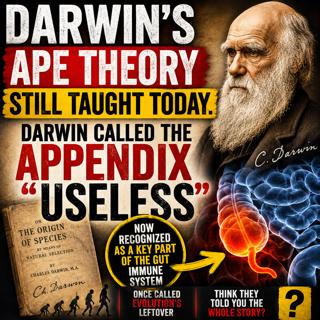

Who Designed the Human Body? A CREATOR -or an APE? Darwin Said Your Organs Were Useless. He Was Wrong.

Who Designed the Human Body? A CREATOR -or an APE? Darwin Said Your Organs Were Useless. He Was Wrong.

"Man is descended from a hairy, tailed quadruped, probably arboreal in its habits."
— Charles Darwin, The Descent of Man

Darwin, Evolution, and the Human Body

Did a Creator design the human body, or did human beings descend through evolution from earlier animal ancestors? Charles Darwin argued that humans shared ancestry with other animals and famously wrote that man descended from a "hairy, tailed quadruped." But Darwin was not alone in spreading the theory. Thomas Henry Huxley, known as "Darwin's Bulldog," became one of Darwin's fiercest public defenders, battling critics and helping establish evolutionary theory in British science and public debate.

This episode examines Charles Darwin, Thomas Henry Huxley, human evolution, natural selection, and the debate over creation and evolution. It also looks at the history of so-called vestigial organs—body parts once portrayed as evolutionary leftovers with little or no important function. The appendix and tonsils became prominent examples as physicians and scientists debated whether certain structures were remnants of humanity's evolutionary past.

But modern medicine has discovered important functions for structures once dismissed or poorly understood. The appendix is associated with immune and gut functions, while the tonsils are part of the lymphatic and immune system. Millions of people nevertheless underwent appendectomies and tonsillectomies during periods when preventive removal became common medical practice.

The larger question goes beyond Darwin himself: What happens when a scientific theory becomes embedded in medicine, education, and culture before everything about the human body is understood? From Darwin and "Darwin's Bulldog" Thomas Henry Huxley to the appendix, tonsils, vestigial organs, evolution, natural selection and intelligent design, this episode returns to the fundamental question: Who—or what—designed the human body?

Music: Liar, Liar - The Castaways (1965)

African gorilla sound

Chimpanzee scream sound effect #shorts #short

Darwinism is an Illuminati Scam - henrymakow.com

Erasmus Darwin

Charles Darwin Illuminati Family Member Exposed ! The Illuminati Evolution Deception (Video) | Alternative | Before It's News

Charles Darwin Was a Massive Satanic Fraud

Lamarckism - Wikipedia

5 books that changed our understanding of the origin of life - Big Think

(28) Evolution without Lamarck's Theory and its Use in the Darwinian Theories of Evolution

An Intimate History of Evolution by Alison Bashford review – the incredible Huxleys | History books | The Guardian

The Huxleys: how one family shaped our view of nature - History Extra podcast notes and takeaways

The X CLUB - FROM THOMAS HUXLEY TO MUSK

Eugenics | History | Research Starters | EBSCO Research

TH Huxley Research Document_ _Why is TH Huxley problematic__.pdf

Saturn - Why Are We Worshiping The Cult Of EL? - In5D

Do you have a psychopath in your life? The best way to find out is read my book. BOOK *FREE* Download – Psychopath In Your Life4

How they flip sex with hormones: Hormones

Support is Appreciated: Support the Show – Psychopath In Your Life Tune in: Podcast Links – Psychopath In Your Life

Download Pods here - one click and pods load to any device fully titled and ready to listen to or archive: TOP PODS – Psychopath In Your Life

My old discussion forum with last 10 years of victim stories, is back online. Psychopath Victim Support Community | Forums powered by UBB.threads™

Google Maps My HOME Address: 309 E. Klug Avenue, Norfolk, NE 68701 SMART Meters & Timelines – Psychopath In Your Life

Universities, especially those with biology, genetics, anthropology, and medical programs, overwhelmingly teach evolution as the foundational framework for modern biology. This is true at institutions such as:

  • Harvard University
  • Stanford University
  • University of Oxford
  • University of Cambridge
  • Massachusetts Institute of Technology
  • University of California, Berkeley

In biology departments, evolution is generally presented not as a single hypothesis but as the organizing principle that connects genetics, ecology, microbiology, paleontology, anatomy, and medicine.

What they teach

A typical university biology curriculum teaches that:

  • Life on Earth has changed over billions of years.
  • Species share common ancestry.
  • Natural selection is one of several mechanisms driving evolution.
  • Other mechanisms include genetic drift, mutation, gene flow, and sexual selection.
  • DNA and genetics provide strong evidence for common ancestry.

Importantly, universities do not teach Darwin's original 1859 theory unchanged. They teach modern evolutionary biology, which incorporates discoveries Darwin never knew about, including:

  • Gregor Mendel's work on heredity.
  • DNA and molecular genetics.
  • Population genetics.
  • Genomics.
  • Evolutionary developmental biology ("evo-devo").
  • Horizontal gene transfer in microorganisms.

So, students are taught that Darwin made a major breakthrough, but that science has refined and expanded his ideas over the past 165+ years.

Are there universities that disagree?

There are some universities and colleges founded on particular religious traditions that present alternative viewpoints, including:

  • Liberty University
  • Bob Jones University

Some institutions associated with young-Earth creationism or Intelligent Design may teach critiques of mainstream evolutionary theory alongside or instead of the scientific consensus.

However, among mainstream research universities worldwide—including those in North America, Europe, Australia, Japan, and much of Asia—acceptance of evolution is the norm in biological sciences.

Is there debate?

Yes, but it's important to distinguish what is debated.

Within universities, researchers actively debate questions such as:

  • How quickly evolution occurs.
  • The relative importance of natural selection versus genetic drift.
  • The origins of specific traits.
  • The timing of evolutionary events.
  • Details of human evolution.

They generally do not debate whether evolution has occurred. The debates are about mechanisms, evidence, timing, and interpretation within the broader evolutionary framework.

This is similar to other sciences: geologists debate the details of plate tectonics, but they do not generally debate whether continents move.

So, if you walked into the biology department of a major research university today, you would almost certainly find that evolution is taught as the central framework of modern biology, while acknowledging that Darwin's original ideas have been substantially revised and expanded by later scientific discoveries.

  • Most universities, especially research universities, teach modern evolutionary biology as the scientific consensus.
  • Most scientists working in biology, genetics, paleontology, anthropology, and related fields accept evolution and common ancestry.
  • Not all scientists do. Some scientists hold creationist or Intelligent Design views, and some believe God guided evolution, but they are a minority within those disciplines.
  • Universities are where many scientists receive their education and research training, so evolutionary theory is a standard part of that training in the life sciences.
Gorillas at the Movies: From Evolution to Hollywood

The gorilla became known to Western science relatively recently. Although African peoples had long known of these animals, the genus Gorilla was formally named in 1852, just before the great nineteenth-century arguments about evolution and humanity's relationship to other primates.

That timing matters.

1850s–1870s — The Gorilla Enters the Human-Origin Debate

By the 1860s, the gorilla had become part of one of the biggest scientific arguments of the century: Where did human beings come from, and how closely were humans related to apes?

Thomas Henry Huxley put the comparison directly before the public in his 1863 book, Evidence as to Man's Place in Nature. One of its best-known illustrations arranged the skeletons of a gibbon, orangutan, chimpanzee, gorilla, and human alongside one another.

Charles Darwin went considerably further into human evolution with The Descent of Man in 1871.

Darwin did not say that modern humans descended from modern gorillas. Evolutionary theory argues that humans and today's great apes ultimately share ancestral populations.

But popular culture did not always preserve that distinction.

The much simpler image was:

MAN — APE — EVOLUTION.

And the gorilla was perfect for the visual shorthand.

Late 1800s — The Gorilla Becomes a Sensation

Gorillas fascinated Western audiences.

They appeared in newspaper stories, scientific illustrations, museum displays, adventure literature, cartoons, and exhibitions.

Unfortunately, these portrayals frequently had another dimension.

Apes and monkeys had long been used in racist caricatures, and nineteenth- and early-twentieth-century racial ideology sometimes used supposed comparisons between Africans and apes to portray certain human populations as more "primitive."

Consequently, the history of gorilla imagery cannot be separated completely from the history of race.

Science, entertainment, colonial attitudes, evolutionary arguments, and racial stereotypes sometimes became mixed together.

1918 — Tarzan of the Apes

Edgar Rice Burroughs published Tarzan of the Apes in 1912, and the first major film adaptation appeared in 1918.

Tarzan was not a gorilla movie in the sense that King Kong would become one. But the enormously successful Tarzan phenomenon helped establish a Hollywood image of Africa as a mysterious and dangerous place populated by wild animals, "primitive" societies, and a white man capable of mastering the wilderness.

Dozens of Tarzan films followed.

1927 — The Gorilla

A movie actually called The Gorilla appeared in 1927, adapted from a successful stage play.

It was a silent mystery involving a terrifying gorilla and a series of apparent murders.

The story was subsequently filmed again, including a 1939 version starring the Ritz Brothers and Bela Lugosi.

By this point, Hollywood understood something very simple:

Gorillas frightened and fascinated audiences.

1930 — Ingagi

Then came one of the strangest episodes in gorilla-movie history.

Ingagi was released in 1930 and presented to audiences as though filmmakers had documented an expedition into Africa.

Its sensational attraction involved supposed encounters between African women and gorillas.

But the movie wasn't an authentic African documentary.

It was largely fraudulent and staged.

The filmmakers exploited the public's fascination with Africa, gorillas, sexuality, race, and the supposed boundary between human beings and apes.

It became a major commercial success.

Ingagi is important because it demonstrates just how far popular entertainment could take the human-gorilla association. What had been a serious nineteenth-century scientific discussion about human and primate anatomy had entered a sensational entertainment culture filled with racial and sexual imagery.

1933 — King Kong

Three years later came the gorilla movie that changed everything.

King Kong was released in 1933.

Kong wasn't simply a realistic gorilla. He was an enormous fantasy ape living on Skull Island.

A filmmaking expedition discovers him, captures him, transports him to New York, and exhibits him publicly as:

"Kong — The Eighth Wonder of the World."

He escapes, takes Ann Darrow, climbs the Empire State Building, and is eventually killed.

The movie became a landmark of American cinema.

But viewed in its historical setting, King Kong also contains themes that had been circulating for decades:

Africa and other non-Western places portrayed as mysterious and primitive.

The boundary between humans and apes.

The "civilized" world confronting the "primitive" world.

A powerful ape fascinated by a white woman.

Western explorers capturing something from another world and bringing it home for exhibition.

Those themes did not originate with Darwin. Nor does their presence prove that King Kong was intended as propaganda for Darwinian evolution.

But they existed within a culture that had spent approximately 70 years publicly debating man's relationship to the apes.

After King Kong

Once King Kong became successful, gorillas became a Hollywood fixture.

Son of Kong — 1933

Released the same year, it immediately capitalized on the success of the original.

Mighty Joe Young — 1949

Another enormous gorilla story, produced by members of the creative team associated with King Kong. This time the gorilla was portrayed much more sympathetically.

Bela Lugosi Meets a Brooklyn Gorilla — 1952

By the 1950s, gorillas had become familiar enough to audiences that they could be used for outright comedy.

The Bride and the Beast — 1958

This bizarre film went much further with the woman-and-gorilla theme, involving reincarnation and a woman's supposed previous existence as a gorilla's mate.

1968 — Planet of the Apes

Then the relationship was reversed.

Planet of the Apes appeared in 1968.

Instead of humans controlling apes, intelligent apes controlled humans.

Gorillas, chimpanzees, and orangutans occupied different positions within an ape civilization while humans had lost their dominant position.

The movie dealt with far more than evolution. It addressed war, nuclear destruction, prejudice, religion, political authority, and the arrogance of civilization.

But once again Hollywood returned to the same extraordinary question:

What separates man from the ape?

1976 — King Kong Returns

Hollywood remade King Kong in 1976, starring Jeff Bridges and Jessica Lange.

The basic formula remained: outsiders encounter Kong, capture him, transport him to New York, put him on display, and discover that controlling him isn't quite as easy as they expected.

1986 — King Kong Lives

A sequel, King Kong Lives, appeared in 1986.

Kong had now become an enduring franchise rather than simply a character from a 1933 movie.

2005 — King Kong Again

Peter Jackson directed another major King Kong remake in 2005.

Modern visual effects allowed Kong to behave much more like an actual gorilla, and the character became considerably more emotionally expressive and sympathetic.

The monster was increasingly becoming the victim.

2011 — Rise of the Planet of the Apes

The modern Planet of the Apes series began with Rise of the Planet of the Apes in 2011.

The films explicitly revolve around genetics, scientific experimentation, intelligence, evolution, disease, and the relationship between humans and other primates.

The gorilla Buck is one of the apes in the first film, while Caesar, the central character, is a chimpanzee.

The franchise continued with Dawn of the Planet of the Apes in 2014, War for the Planet of the Apes in 2017, and Kingdom of the Planet of the Apes in 2024.

2017 — Kong Returns Again

Kong: Skull Island appeared in 2017, followed by the modern MonsterVerse films in which Kong encounters Godzilla and other gigantic creatures.

Nearly ninety years after the original King Kong, Hollywood was still selling tickets with essentially the same extraordinary animal at the center of the story.

The Bigger Story

Put the chronology together:

1852: Gorilla formally receives its modern scientific genus name.

1863: Huxley prominently compares human and ape anatomy.

1871: Darwin publishes The Descent of Man.

Late nineteenth century: Gorillas become prominent in Western science, newspapers, museums, racial imagery, adventure stories, and public discussions about human origins.

1918: Tarzan of the Apes reaches movie audiences.

1927: The Gorilla.

1930: Ingagi sensationalizes supposed relationships between African women and gorillas.

1933: King Kong turns the giant ape into an international cultural icon.

1949: Mighty Joe Young.

1968: Planet of the Apes reverses the human-ape hierarchy.

1976: King Kong remake.

2005: King Kong returns again.

2011 onward: Planet of the Apes returns with genetics and biological experimentation central to the story.

2017 onward: Kong becomes the centerpiece of another generation of blockbuster movies.

There is a fascinating transformation here.

In the mid-nineteenth century, the gorilla was at the center of serious arguments about anatomy and man's place in nature.

Within decades, the gorilla had moved into popular entertainment.

And Hollywood repeatedly returned to the same basic subjects: humans versus apes, civilization versus the supposedly primitive, intelligence, evolution, race, sexuality, science, and the question of what actually makes us human.

It would be too simplistic to say Darwin created the gorilla movie. He didn't.

But the gorilla movie emerged from a culture already intensely preoccupied with the question Darwin and Huxley had helped push into public debate:

What is the relationship between human beings and the great apes?

Hollywood discovered that audiences would keep paying to watch that question played out on the screen for the next hundred years.

Some of his clearest examples in The Descent of Man include:

  • Appendix / vermiform appendix — Darwin treated it as a reduced portion of a much larger ancestral caecum, associated with digestion in other animals.
  • Wisdom teeth — He argued that human jaws had become smaller and that the posterior molars were tending toward becoming rudimentary.
  • Ear muscles — Darwin discussed muscles that allow some people to wiggle their ears, reasoning that they were inherited from ancestors in whom moving the ears was much more useful.
  • Coccyx (tailbone) — He regarded the coccyx as the remnant of an ancestral tail.
  • Body hair — Darwin regarded humans' sparse body hair as a reduced remnant of the more extensive hairy covering of ancestral mammals.
  • Certain eye structures — He discussed the semilunar fold at the inner corner of the human eye as a remnant corresponding to the more developed third eyelid/nictitating membrane found in other animals.
  • Male nipples/mammary structures — Darwin discussed these in connection with rudimentary structures and inheritance between the sexes.
  • Certain reproductive structures — He discussed several small structures of the reproductive system as rudimentary counterparts of organs that are functional in the opposite sex or other animals.

One thing I'd be careful with is tonsils. Darwin is frequently associated online with claims that tonsils were among his "useless organs," but the historical trail is much weaker than it is for the appendix, coccyx, ear muscles, wisdom teeth, and the eye's semilunar fold.

The Huxleys: From Darwin's Bulldog to Eugenics, UNESCO and Brave New World

The Huxley family is one of the more remarkable intellectual families in modern British history. What makes the family particularly interesting is the continuity of certain subjects across several generations: evolution, human development, science, education, population, heredity and the future direction of society.

The story begins with Thomas Henry Huxley (1825–1895).

Thomas Henry Huxley — "Darwin's Bulldog"

Thomas Henry Huxley was a zoologist, anatomist and one of the most influential scientific figures in Victorian Britain. He became famous for publicly defending Charles Darwin's theory of evolution after the publication of On the Origin of Species in 1859.

He is remembered as "Darwin's Bulldog," although historians have questioned whether that nickname was actually used for him during his lifetime. What is not disputed is his aggressive public defense of evolutionary ideas.

Huxley was more than Darwin's spokesman. He became an enormously influential figure in British science.

He was elected a Fellow of the Royal Society in 1851, served as its secretary from 1872 to 1881, and became President of the Royal Society from 1883 to 1885.

And this is where the story becomes particularly interesting.

1864 — Huxley Creates the X Club

In November 1864, Huxley organized what became known as the X Club.

There were only nine members.

They included:

Thomas Henry Huxley
Joseph Dalton Hooker
John Tyndall
Herbert Spencer
John Lubbock
George Busk
Edward Frankland
Thomas Archer Hirst
William Spottiswoode

These weren't obscure men having dinner together. They occupied important positions throughout British science.

The club supported scientific naturalism, greater professionalization of science and a diminished role for religious authority in determining scientific questions. It also strongly supported evolutionary science.

The group's influence became substantial. Its members occupied leadership positions in scientific societies, including the Royal Society.

Huxley himself eventually became president.

So Huxley didn't simply argue for Darwin.

He participated in building an institutional network through which the new scientific worldview could gain influence.

That distinction is important.

Then Comes the Next Generation

Thomas Henry Huxley had several children, and his descendants became extraordinarily prominent.

Two of his grandsons are particularly important to this story:

Julian Huxley became an evolutionary biologist, eugenicist and the first Director-General of UNESCO.

Aldous Huxley became the novelist who wrote Brave New World.

Another grandson, Andrew Fielding Huxley, became a distinguished physiologist and later won the Nobel Prize in Physiology or Medicine.

The Royal Society itself describes the remarkable scientific influence that continued through Huxley's descendants.

Julian Huxley — Evolution Becomes a Social Philosophy

Julian Huxley (1887–1975) carried his grandfather's evolutionary interests into the twentieth century.

But Julian went considerably further.

He became a major advocate of what he called "evolutionary humanism."

He was also deeply involved with the British eugenics movement.

This isn't an accusation based on modern interpretations. Historians have extensively documented Julian Huxley's long involvement with eugenics. One scholarly historical analysis describes his postwar "evolutionary humanism" as representing a continuity of his earlier eugenic commitments, although Huxley rejected Nazi racial ideology and racism.

That distinction matters.

Julian Huxley's eugenics should not simply be equated with Nazi racial policy. But neither should his commitment to eugenics be erased from the story.

He believed human beings could deliberately influence humanity's biological future.

1946 — Julian Huxley and UNESCO

Then the family story moves from British scientific institutions onto the international stage.

Julian Huxley became the first Director-General of UNESCO.

In 1946 he wrote an extraordinary document called:

UNESCO: Its Purpose and Its Philosophy.

It is worth reading the original rather than relying on someone else's interpretation.

Huxley argued that UNESCO should operate within what he called a:

"scientific world humanism"

and that this philosophy should be "evolutionary" rather than static.

He argued that evolution provided an intellectual framework for understanding humanity's future and described mankind as having become responsible for directing further evolutionary progress.

This produces a striking historical progression.

Thomas Henry Huxley spent the nineteenth century fighting to establish evolutionary science within British intellectual life.

His grandson Julian Huxley was helping formulate an explicitly evolutionary philosophy for an international institution less than a century later.

That doesn't mean Thomas Henry Huxley somehow planned UNESCO.

It does demonstrate how far evolutionary thinking had traveled institutionally between the two generations.

And Julian Huxley Did Not Abandon Eugenics

This part deserves particular attention.

After the horrors of Nazi racial policy became known, the word eugenics became politically and morally toxic.

Julian Huxley nevertheless continued discussing eugenics.

Historical research shows that he attempted to redefine it as progressive, humanitarian and compatible with modern social policy rather than Nazi racial ideology.

His 1946 UNESCO document itself discussed what he called the "eugenic problem."

He recognized that radical eugenic policies were politically impossible at the time, while arguing that the subject should continue to be examined.

That is an important historical fact because it connects three subjects that are often presented separately:

evolution

eugenics

international social planning

In Julian Huxley's own writings, they were connected.

Aldous Huxley — Brave New World

Then there is Julian's brother:

Aldous Huxley (1894–1963).

In 1932 he published one of the most famous dystopian novels ever written:

Brave New World.

Its society manufactures human beings biologically.

  • Embryos are divided into predetermined social classes.
  • Reproduction is controlled.
  • People are psychologically conditioned.
  • Drugs help maintain social stability.
  • Sex and entertainment provide distraction.
  • And an elite manages the system.
  • It is tempting to treat Brave New World simply as Aldous inventing a bizarre futuristic nightmare.

But the historical setting matters.

Aldous was writing during an era in which eugenics was a serious political and scientific movement in Britain — and his own brother Julian was deeply involved in that movement.

Scholarly research specifically places Brave New World within the context of Britain's eugenics movement and notes that Aldous's own nonfiction writings contained complicated and sometimes favorable views concerning eugenics, citizenship and meritocracy.

Aldous later returned explicitly to these subjects in Brave New World Revisited in 1958, discussing population, heredity and what he regarded as deterioration in biological quality.

So Brave New World didn't emerge from an intellectual vacuum.

The Huxley Family Timeline

1825 — Thomas Henry Huxley is born.

1859 — Darwin publishes On the Origin of Species.

1860 — Huxley becomes famous for publicly defending evolutionary theory.

1864 — Huxley organizes the X Club.

1872–1881 — Huxley serves as Secretary of the Royal Society.

1883–1885 — Huxley serves as President of the Royal Society.

1887 — Julian Huxley is born.

1894 — Aldous Huxley is born.

1895 — Thomas Henry Huxley dies.

1932 — Aldous Huxley publishes Brave New World.

1946 — Julian Huxley writes UNESCO: Its Purpose and Its Philosophy.

1946–1948 — Julian Huxley becomes UNESCO's first Director-General.

1958 — Aldous publishes Brave New World Revisited.

The Part That Makes the Huxley Story So Interesting

Look at the progression across the family.

The grandfather, Thomas Henry Huxley, becomes one of the most formidable public advocates of evolutionary science and helps organize an influential network of scientists.

His grandson Julian Huxley becomes one of the twentieth century's leading evolutionary thinkers, promotes eugenics and evolutionary humanism, and becomes the first leader of UNESCO.

Julian's brother Aldous Huxley writes perhaps the world's most famous fictional warning about a scientifically managed society in which reproduction, biological characteristics and human behavior are controlled.

Evolution begins as the great scientific battle of Thomas Henry Huxley's generation.

By Julian Huxley's generation, evolution has expanded into ideas about human biological and social development.

And Aldous Huxley turns many of the implications of scientifically managed humanity into the disturbing world of Brave New World.

That makes the Huxleys much more than a footnote to Darwin.

They provide a remarkable window into how ideas about evolution, heredity, eugenics, scientific authority and the management of human society developed from the Victorian era into the twentieth century.

Critics of Charles Darwin's Theory: How Scientific Opinion Changed Over Time

When Charles Darwin published On the Origin of Species in 1859, his theory was immediately controversial. It challenged the long-held belief that species had been separately created and instead proposed that life changed gradually through natural selection.

His ideas were debated intensely throughout the late nineteenth century. Some scientists embraced them, while others accepted evolution but doubted that natural selection alone could explain it. Religious leaders often opposed Darwin because his theory challenged traditional interpretations of creation.

The Rise of Darwin's Theory

By the early 1900s, Darwin's original theory had lost some influence because scientists still did not understand how traits were inherited. Without a mechanism for heredity, some researchers questioned whether natural selection could account for evolution.

That changed in the 1930s and 1940s with what became known as the Modern Synthesis. Scientists combined Darwin's theory with Gregor Mendel's discoveries in genetics. Later discoveries involving DNA, molecular biology, and genomics strengthened the scientific case for evolution.

As a result, by the second half of the twentieth century, evolution had become the dominant framework taught in biology departments throughout most major universities around the world.

Today, the overwhelming majority of professional biologists, geneticists, paleontologists, and anthropologists accept evolution and common ancestry as the best scientific explanation for the diversity of life. However, they do not teach Darwin's original theory exactly as he proposed it. Instead, they teach a modern version that includes genetics, DNA, mutation, genetic drift, gene flow, developmental biology, and genomics.

Did the Tide Ever Shift?

Yes—but perhaps not in the way many people imagine.

The major shift occurred toward Darwin's central ideas during the twentieth century as genetics and DNA provided evidence that Darwin himself never had.

There has not been a broad shift within mainstream biology away from evolution. Instead, scientists have continually modified and expanded Darwin's original work while retaining natural selection as one of its central mechanisms.

Outside the scientific community, however, debates have continued. Public opinion has remained divided in many countries, particularly where religious beliefs strongly influence views about human origins.

Who Criticizes Darwin Today? Creationists

Creationists believe that human beings were created directly by God rather than evolving from a common ancestor with other apes.

Among the best-known are Ken Ham and Henry M. Morris, who argue that the biblical account of creation is historically accurate.

Intelligent Design

Supporters of Intelligent Design accept that living things can change over time but argue that some biological systems are too complex to have arisen through unguided evolutionary processes alone.

Two of the movement's best-known advocates are Michael Behe and Stephen C. Meyer.

Philosophers

Some philosophers argue that Darwinian evolution does not fully explain consciousness, reason, morality, or the existence of objective truth.

Among the most prominent are Thomas Nagel and David Berlinski, both of whom have questioned whether Darwinian explanations are sufficient for understanding humanity.

Scientists Who Revised Darwin

Ironically, many of Darwin's strongest scientific critics have accepted evolution while arguing that Darwin's original theory was incomplete.

Darwin knew nothing about genes, chromosomes, DNA, or molecular biology because those discoveries came decades after his death. Modern evolutionary biology therefore differs substantially from Darwin's original work while retaining natural selection as a central concept.

The Current Landscape

Most universities and scientific organizations continue to teach modern evolutionary biology as the consensus scientific explanation for the history and diversity of life.

At the same time, a significant number of religious scholars, philosophers, Intelligent Design advocates, and a smaller number of scientists continue to argue that evolution does not answer humanity's deepest questions about origins, purpose, consciousness, and whether life ultimately points to a Creator.

More than 165 years after Darwin published On the Origin of Species, his work remains one of the most influential—and most debated—ideas in the history of science. While mainstream biology has largely accepted and expanded his central ideas, philosophical and religious debates about human origins continue around the world.

Critics of Charles Darwin's Theory: How Scientific Opinion Changed Over Time

When Charles Darwin published On the Origin of Species in 1859, his theory was immediately controversial. It challenged the long-held belief that species had been separately created and instead proposed that life changed gradually through natural selection.

His ideas were debated intensely throughout the late nineteenth century. Some scientists embraced them, while others accepted evolution but doubted that natural selection alone could explain it. Religious leaders often opposed Darwin because his theory challenged traditional interpretations of creation.

The Rise of Darwin's Theory

By the early 1900s, Darwin's original theory had lost some influence because scientists still did not understand how traits were inherited. Without a mechanism for heredity, some researchers questioned whether natural selection could account for evolution.

That changed in the 1930s and 1940s with what became known as the Modern Synthesis. Scientists combined Darwin's theory with Gregor Mendel's discoveries in genetics. Later discoveries involving DNA, molecular biology, and genomics strengthened the scientific case for evolution.

As a result, by the second half of the twentieth century, evolution had become the dominant framework taught in biology departments throughout most major universities around the world.

Today, the overwhelming majority of professional biologists, geneticists, paleontologists, and anthropologists accept evolution and common ancestry as the best scientific explanation for the diversity of life. However, they do not teach Darwin's original theory exactly as he proposed it. Instead, they teach a modern version that includes genetics, DNA, mutation, genetic drift, gene flow, developmental biology, and genomics.

Did the Tide Ever Shift?

Yes—but perhaps not in the way many people imagine.

The major shift occurred toward Darwin's central ideas during the twentieth century as genetics and DNA provided evidence that Darwin himself never had.

There has not been a broad shift within mainstream biology away from evolution. Instead, scientists have continually modified and expanded Darwin's original work while retaining natural selection as one of its central mechanisms.

Outside the scientific community, however, debates have continued. Public opinion has remained divided in many countries, particularly where religious beliefs strongly influence views about human origins.

Who Criticizes Darwin Today? Creationists

Creationists believe that human beings were created directly by God rather than evolving from a common ancestor with other apes.

Among the best-known are Ken Ham and Henry M. Morris, who argue that the biblical account of creation is historically accurate.

Intelligent Design

Supporters of Intelligent Design accept that living things can change over time but argue that some biological systems are too complex to have arisen through unguided evolutionary processes alone.

Two of the movement's best-known advocates are Michael Behe and Stephen C. Meyer.

Philosophers

Some philosophers argue that Darwinian evolution does not fully explain consciousness, reason, morality, or the existence of objective truth.

Among the most prominent are Thomas Nagel and David Berlinski, both of whom have questioned whether Darwinian explanations are sufficient for understanding humanity.

Scientists Who Revised Darwin

Ironically, many of Darwin's strongest scientific critics have accepted evolution while arguing that Darwin's original theory was incomplete.

Darwin knew nothing about genes, chromosomes, DNA, or molecular biology because those discoveries came decades after his death. Modern evolutionary biology therefore differs substantially from Darwin's original work while retaining natural selection as a central concept.

The Current Landscape

Most universities and scientific organizations continue to teach modern evolutionary biology as the consensus scientific explanation for the history and diversity of life.

At the same time, a significant number of religious scholars, philosophers, Intelligent Design advocates, and a smaller number of scientists continue to argue that evolution does not answer humanity's deepest questions about origins, purpose, consciousness, and whether life ultimately points to a Creator.

More than 165 years after Darwin published On the Origin of Species, his work remains one of the most influential—and most debated—ideas in the history of science. While mainstream biology has largely accepted and expanded his central ideas, philosophical and religious debates about human origins continue around the world.

The Rise, Decline, and Revival of Darwin's Theory

Most people assume Charles Darwin's theory was published in 1859 and then steadily gained acceptance. The actual history is more complicated.

1859–Late 1800s: Darwin Changes Science

When Charles Darwin published On the Origin of Species in 1859, his theory of evolution by natural selection immediately became one of the most controversial ideas in science.

Many scientists accepted that species change over time, but not everyone agreed that natural selection was the primary mechanism. Darwin's greatest weakness was that he could not explain how traits were inherited because genes and DNA had not yet been discovered.

As a result, even some scientists who admired Darwin questioned whether natural selection alone could account for evolution.

Around 1900: Darwin Falls Out of Favor

Around the turn of the twentieth century, Darwin's theory entered a period sometimes called the "Eclipse of Darwinism."

Scientists continued to accept that evolution occurred, but many became skeptical that natural selection was the main driving force. Alternative ideas competed for attention, including Lamarckism, orthogenesis (the idea that evolution follows a built-in direction), and mutation-based theories.

One reason for this shift was simple: no one yet understood heredity well enough to explain how favorable traits could persist from one generation to the next.

For several decades, Darwin's mechanism—not evolution itself—was under significant debate within the scientific community.

1900–1940: Genetics Changes Everything

The rediscovery of Gregor Mendel's work on heredity transformed biology.

Scientists gradually realized that genetics could provide the missing mechanism Darwin never had.

Researchers in population genetics showed mathematically that natural selection could work together with genetic inheritance.

The 1930s and 1940s: The Modern Synthesis

During the 1930s and 1940s, biology experienced a major turning point known as the Modern Synthesis.

Scientists combined Darwin's theory of natural selection with Mendelian genetics, creating a more complete explanation of evolution.

This new framework became the foundation of modern biology.

Later discoveries—including DNA, molecular biology, genomics, and evolutionary developmental biology—expanded the theory even further.

Today

Today, most universities teach modern evolutionary theory, not Darwin's original 1859 theory.

Natural selection remains one of its central ideas, but modern biology also includes genetics, mutation, gene flow, genetic drift, genomics, and many other discoveries that Darwin never knew about.

Why This Matters

One of the most interesting facts in the history of science is that Darwin's ideas were not accepted in a straight line.

His theory rose to prominence after 1859.

It then experienced a period of significant scientific skepticism around the early twentieth century.

Only after genetics provided the missing mechanism did natural selection regain widespread acceptance among biologists.

In other words, Darwin's theory itself was tested, questioned, criticized, modified, and strengthened over many decades rather than being accepted without challenge.

  • 1859: Darwin publishes his theory.
  • Late 1800s: Fierce debate.
  • Early 1900s: His mechanism (natural selection) loses support among many scientists during the "Eclipse of Darwinism."
  • 1930s–1940s: Genetics revives and strengthens his core ideas through the Modern Synthesis.
  • Today: Most universities teach modern evolutionary biology, which retains Darwin's central idea of common ancestry and natural selection but incorporates DNA, genetics, and many later discoveries.

Many well-known public figures have rejected the idea that humans arose solely through unguided evolution and instead believe humans were created by God or an intelligent creator. They do not all hold the same view—some advocate young-Earth creationism, some old-Earth creationism, and others Intelligent Design.

Here are some prominent examples:

Creationist (God directly created humans)
  • Ken Ham – Founder of Answers in Genesis and the Creation Museum. Argues that God created humans directly as described in Genesis.
  • John C. Whitcomb – Co-author of The Genesis Flood, influential in modern young-Earth creationism.
  • Henry M. Morris – Often called the father of modern scientific creationism.
Intelligent Design (argues some features of life require an intelligent cause)
  • Stephen C. Meyer – Senior fellow at the Discovery Institute and author of Darwin's Doubt and Signature in the Cell.
  • Michael Behe – Known for the concept of "irreducible complexity."
  • William A. Dembski – Developed arguments about "specified complexity."
Scientists who are Christians and accept evolution

These individuals do not reject evolution, but they believe God is the creator and that evolution is compatible with faith:

  • Francis Collins – Former director of the U.S. National Institutes of Health. Accepts evolution while believing God created the universe.
  • Kenneth R. Miller – Evolutionary biologist and practicing Catholic who argues that evolution and belief in God can coexist.
Public figures

Some well-known public figures have publicly expressed belief that humans were created by God or have questioned Darwinian evolution, including:

  • Mike Pence – Has expressed creationist views rooted in his Christian faith.
  • Ben Carson – Has said he believes God created humans and has criticized aspects of evolutionary theory.
It's important to distinguish three positions
  1. Evolution without divine guidance – Humans evolved through natural processes alone.
  2. Theistic evolution – God created humans through evolutionary processes.
  3. Special creation – God created humans directly rather than through common descent.

Many people who say "we come from God" fall into either the second or third category, so it's worth asking which view they actually hold rather than assuming they reject all aspects of evolution.

THE MASONIC THEORY OF THE ORIGINS OF LIFE

The hidden link between Darwin, Marx, Nietzsche & Hitler

Those generally thought to be the founders of the theory of evolution are the French biologist Jean Lamarck and the English biologist Charles Darwin. According to the classic story, Lamarck first proposed the theory of evolution, but he made the mistake of basing it on the "inheritance of acquired traits." Later, Darwin proposed a second theory based on natural selection.

Though, here we must mention the name of another theoretician who played an important role in the origins of the theory of evolution: Erasmus Darwin, Charles Darwin's grandfather.

Erasmus Darwin was a Mason. Though, Erasmus Darwin was no ordinary Mason, he was one of the highest ranking masters in the organization; a 33rd Degree Mason.

He was the master of the famous Canon-gate lodge in Edinburgh, Scotland. Moreover, he had close ties with the Jacobin Masons who were the organizers of the revolution in France at the time, and with the Illuminati, whose prime cause was fostering hostility to religion. That is, Erasmus Darwin was an important name in European Masonic anti-religious organizations.

Erasmus educated his son Robert (Charles Darwin's father), who too had been and made a member of the Masonic lodge. For this reason, Charles Darwin received the inheritance of Masonic teachings from both his father and his grandfather.

Erasmus Darwin hoped to have his son Robert develop and publish his theory, but it would be his grandson Charles who would undertake the enterprise. Although it came some time later, Erasmus Darwin's Temple of Nature was finally revised by Charles Darwin. Darwin's views did not have the weight of a scientific theory; it was merely the expression of a naturalist doctrine that accepts that nature has creative power.

The fundamental philosophy of freemasonry is based on Darwinism. That is because, though having no scientific aspect whatsoever, Darwinism is a fake ideology with a scientific guise propounded solely to make the mainstays of freemasonry (atheism, aimlessness, wars and degeneration) legitimate.

The Mason Magazine [printed in Turkey by the freemasons] explains why they support evolution theory as follows:

Darwin's evolution theory showed that many events in the nature are not the work of God. Freemasons try to impose Darwinism as a scientific theory. Darwinism is used as a tool to pave the way for the atheist Masonic powers to spread their deviant belief system. Therefore masons adopt the propagation of this theory as one of their primary duties.

Mason Magazine refers to this "masonic duty" as below:

The greatest humane and Masonic duty we all own is to hold on to the positive science, to spread this belief among people and educate them with positive science [Darwinism] by adopting the view that this is the best and only way in evolution. An important example which proves the fact that Darwinism is one of the biggest deceptions of freemasonry is a resolution carried out in a mason meeting. The 33rd degree Supreme Council of Mizraim Freemasonry at Paris, reveals in its minutes its promotion of evolution as science, while they themselves scoffed at the theory.

The minutes read as follows:

"It is with this object in view [scientific theory of evolution] that we are constantly by means of our press, arousing a blind confidence in these theories. The intellectuals will puff themselves up with their knowledge and without any logical verification of them will put into effect all the information available from science, which our agentur specialists have cunningly pieced together for the purpose of educating their minds in the direction we want. Do not suppose for a moment that these statements are empty words: think carefully of the successes we arranged for Darwinism…"

Masons openly admit that they will use the scientists and media which are under their control to present this deception as scientific, which even they find funny. When freemasons talk about the successes they arranged for Darwinism, they actually refer to infiltrating a deception into universities, schools, text books, into most of the mass media as a scientific truth, squelching the ones who have anti-Darwinist views, and hindering anti-Darwinist activities by oppression.

By means of Darwinism, it was, of course, not difficult for freemasonry to cause outbreak of hostilities, to commit mass murders, genocide and racism. Freemasonry drifted the world into a horrible disaster by means of various senior freemasons, by making Darwinist ideology a basis to its objectives, and by brainwashing methods. This horrible plot caused more than 350 million lives. They experienced the destruction of two world wars without understanding what was going on.

In The Secret Cult of the Order, Antony Sutton states: 'Both Marx and Hitler have their philosophical roots in Hegel. It is here that one arrives at the Hegelian nexus where Darwin, Marx, and Hitler intersect. Recall that Nietzsche-ism, Darwinism and Marxism were all mentioned together in the Protocols of the Wise Men of Sion. This was no accident. Nazism (a variant of fascism) sprung from Nietzsche-ism. Communism sprung from Marxism. Both were based upon Hegelian principles. Moreover, both were 'scientific dictatorships' legitimized by the 'science' of Darwinism.

The interest of both Hitler and Marx in Darwinian evolution is a matter of history. While he was living in London, Karl Marx attended lectures on evolutionary theory delivered by T.H. Huxley.

Recognizing the odd synchronicity between the communist concept of class war and the Darwinian principle of natural selection, Marx sent Darwin a copy of Das Kapital in 1873. Enamored of evolution, Marx asked Darwin the permission to dedicate his next volume to him…

However, Fascism or Marxism, right wing or left … while the foundation for each of these roads is Darwin's theory of evolution.

In fact, in Evolution and Ethics, Keith candidly stated: 'The German Fuhrer (Hitler) as I have consistently maintained, is an evolutionist; he has consciously sought to make the practice of Germany conform to the theory of evolution' (Keith, Evolution and Ethics, 230)

In both the case of communism and Nazism, the results were enormous bloodbaths. This is the natural consequence of Darwinian thinking and the legacy of the 'scientific dictatorship.'

In applying the ideas of Darwin, both communists and fascists have murdered millions. Both of these groups find their origins in the elite (the Illuminati), who are still pursuing the same objectives today. According to the Darwinian mantra of 'survival of the fittest,' victory will demand bloodshed…

Atheistic freemasonry infiltrated to masses under the appearance of Darwinism and led millions of people to be murdered. This system of Satan himself ruined nations and became the primary perpetrator of massacres against believers. The methods of this system has always been tried to be shown as reasonable and thought to be shown to have a scientific base under the veil of evolution. The fact is however, apart from being bereft of a single scientific proof, every scientific evidence once again demolishes this theory. The fact that Darwinism is a great deception is a certified, proven fact. Source: David J. Stewart #conspiracy

For much of the twentieth century, doctors routinely removed children's tonsils. At its peak, tonsillectomy became one of the most common operations performed on children in the United States and other Western countries.

The reasoning sounded straightforward: tonsils became infected, therefore removing them would prevent future infections.

But there was a problem with that logic.

Tonsils aren't useless pieces of tissue. They are part of the immune system.

The palatine tonsils sit at the back of the throat, where air, food, bacteria, viruses and other material entering through the mouth and nose can encounter immune tissue. Along with the adenoids and other lymphoid tissue, they form part of Waldeyer's ring, a defensive circle positioned around the entrance to the respiratory and digestive tracts.

Tonsils contain large numbers of lymphocytes and specialized structures that help the immune system recognize antigens and mount immune responses. They are especially active during childhood—the very period when tonsillectomies historically were performed most aggressively.

How Did Removing Tonsils Become So Common?

By the early twentieth century, enlarged or chronically infected tonsils were increasingly blamed for an extraordinary range of childhood problems.

The medical profession was also embracing the "focal infection" theory: the idea that localized infections in places such as the tonsils or teeth could poison the rest of the body and cause distant diseases.

That thinking helped produce an era of preventive surgery.

Instead of asking whether a particular child's tonsils were causing serious recurrent disease, physicians increasingly treated the tonsils themselves as potential troublemakers.

By the 1920s and 1930s, tonsillectomy had become extraordinarily common. In some communities, having your tonsils removed became almost a childhood rite of passage.

And once a medical procedure becomes routine, an important psychological shift occurs:

Doctors stop asking why the organ should be removed and begin asking why it should be left in.

That is a very different standard.

The "Vestigial Organ" Problem

This history becomes especially interesting when placed beside the nineteenth- and twentieth-century concept of vestigial organs.

Structures including the tonsils and appendix were frequently described as evolutionary leftovers—organs that had supposedly lost most or all of their original usefulness.

Modern biology presents a much more complicated picture.

The appendix contains substantial lymphoid tissue and participates in immune functions, particularly early in life. Tonsils likewise are organized lymphoid organs involved in immune surveillance.

That doesn't mean tonsils or appendixes should never be removed.

An appendix with acute appendicitis can become life-threatening. Tonsillectomy can be appropriate for carefully selected patients with severe recurrent infections, obstructive sleep apnea, airway obstruction, abscesses, suspected malignancy or other significant problems.

The mistake is something different:

Assuming an organ is expendable simply because medicine does not yet understand what it does.

Medicine Eventually Pulled Back

The enormous enthusiasm for routine tonsillectomy did not last.

As physicians demanded better evidence, the indications became narrower. Today, clinical guidelines generally do not recommend removing tonsils merely because a child has them, because they are somewhat enlarged, or because the child occasionally gets a sore throat.

For recurrent throat infections, physicians generally look for a substantial, documented pattern of illness before recommending surgery. Tonsillectomy is also commonly considered when enlarged tonsils contribute to significant sleep-disordered breathing or obstructive sleep apnea.

In other words, modern medicine has moved a long way from the era of routinely removing tonsils as preventive maintenance.

The Bigger Lesson

The tonsil story isn't really just about tonsils.

It is about what happens when medical certainty outruns medical knowledge.

An organ appears troublesome.

Its purpose isn't completely understood.

A theory says it isn't particularly important.

Removing it becomes fashionable.

Millions of operations later, science discovers that the supposedly disposable tissue actually participates in a sophisticated biological system.

That should raise an obvious question whenever we are told that some part of the human body is useless:

Useless—or have we simply not figured out what it does yet?

The history of the tonsils should make us cautious about confusing those two things.

Tonsillectomy: It Became Big Business

There is another part of the tonsil story that shouldn't be overlooked: removing tonsils became a very large medical business.

For much of the twentieth century, tonsillectomy wasn't some obscure operation. According to the American Academy of Otolaryngology–Head and Neck Surgery, between 1915 and the 1960s, tonsillectomy was the most frequently performed surgical procedure in the United States. Government researchers later reported that tonsillectomy incidence actually peaked in the 1930s and declined substantially only after researchers began seriously questioning its use and indications.

And we're still talking about enormous numbers.

In 2006, approximately 530,000 tonsillectomies were performed on American children younger than 15, accounting for an extraordinary 16 percent of all ambulatory surgery in that age group.

The numbers vary considerably depending upon the year, age range and database being examined. The 2019 tonsillectomy guideline cited 289,000 ambulatory procedures annually among children under 15, down from the earlier 530,000 estimate. But a more comprehensive national study published in 2023, covering patients through age 20 and including inpatient as well as ambulatory surgery, estimated 567,000 pediatric tonsillectomies in 2019—559,900 ambulatory procedures and another 7,100 inpatient procedures.

That is an enormous surgical marketplace.

The money involved isn't trivial either. A study of children's hospitals found self-pay estimates for tonsillectomy with adenoidectomy ranging from $1,200 to $15,360, depending upon the hospital and what the quoted price included. Researchers studying U.S. children's hospitals have explicitly described tonsillectomy as one of the most common and cumulatively expensive surgical procedures in children.

Even complications generate additional medical expenditures. A study involving more than 305,000 privately insured children found that a postoperative hemorrhage requiring surgery or hospitalization produced an average 30-day cost of $7,660.

So this wasn't simply a medical theory about an allegedly expendable piece of anatomy. Once tonsillectomy became routine, an entire economic system existed around it: hospitals, surgeons, anesthesiology, operating rooms, medications, pathology, follow-up care and treatment of complications.

And there is an especially important historical point. A CDC report examining the decline in tonsil and adenoid surgery said physicians had become more stringent about indications that previously had been "ill-defined," and noted evidence suggesting that the operation had been used too often.

That changes the story.

Millions of children weren't undergoing an insignificant little procedure. Doctors were permanently removing lymphatic tissue involved in the immune system. Your source correctly identifies the tonsils as lymphatic tissue and part of the immune system.

And while medicine eventually became much more selective about who should undergo the operation, tonsillectomy had already become one of the most commonly performed—and economically significant—operations in American childhood.

The history therefore raises two separate questions:

Why did medicine become so confident that removing tonsils was a good idea?

And once hundreds of thousands of operations were being performed every year, how much harder did the enormous medical business surrounding tonsillectomy make it to question that assumption?

Year U.S. pediatric tonsil/adenotonsil surgery What the data show 1996 ~315,000 tonsillectomy + adenotonsillectomy Plus ~127,000 adenoidectomy-only procedures 2006 ~565,000 tonsillectomy + adenotonsillectomy Major increase 2006 ~583,000 outpatient tonsillectomies in another national estimate Wide 95% CI: 370,000–796,000 2010 ~339,000 ambulatory tonsillectomies Different national survey/methodology 2019 ~567,000 total pediatric tonsillectomies ~559,900 outpatient + 7,100 inpatient 2020–21 Sharp temporary decline COVID disrupted elective surgery Current literature, 2024–26 ~500,000/year commonly cited Still among America's most common pediatric operations

The 2019 estimate is particularly useful because researchers used national Healthcare Cost and Utilization Project databases and estimated 567,000 pediatric tonsillectomies in that single year.

And remarkably, a medical reference updated in March 2026 still describes tonsillectomy as one of America's most frequently performed operations and states that more than 500,000 are performed annually in children under 15.

The part I think you're picking up on

Look farther back and the trend becomes clearer.

A study comparing 1996 with 2006 found that approximately 441,870 children underwent some form of tonsil/adenoid surgery in 1996. By 2006 it had increased to approximately 695,029.

But here's the kicker: operations for infection were declining.

The increase was being driven largely by adenotonsillectomy, which jumped from about 255,000 to 507,000.

Another long-term study found essentially the same thing. From the early 1970s through 2005, adenotonsillectomy incidence went from 243 to 485 per 100,000 person-years—approximately doubling.

Meanwhile, upper-airway obstruction went from being the reason for surgery in only 12% of patients in 1970 to 77% in 2005.

And researchers subsequently reported that between 1996 and 2006 the pediatric tonsillectomy rate nearly doubled, with an increasing trend toward operations for pediatric obstructive sleep apnea.

So the story isn't:

Doctors realized tonsils were important and quit removing them.

It's closer to:

Doctors became much more restrictive about removing tonsils simply because children suffered repeated infections—but tonsil surgery remained extremely common as the medical rationale shifted toward enlarged tonsils, airway obstruction, sleep-disordered breathing and obstructive sleep apnea.

That distinction is important.

There is even contemporary literature discussing "inappropriate utilization" and substantial geographic, racial and insurance-related differences in who receives tonsillectomies. A recent review continues to put the number at approximately half a million American children annually.

Twenty years after roughly half a million American children were having tonsil surgery annually, we're still talking about roughly half a million procedures a year. What changed dramatically wasn't necessarily the existence of the operation—it was the medical justification for performing it.

And for historical perspective, even today's numbers are well below the extraordinary peak: UCLA's 2026 review reports that tonsillectomy peaked in the late 1950s at more than 1.4 million operations in a single year.

The Tonsils Didn't Change — Medicine Changed the Reason for Removing Them

For more than a century, doctors have removed children's tonsils on a massive scale. What changed over those years wasn't the tonsils themselves. What changed was medicine's reason for taking them out.

Tonsillectomy became one of the most common operations performed on American children. During the first half of the twentieth century, removing tonsils was so widespread that generations of children grew up regarding it almost as a normal part of childhood.

The original justification centered heavily on infection. Tonsils became inflamed and infected, sometimes repeatedly, and doctors reasoned that removing the troublesome tissue would eliminate the source of the problem.

But medicine eventually became much more cautious about that approach.

Today, guidelines generally recommend watching and waiting when recurrent infections don't reach relatively stringent thresholds. A commonly used standard is at least seven documented throat infections during the preceding year, five annually for two consecutive years, or three annually for three consecutive years.

So did tonsillectomy disappear as doctors became more reluctant to remove tonsils for infection?

No.

Instead, another reason for performing the operation became dominant.

From Infection to Obstructed Breathing

One of the clearest demonstrations comes from a long-term study published in Otolaryngology–Head and Neck Surgery examining tonsil and adenotonsil surgery between 1970 and 2005.

In 1970, upper-airway obstruction accounted for only 12 percent of the operations.

By 2005, upper-airway obstruction accounted for 77 percent.

The researchers themselves described the change as a shift in surgical indications "from infection to upper airway obstruction."

And the surgery itself wasn't disappearing.

The incidence of adenotonsillectomy in the population studied increased from 243 operations per 100,000 person-years in 1970–1974 to 485 per 100,000 in 2000–2005.

It had approximately doubled.

That is an extraordinary transformation.

Doctors increasingly stopped saying:

The tonsils keep becoming infected, so they should come out.

Instead, the argument increasingly became:

The tonsils are interfering with breathing and sleep, so they should come out.

Obstructive sleep-disordered breathing and pediatric obstructive sleep apnea subsequently became major indications for removing tonsils and adenoids.

Hundreds of Thousands of Operations Continued

The change in rationale did not turn tonsillectomy into a rare operation.

A national study estimated approximately 567,000 pediatric tonsillectomies in the United States in 2019, including approximately 559,900 ambulatory operations and another 7,100 inpatient procedures.

That is particularly striking when compared with the history.

Medicine had become considerably more conservative about operating simply because a child repeatedly developed throat infections, yet hundreds of thousands of tonsils were still being removed.

The operation survived.

The principal justification changed.

But the Tonsils Turned Out to Have a Job

Meanwhile, understanding of the tonsils themselves changed dramatically.

Tonsils aren't simply useless lumps of tissue sitting at the back of the throat.

They are lymphoid organs and part of the immune system. Their anatomical location puts them directly in contact with material entering through the mouth and nose, where they participate in detecting antigens and mounting immune responses.

This is particularly important during childhood.

Your source describes them as lymphatic tissue positioned where inhaled and swallowed material enters the body, participating in immune surveillance during childhood.

That doesn't mean tonsils can never safely be removed. Nor does it mean a child suffering serious airway obstruction should be denied an operation that could substantially improve breathing and sleep.

It does mean something historically important:

Medicine was removing an organ on an enormous scale before medicine fully understood everything that organ was doing.

What About Darwin?

Charles Darwin needs to be separated from the actual history of tonsil surgery.

Darwin didn't invent tonsillectomy. He didn't develop the operation, and he didn't instruct physicians to remove children's tonsils.

His connection is to the broader evolutionary concept of rudimentary or vestigial structures—body parts interpreted as remnants inherited from ancestors whose original functions had diminished or disappeared.

Darwin discussed rudimentary organs extensively as evidence for common descent.

Later generations produced long lists of supposedly vestigial human structures, and the tonsils were sometimes included among structures described as vestigial or of little importance.

Modern biology has demonstrated that many structures historically described as useless or vestigial have biological functions. The tonsils are an excellent example because their immunological activity is now well established.

That doesn't disprove evolution. A vestigial structure in evolutionary biology can retain secondary functions.

But it certainly undermines the much stronger historical notion that because an organ's purpose wasn't understood, it didn't have one.

And that distinction matters enormously when the proposed treatment is permanently removing it from a child.

The Business Never Became Small

There is also an economic dimension that shouldn't be ignored.

Hundreds of thousands of operations annually represent an enormous amount of medical activity.

Every tonsillectomy can involve a surgeon, anesthesiologist, operating facility, nursing staff, medications, pathology, postoperative care and sometimes treatment of complications.

Tonsillectomy therefore isn't merely a medical theory. It became part of a substantial medical industry.

That doesn't establish that doctors recommend unnecessary surgery for financial reasons. The numbers alone cannot prove motive.

But they do establish that tonsillectomy became an economically significant procedure and remained an extremely common operation even as its principal medical indication changed.

That makes the history worth examining.

The Question That Remains

There are legitimate situations in which removing tonsils can provide substantial benefits. A child whose enlarged tonsils seriously obstruct the airway or contribute to significant obstructive sleep apnea presents a very different medical problem from a child who simply experiences occasional sore throats.

But that doesn't erase the historical pattern.

For generations, enormous numbers of tonsils were removed.

Medicine subsequently learned considerably more about their role in the immune system.

Standards for removing them because of recurrent infections became more restrictive.

Yet tonsillectomy didn't disappear.

A different indication became dominant.

The numbers capture the transformation better than anything else:

1970: Upper-airway obstruction accounted for 12 percent of these operations.

2005: Upper-airway obstruction accounted for 77 percent.

And hundreds of thousands of American children continued undergoing tonsillectomy annually.

That leaves a remarkably simple question:

If medicine once underestimated the importance of the tonsils, how certain should we be before permanently removing them from a child today?

The tonsils didn't change.

Our understanding of them did. And so did the reason medicine gave for taking them out.

Conflicts and confusion between Lamarckism and Darwinism


Figure 1. Portrait of Jean-Baptiste Lamarck (by Charles Thévenin) and cover page of his book "Philosophie zoologique, ou Exposition des considérations relatives à l'histoire naturelle des animaux… " published in 1809 [Source: portrait – Charles Thévenin [Public domain], via Wikimedia Commons. Cover page: CC BY 4.0, via Wikimedia Commons] The first coherent and solidly supported theory on the evolution of life was established in 1800 by Jean-Baptiste Lamarck (1744-1829), a great French naturalist, and published in 1809 in his book Philosophie zoologique (Figure 1).

Fifty years later, in England, The Origin of Species was published in which Charles Darwin (1809-1882) developed his own theory on the transformation of species by "descent with modification" (Figure 2) (see focus Darwin).

Figure 2. Portrait of Charles Darwin (by John Collier, 1883) and cover page of his book "The origin of species by mean of natural selection, on the…", 1859 edition [Source: portrait – John Collier [Public domain], via Wikimedia Commons. Cover page: public domain] The great common point between the theories of these two great naturalists is the affirmation of the evolutionary fact, which goes against creationism, universally accepted until then. But their conceptions of the living world diverge radically on such essential issues as the origin of life and the very mechanisms of evolution. Genetics, born at the very beginning of the 20th century, provided Darwin theory with knowledge that was sorely lacking. In the 1940s, it made it possible to develop the synthetic theory of evolution or neodarwinism. One might have thought that the debate between Lamarkism and Darwinism was over.

This is not the case, these two theories are still the subject of conflicts and confusion. For the general public, evolution – when it is accepted, which is far from always being the case [1] – is generally understood in a Lamarckian way. That is, evolutionary changes occur under the more or less direct influence of the environment. The Darwinian process, which implies that fortuitous genetic variations may be the basis for significant biological transformations (see below), strikes common sense.

Surprisingly enough, these conflicts and confusions are also found among biologists, philosophers and science historians. Conflicts that are often linked to a deep rejection of Darwinism, for non-scientific motivations (seeTheory of Evolution: misunderstandings and resistance). Confusions that are due to misunderstandings or difficulties of interpretation. This is particularly the case with some of Lamarck's writings on the appearance of life, which are ambiguous, if not contradictory [2].

This situation has been accentuated over the past two decades with the importance acquired by the epigenetic imprints of the genome, which is discussed in several articles in this encyclopedia (see Adaptation: Responding to environmental challenges; Epigenetics, the genome and its environment; The adaptation of organisms to their environment). Very briefly, these imprints involve chemical changes in DNA (or the proteins surrounding it), but do not change the sequence of nucleobases (so they are not mutations) and are reversible. They are usually triggered by stressful situations and influence gene expression, often in an adaptive sense. They can be transmitted to offspring for a few generations, referred to as epigenetic memory or transgenerational effect. This type of phenomenon, known for a long time, has been the subject of renewed studies since the beginning of the century (see Epigenetics, the genome and its environment).

This transgenerational effect, although transitory, may recall the heredity of the acquired traits discussed later. A phenomenon that is often, and wrongly, considered to be the main characteristic of Lamarck's theory. This has led biologists to re-launch the debate on a possible update of this one. Some even go so far as to mention the need for a synthesis between the two theories. We will see that the considerable differences between them do not argue in favour of such an idea.

This subject will be treated here from the strict biological point of view, by comparing the basic principles of these theories and the visions of the living world that flow from them, particularly on the origin of life and on the mechanisms of transformation of species. An article by Laurent Loison and Francesca Merlin, which addresses this problem from the perspective of the history and philosophy of science, can also be found in the Encyclopaedia Universalis [3].

2. The origin of living beings and their genealogical relationship

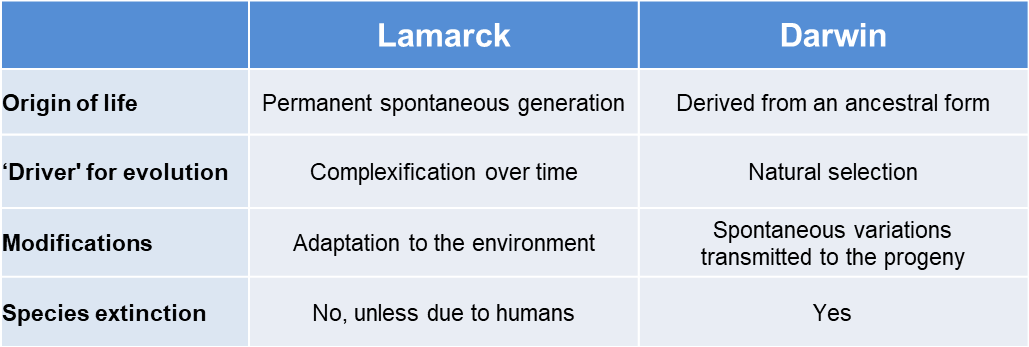
In Lamarck's vision, the "simplest" or "most imperfect" organisms always appear as "spontaneous generation" or "direct generation". He writes in Zoological Philosophy: "In its march, nature began, and continues to do so every day [underlined by the author of this article] by forming the simplest organized bodies and it only forms directly those, that is to say, these first drafts of the organization, which have been designated by the expression of spontaneous generations".

It should be noted in passing that in the light of our current knowledge on the extraordinary complexity of the most elementary living cells and on the origin of life, this idea of permanent spontaneous generation makes people smile. As well as the qualifier "simple" for living organisms (Read the articles The Origin of Life as seen by a geologist who loves astronomy; Once upon a time there was life… and Origin of the first cells: the engineer's point of view).

Lamarck imagines that these primitive organisms gradually become more complex over the course of geological time to reach all existing living beings. A complexity that is synonymous for him with perfection and which would result from an inherent property of the living beings to which we will return later.

Figure 3. Representation of phylogeny of animal species according to Lamarck. On the left, diagram from his book "Philosophie zoologique" (1809) showing the increasing complexity of species. On the right, representation of the evolution of living organisms over time. Appeared by spontaneous generation, organisms become more complex over time. There is no filiation between two distinct lines. [Source: excerpt from the book (Public Domain); Diagram: JC Bregliano] Thus, for Lamarck, spontaneous generations would occur frequently and, each time, the process of complexification would be repeated (although on these two points his writings are somewhat ambiguous). Thus, since the origin of the planet, the simplest organisms would spontaneously appear from the inert matter and would repeatedly initiate series that would evolve in parallel (Figure 3). Within each of these lines, filiation exists, from the simplest to the most complex, but there can be no genealogical relationship between the lines.

Lamarck also postulates that primitive plants and animals appear in two independent ways. It also allowed two separate routes for animals. One is relatively short, starting with what were then called "infusoria" (unicellular microorganisms) and the other is longer, starting with the simplest worms and leading to the vertebrates (Figure 3). In short, in Lamarckian theory, the living world would be composed of multiple successive and independent lines. There would be no single common ancestor.

Darwin, for his part, does not speak of the appearance of life in The Origin of Species, except to say that the knowledge of his time did not allow him to approach it. It is sometimes mentioned in his correspondence, notably in a letter from 1871 to his best friend Joseph Hooker. "It is often said that all the conditions for the first production of a living organism are present, which could ever have been present. But if (and oh! what a big if!) we could conceive in some warm little pond, with all sorts of ammonia and phosphoric salts, light, heat, electricity, etcetera present, that a protein compound was chemically formed, ready to undergo still more complex changes, at the present day such matter would be instantly devoured or absorbed, which would not have been the case before living creatures were formed.".

Figure 4. On the left, a diagram in which Darwin describes the principle of "descent with modification". This is the only scheme that has been published in "The Origin of Species". On the right, a sketch of a phylogenetic tree by Darwin, diagram taken from the 1st notebook (known as the B notebook) on the "Transmutation of Species" (1837-1838). Darwin describes very clearly here his ideas on the appearance and extinction of species. [Source: Public domain] So for Darwin, the appearance of life could only have occurred in a world that was still abiotic, through a very slow process. He refuses the idea of permanent spontaneous generation, which has been universally accepted since Pasteur [4]. As a result, all living beings on the planet are derived from this ancestral form of life (Figure 4). In the conclusion of The Origin of Species he writes:"…all the organic beings which have ever lived on this earth have descended from some one primordial form, into which life was first breathed. ". Figure 5. Schema summarizing the phylogeny of species from a common ancestor called LUCA (Last Universal Common Ancestor) [Source: Public domain]. This vision is fully in line with modern scientific research that is trying to understand the characteristics of this primordial ancestral form, called LUCA for Last Universal Common Ancestor (Figure 5). On this subject, we can consult the videos of the remarkable symposium "The Origins of Life" organized in 2013 by the french Academy of Sciences [5].

We can therefore see that from the outset, on the very origin of life, Lamarck and Darwin's theories are based on two very different visions of the structure of the living world.

There are at least two other important differences between these theories. As they both concern the modalities of evolution, they are very intertwined; but for the sake of clarity we will present them separately.

3. The mechanisms of evolutionary transformations

We are entering into what is really the heart of the two theories. According to Lamarck, the variations of the individuals who are at the root of the transformation of species occur under the effect of external circumstances leading to "needs", themselves at the origin of "actions" or "efforts", which will create "habits". Let us quote him: "The second conclusion is my own: it assumes that, by the influence of circumstances on habits, and then by the influence of habits on the condition of the parts of the animal, and even on that of the organization, each animal can receive in its parts and its organization, changes that can become very significant. ».

In the same Chapter VII of Zoological Philosophy it states a first law: "In any animal which has not gone beyond the end of its development, the more frequent and sustained use of any organ gradually strengthens, develops, enlarges (…) this organ; while the constant defect of such an organ, imperceptibly weakens and deteriorates it, gradually reduces its faculties and eventually makes it disappear".

In plants, Lamarck is led to propose an even more direct influence of the environment on the organism because, of course, we cannot talk about efforts and habits in plants! In his theory, variations are therefore always induced, more or less directly, under the influence of external conditions.

Since the discovery of genetic mutations at the beginning of the 20th century, neolamarckians have had to integrate the idea that these mutations are at the root of variations. They then imagined that they had to be directed by the environment, on specific genes, to adapt the organism to its environment. But this idea is in contradiction with all the experimental research carried out since the 1940s. The most recent and one of the most demonstrative was published in 1997 by an American team [6]. We will come back to this later.

Based on these induced variations, the transformation of species would be driven by a trend towards increasing complexity, at least in animals. This trend would have the role of "driving" in the evolution. But where would this trend come from? It would be an immanent property of living beings that irreversibly pushes them towards ever greater complexity. It is therefore a law of nature that requires no explanation. It should be noted in passing that, in the same logic, Lamarck did not believe in the extinctions of species, except those destroyed by human actions. For him, species are transformed by becoming more complex but do not become extinct.

Lamarck, however, wanted to be very materialistic and often repeats that the living obey only physical laws. It can be admitted that the reference to the "Supreme Author of all things", frequent in his writings, is a matter of political opportunism (Napoleon did not appreciate that the role of God was neglected!). Nevertheless, this push towards complexity, which according to him is the exclusive property of the living world, is a singular reminder of vitalism.

It should be noted that this trend towards complexity, as well as the influence of the environment on changes, both function as an anti-hasard. The share of randomness in the transformation of species is therefore limited in Lamarck. This is what seduces many people in his theory, including biologists and philosophers of science.

Darwin, for his part, strongly contests that external conditions are the cause of the variations. In the introduction to The Origin of Species, he writes: "Naturalists continually refer to external conditions, such as climate, food, etc., as the only possible cause of variation. In one very limited sense, as we shall hereafter see, this may be true; but it is preposterous to attribute to mere external conditions, the structure, for instance, of the woodpecker, with its feet, tail, beak, and tongue, so admirably adapted to catch insects under the bark of trees. ... ». He also refuses the idea of a force pushing for increasing complexity, which he finds "silly".

In Darwinian theory, the main forces at play are "spontaneous and accidental" hereditary variations from which natural selection operates (see Figure 4; see Theory of Evolution: Misunderstandings and Resistance). It is the latter that plays the role of "engine" of evolution, accidental variations are only the basic "material". Darwin writes: "I am convinced that Natural Selection has been the main but not exclusive means of modification".

Figure 6. Diagram summarizing the evolutionary transformation of species according to Lamarck (A) and Darwin (B). In Lamarck (A1 to A3), this transformation occurs under the effect of external circumstances leading to "needs": here, the giraffe's neck will lengthen (arrows) so that it can feed on the high leaves of the trees. For Darwin, "spontaneous and accidental" hereditary variations within a species will increase its diversity (B1) and this is what natural selection is based on: in the example of the giraffe, there are neck size variations in an ancestor of the giraffe and the environment (the height of the branches) will serve as a selection screen; long-necked individuals will reproduce more effectively because they are better fed (B2). Diagram based on Solarist's drawing (Own work) [CC BY 3.0], via Wikimedia Commons. [Source: Photo © Jacques Joyard] The Darwinian evolutionary process therefore does not imply any finality. The combination of accidental variation and selection results in the best adaptation of a population at a given time in a given environment, with a significant proportion of hazards (see Focus The ups and downs of evolution: the role of small numbers). By itself, this process does not imply any tendency towards complexity, let alone perfection. There may be acquisition of new functions but also loss of functions, thus simplification, which is often observed in parasites. Not to mention the extinctions of species, or even entire zoological groups, , not accepted by Lamarck. Darwinian evolutionists readily say that if evolution were to begin again, there is no reason to believe that it would follow the same path. Here again, there is a wide gap between the Lamarckian and Darwinian visions.

4. Transmission of changes to progeny

Let us return to the question already mentioned of the inheritance of acquired characteristics, an expression often associated with Lamarck, but which is in fact much later. This third point is much less different between the two theories than the previous ones, but still important with regard to the knowledge accumulated in genetics.

Under the pen of biologists or science historians, this inheritance of acquired characteristics is sometimes presented as an analogy between Lamarck and Darwin's theories and sometimes as the only major difference between them. It is therefore difficult for non-specialists to find their way around. Let's try to clarify.

First of all, let us recall that in both Lamarck's and Darwin's time, we knew nothing about the mechanisms of heredity [7]. So we had to try to understand why dogs don't make cats…, among other things!

Since, in Lamarckism, variations occur under the influence of the environment, they are not, from the outset, hereditary (today we say: they are not genetic, but only phenotypic). However, for them to play a role in the transformation of species, they must absolutely be heritable, hence Lamarck's second law: "Everything that nature has caused to be lost or acquired through the influence of circumstances in which their race has long been exposed (…) it retains by generation to new individuals from them, provided that the changes acquired are common to both sexes or to those who produced these new individuals".

Thus the characters acquired under the influence of the environment would be transmitted to the progeny. This was not a hypothesis specific to Lamarck, he took up an idea considered in his time, and already since antiquity, as self-evident, but contradicted by the research carried out over the last century.

Darwin does not totally exclude that certain traits acquired under the direct influence of the environment may become heritable. He had even brought to light a very old hypothesis (the pangenesis), dating from Hippocrates (460-370 BC), to explain heredity in general and who could also explain this heredity of the acquired characters. But for him it could only be, at best, a secondary mechanism. Concerning pangenesis, he himself wrote that this hypothesis was very speculative and provisional. He considered that the only significant variations for the transformation of species are those that are heritable, those that are now called "genetic" (see The genome between stability and variability). He wrote, from the first chapter of The Origin of Species: "Any variation which is not inherited is unimportant for us". A phrase that can be used by breeders and agronomists who create new breeds and varieties.

In short, the inheritance of acquired characteristics is absolutely necessary to Lamarck's theory. From Darwinian perspective, it is not an integral part of the theory, although Darwin does not exclude it completely in some cases.

5. The multiple resistances to Darwinism

This brief overview of the essential differences between the two theories shows that they are based on visions of the living world that are difficult to reconcile (see Table). To speak of a new synthesis between Darwinism and Lamarckism based on epigenetic phenomena is therefore irrelevant and can only be a source of confusion. Nevertheless, these phenomena will certainly lead to the enrichment of synthetic theory, as discussed in another article on this site (see The adaptation of organisms to their environment), but it is still too early to say more.

Table. Some major differences between Lamarck's and Darwin's ideas

But here we need to broaden the debate on this propensity to challenge the basic mechanisms of Darwinian theory. It is nothing new, it is a recurrent phenomenon since the publication of The Origin of Species in 1859, relaunched after the development of synthetic theory in the 1940s. As soon as new experimental facts seem to disagree with this theory, journalists, but also scientists, seize the opportunity to question it, even when the authors of these works recognize themselves in the Darwinian current.

Two recent examples are very emblematic of this trend. The first concerns the work of a Japanese researcher, Motoo Kimura, published from 1968 onwards. He published a summary of his work in 1983 in a book entitled The neutral theory of molecular evolution, which was published in 1990 [8]. In short, Kimura emphasizes that many of the DNA mutations revealed by biochemical techniques must be neutral with regards to natural selection. At the time, journalists and biologists (who had obviously not read his texts) used it against neodarwinism on the theme: "all mutations are neutral so natural selection plays no role in evolution". It was the central pillar of Darwinian theory that was targeted.

Kimura issued very strong denials because he never wrote that all mutations were neutral. His work is not at all outside Darwinian theory; a whole chapter of his book is devoted to natural selection. Its conclusions are now widely accepted by evolutionists and population geneticists (see Genetic Polymorphism and Selection).

The second example is more recent and even more edifying. It is based on the 1987 experiments on the colibacillus carried out by a famous American geneticist, John Cairns. He used a strain carrying a defective gene responsible for a nutritional sugar deficiency, a deficiency that prevents bacteria from reproducing but does not kill them. He observes that the rate of reverse mutations (gene that has become functional again) is much higher under deficiency conditions than under normal conditions. It was then legitimate to wonder whether this abnormal rate of reversion would not be due to mutations directed by the medium, targeted precisely on the defective gene to make it functional again. Many laboratories have tackled the problem and a high-level scientific controversy has been ongoing for 10 years.

It was decided in 1997 by the remarkable experiences of Susan M. Rosenberg's team, already mentioned above [6]. This team demonstrated that the rapidity of onset of reverse mutations was due to the induction, by the deficiency situation, of an unusually high mutagenesis rate; but it operated throughout the genome, without any targeting of the defective gene. A result that is in line with neodarwinism. This increase in the mutation rate, triggered by stress conditions, is also discussed in another article on this site, about the "SOS response" (see The genome between stability and variability).

What is particularly significant is that during the first years of the controversy, articles of extreme virulence against neodarwinism, described among other things as "an absurd theory from which we would finally be rid", were published in specialized scientific journals, which were considered serious.

We will note that the attacks provoked by these two types of work go to the very heart of the differences between Darwinism and Lamarckism: natural selection in the first case and the random nature of mutations in the second. It is difficult not to see in it a desire to return to Lamarckism. Some of the reactions to epigenetics may well be in the same vein.

Elements of explanation on this persistent craze for the Lamarckian vision have been mentioned in another article already mentioned (see Theory of Evolution: Misunderstandings and Resistance). On the one hand, Lamarck's role in adaptation through effort is more in line with common sense and social morality, and therefore easier to accept. As for the immanent tendency towards the living to become ever more complex, it may suggest a certain spiritualism (reinforced by Lamarck's frequent reference to "the Supreme Author of all things"), which may reassure those who are unhappy with Darwinian materialism. Feelings rarely go hand in hand with science.

Source: Lamarck and Darwin: two divergent visions of the living world - Encyclopedia of the Environment

Thomas Henry Huxley (1825–1895) was one of the most influential British scientists of the Victorian era. Although he is remembered today as "Darwin's Bulldog," he was far more than simply Charles Darwin's defender. Huxley was a physician, anatomist, paleontologist, educator, and one of the architects of modern science education in Britain. He championed the idea that science should be based on observation and evidence rather than religious or traditional authority.

His younger brother, George Huxley (1827–1914), had a much quieter career. He became a lawyer and was not nearly as prominent. The Huxley family would become famous primarily because of Thomas and later generations. Thomas's descendants included remarkable intellectuals:

  • Julian Huxley — first Director-General of UNESCO.
  • Aldous Huxley — author of Brave New World.
  • Andrew Huxley — won the 1963 Nobel Prize for work on nerve impulses.

The Huxleys became one of Britain's best-known scientific and literary families.

Why was Thomas Huxley called "Darwin's Bulldog"?

The nickname came because Huxley became the most aggressive and effective public defender of Charles Darwin after the publication of On the Origin of Species in 1859.

Ironically, Huxley had not been an early believer in evolution. When Darwin first sent him a copy of the book, Huxley accepted much of the evidence for evolution but remained skeptical about whether natural selection alone explained it.

What made Huxley famous was not blind loyalty—it was his willingness to publicly defend Darwin's right to present the evidence.

He argued that:

  • Species change over time.
  • Humans and apes share common ancestry.
  • Scientific questions should be decided by evidence, not religious authority.
  • Biology should be studied as a natural science rather than through theological assumptions.
The Oxford debate

The event most associated with the nickname occurred in 1860 at Oxford.

There, Huxley debated Samuel Wilberforce, an eloquent church leader who criticized Darwin's theory.

According to the most famous version of the story, Wilberforce mockingly asked Huxley whether he claimed descent from an ape through his grandfather or grandmother.

Huxley reportedly replied that he would rather be descended from an ape than from a man who used his intellect to obscure the truth.

Although later accounts embellished parts of the exchange, the debate became symbolic of the broader conflict between emerging scientific ideas and established religious authority.

Why Darwin needed Huxley

One reason Huxley became so important is that Darwin himself disliked public confrontation.

Darwin:

  • suffered from chronic illness,
  • rarely attended public debates,
  • preferred writing letters and books,
  • avoided personal disputes whenever possible.

Huxley, by contrast:

  • loved public debate,
  • was a powerful speaker,
  • wrote forceful essays,
  • confronted critics directly.

In effect:

  • Darwin developed and documented the theory.
  • Huxley defended it in lecture halls, newspapers, scientific societies, and public debates.

That complementary relationship is why contemporaries began calling him "Darwin's Bulldog."

Was Huxley simply Darwin's follower?

Not entirely.

Huxley disagreed with Darwin on several scientific questions, including whether natural selection alone could explain all evolutionary change. He also coined the term "agnostic" in 1869 to describe the view that people should not claim certainty about matters for which there is insufficient evidence.

So the nickname reflects his role as Darwin's foremost public advocate, not unquestioning agreement with everything Darwin wrote.

Thomas Henry Huxley (1825–1895) was one of the most influential British scientists of the Victorian era. Although he is remembered today as "Darwin's Bulldog," he was far more than simply Charles Darwin's defender. Huxley was a physician, anatomist, paleontologist, educator, and one of the architects of modern science education in Britain. He championed the idea that science should be based on observation and evidence rather than religious or traditional authority.

His younger brother, George Huxley (1827–1914), had a much quieter career. He became a lawyer and was not nearly as prominent. The Huxley family would become famous primarily because of Thomas and later generations. Thomas's descendants included remarkable intellectuals:

  • Julian Huxley — first Director-General of UNESCO.
  • Aldous Huxley — author of Brave New World.
  • Andrew Huxley — won the 1963 Nobel Prize for work on nerve impulses.

The Huxleys became one of Britain's best-known scientific and literary families.

Why was Thomas Huxley called "Darwin's Bulldog"?

The nickname came because Huxley became the most aggressive and effective public defender of Charles Darwin after the publication of On the Origin of Species in 1859.

Ironically, Huxley had not been an early believer in evolution. When Darwin first sent him a copy of the book, Huxley accepted much of the evidence for evolution but remained skeptical about whether natural selection alone explained it.

What made Huxley famous was not blind loyalty—it was his willingness to publicly defend Darwin's right to present the evidence.

He argued that:

  • Species change over time.
  • Humans and apes share common ancestry.
  • Scientific questions should be decided by evidence, not religious authority.
  • Biology should be studied as a natural science rather than through theological assumptions.
The Oxford debate

The event most associated with the nickname occurred in 1860 at Oxford.

There, Huxley debated Samuel Wilberforce, an eloquent church leader who criticized Darwin's theory.

According to the most famous version of the story, Wilberforce mockingly asked Huxley whether he claimed descent from an ape through his grandfather or grandmother.

Huxley reportedly replied that he would rather be descended from an ape than from a man who used his intellect to obscure the truth.

Although later accounts embellished parts of the exchange, the debate became symbolic of the broader conflict between emerging scientific ideas and established religious authority.

Why Darwin needed Huxley

One reason Huxley became so important is that Darwin himself disliked public confrontation.

Darwin:

  • suffered from chronic illness,
  • rarely attended public debates,
  • preferred writing letters and books,
  • avoided personal disputes whenever possible.

Huxley, by contrast:

  • loved public debate,
  • was a powerful speaker,
  • wrote forceful essays,
  • confronted critics directly.

In effect:

  • Darwin developed and documented the theory.
  • Huxley defended it in lecture halls, newspapers, scientific societies, and public debates.

That complementary relationship is why contemporaries began calling him "Darwin's Bulldog."

Was Huxley simply Darwin's follower?

Not entirely.

Huxley disagreed with Darwin on several scientific questions, including whether natural selection alone could explain all evolutionary change. He also coined the term "agnostic" in 1869 to describe the view that people should not claim certainty about matters for which there is insufficient evidence.

So the nickname reflects his role as Darwin's foremost public advocate, not unquestioning agreement with everything Darwin wrote.

If Darwin provided the theory, Huxley helped build the institutions that shaped how Victorian science was organized and presented to the public. He was not merely a scientist; he became an influential organizer, educator, and public advocate for science.

Thomas Huxley and the Victorian Scientific Establishment

By the 1850s and 1860s, Britain was changing rapidly. Industry was booming, the British Empire was expanding, and science was becoming increasingly professional. Much scientific work, however, was still dominated by wealthy gentlemen, clergy, and learned societies.

Huxley wanted to change that.

He argued that science should be a profession based on training and evidence, not on social class or religious standing. A talented person from a modest background, he believed, should be able to become a scientist through education and merit.

The X Club

Perhaps Huxley's most important source of influence was a small private dining group called the X Club, founded in 1864.

It had only nine members, but several became among the most powerful scientists in Britain.

The group included:

  • Thomas Henry Huxley
  • Joseph Dalton Hooker
  • John Tyndall
  • Herbert Spencer
  • George Busk
  • William Spottiswoode
  • Edward Frankland
  • Thomas Archer Hirst
  • John Lubbock

The "X" has never been definitively explained. Some historians think it simply meant the group had no official purpose. Others believe it symbolized openness or an unknown quantity.

Regardless of the name, its members occupied influential positions across British science.

Their influence

Members of the X Club served as:

  • Presidents of the Royal Society
  • Editors of major scientific journals
  • University professors
  • Government advisers
  • Museum directors
  • Leaders of scientific associations

This meant they had significant influence over:

  • research funding,
  • scientific appointments,
  • publication opportunities,
  • education,
  • and the public presentation of science.

It is important not to overstate this influence. The X Club did not control all of British science, nor was it a secret government. But historians generally agree it was an unusually well-connected network whose members often supported one another professionally.

The Royal Society

The X Club gradually gained substantial influence within the Royal Society, Britain's premier scientific institution.

Several members eventually became its president.

Huxley himself served as President of the Royal Society from 1883 to 1885.

That position placed him near the center of British scientific life.

Education

Huxley believed science should be taught in every school.

Until then, classical education emphasized:

  • Latin,
  • Greek,
  • theology,
  • and ancient history.

Huxley argued that students should instead study:

  • biology,
  • chemistry,
  • geology,
  • physics,
  • anatomy,
  • and laboratory methods.

Many features of modern science education can be traced to reforms championed during his era.

Museums

Huxley also transformed museums.

Instead of displaying specimens as curiosities, he argued they should demonstrate relationships among organisms and illustrate evolutionary ideas.

Museum exhibits became educational tools rather than simply collections.

Public lectures

Huxley was an exceptionally effective lecturer.

Thousands attended his talks.

His writing reached readers far beyond universities.

In many ways, he became one of Britain's first scientific celebrities.

Why this mattered for Darwin

Darwin spent much of his life at his home in Kent, corresponding by letter and publishing books.

Huxley carried many of the public arguments.

While Darwin was cautious and often avoided controversy, Huxley welcomed debate.

Together they formed an effective partnership:

  • Darwin produced the evidence and theoretical framework.
  • Huxley defended the work publicly.
  • Hooker strengthened its botanical foundations.
  • Tyndall promoted scientific naturalism through physics.
  • The broader network helped integrate evolutionary thinking into universities and scientific institutions.
Critics then—and now

Even during Huxley's lifetime, critics argued that this close-knit network wielded disproportionate influence over British science. Supporters countered that these scientists succeeded because they produced strong research and modernized scientific institutions.

Most historians agree on several points:

  • The X Club was a real and influential network.
  • Its members held many prominent scientific positions.
  • They actively promoted professional science and evolutionary ideas.
  • They did not control every aspect of British science, but they were among its most connected and influential figures.
Darwin's Scientific Circle Charles Darwin (1809–1882)

The naturalist who developed the theory of evolution by natural selection.

His strength was gathering enormous amounts of evidence—from geology, fossils, plants, animals, breeding, and correspondence with scientists around the world.

He was methodical rather than confrontational.

Thomas Henry Huxley (1825–1895)

"The Bulldog."

Huxley became the public defender of Darwin's ideas.

He debated critics, wrote popular essays, influenced education, and helped make science a profession.

Joseph Dalton Hooker (1817–1911)

Joseph Dalton Hooker was one of the world's leading botanists.

He was also one of Darwin's closest personal friends.

When Darwin was hesitant about publishing his theory, Hooker strongly encouraged him.

Hooker later became Director of the Royal Botanic Gardens, Kew, giving him enormous influence over botanical research throughout the British Empire.

Charles Lyell (1797–1875)

Charles Lyell revolutionized geology.

His book Principles of Geology argued that Earth's features were shaped by slow processes acting over immense spans of time.

Without Lyell's concept of "deep time," Darwin's theory would have been much harder to imagine because evolution requires vast periods.

Interestingly, Lyell was initially cautious about Darwin's conclusions but later accepted much of evolutionary theory.

Alfred Russel Wallace (1823–1913)

Alfred Russel Wallace independently conceived the theory of natural selection while working in the Malay Archipelago.

In 1858 he sent Darwin a manuscript outlining his ideas.

Darwin was shocked because Wallace had reached a remarkably similar conclusion.

Rather than creating a bitter rivalry, their work was jointly presented to the Linnean Society in 1858, and Darwin published On the Origin of Species the following year.

Asa Gray (1810–1888)

Asa Gray became Darwin's leading supporter in the United States.

Gray was unusual because he accepted evolution while remaining a committed Christian.

He spent years explaining Darwin's ideas to American audiences.

John Tyndall (1820–1893)

John Tyndall was one of the leading physicists of his generation.

He became famous for promoting scientific naturalism.

His lectures attracted enormous audiences, and he argued that scientific questions should be answered through evidence rather than religious authority.

Herbert Spencer (1820–1903)

Herbert Spencer was not Darwin's scientific collaborator in the same sense, but he popularized evolutionary thinking in philosophy and sociology.

He coined the phrase "survival of the fittest," which Darwin later adopted in later editions of Origin of Species.

Ironically, many people today associate that phrase with Darwin, even though Spencer coined it first.

The Institutions

Notice how many of these men occupied influential positions at the same time.

They were connected through institutions such as:

  • Royal Society
  • Linnean Society of London
  • Royal Botanic Gardens, Kew
  • the X Club
  • British universities
  • scientific journals
  • museums

Many knew one another personally, exchanged letters, reviewed each other's work, and served together on committees and councils.

A Network Rather Than a Conspiracy

One reason historians find this period fascinating is that these scientists clearly formed a highly connected professional network. That is not unusual—scientific communities often develop around collaborations, institutions, and shared interests.

Within this network, they influenced:

  • scientific publications,
  • museum collections,
  • educational reforms,
  • research priorities,
  • public lectures,
  • and the acceptance of new scientific ideas.

Their influence came from a combination of scientific achievement, institutional leadership, and professional relationships.

The Next Generation

The story doesn't end with Darwin's immediate circle.

The next generation includes Thomas Huxley's grandson, Julian Huxley.

Julian became one of the twentieth century's most influential evolutionary biologists and was the first Director-General of UNESCO. He was also a leading advocate of what became known as the Modern Synthesis, which united Darwin's theory of natural selection with Mendelian genetics.

This creates an interesting historical arc:

  • Charles Darwin develops the theory of evolution.
  • Thomas Henry Huxley becomes its principal public defender.
  • Julian Huxley helps shape twentieth-century evolutionary biology and international scientific institutions.

If you're tracing ideas across generations, that Huxley family line is one of the most influential intellectual continuities in modern science.

Charles Darwin: The Man Who Called the Appendix a Vestigial Organ

To understand why the appendix was considered "useless" for more than a century, it helps to understand the man whose ideas shaped modern biology.

Early Life

Charles Robert Darwin was born on February 12, 1809, in Shrewsbury, England.

He came from one of Britain's most accomplished intellectual families.

His father, Dr. Robert Waring Darwin, was a wealthy and highly respected physician.

His grandfather, Erasmus Darwin, was already famous as a physician, inventor, natural philosopher, and writer. Long before Charles published On the Origin of Species, Erasmus had speculated that living things might change over time through natural processes.

Charles therefore grew up in a family where science, medicine, and natural history were everyday topics.

Education

Darwin's father wanted him to become a physician.

In 1825, at just 16 years old, Charles entered the University of Edinburgh Medical School.

Medical school did not go well.

Darwin disliked surgery, particularly because operations were performed before anesthesia became available.

He admitted later that watching surgery was deeply upsetting and he gradually lost interest in medicine.

His father then sent him to Christ's College, Cambridge, intending that Charles become an Anglican clergyman.

Ironically, it was there—not in medical school—that Darwin became deeply interested in geology, botany, insects, and natural history.

The Voyage That Changed Everything

In 1831, at age 22, Darwin accepted a position as the unpaid naturalist aboard HMS Beagle.

The voyage lasted nearly five years.

The expedition traveled around South America, the Galápagos Islands, Australia, Africa, and numerous other locations.

During those years Darwin collected:

  • plants,
  • animals,
  • fossils,
  • insects,
  • rocks,
  • and extensive notebooks.

Those observations eventually became the foundation of his theory of evolution by natural selection.

On the Origin of Species

In 1859, Darwin published one of the most influential scientific books ever written:

On the Origin of Species.

The book proposed that species evolve over long periods through natural selection.

It transformed biology.

The Appendix

Darwin discussed the appendix later.

In 1871, in The Descent of Man, he argued that the appendix represented the shrunken remains of a much larger intestinal structure used by human ancestors that ate more leaves and plant material.

As diets changed, Darwin proposed that this structure gradually lost its original purpose.

The appendix therefore became one of his best-known examples of a vestigial organ.

That single interpretation influenced biology and medicine for more than a century.

Medical textbooks repeated it.

Biology textbooks repeated it.

Generations of physicians learned the appendix had little or no biological function.

Only during the last two decades has that assumption been seriously challenged.

Did Charles Darwin Have a Famous Brother?

Yes.

His older brother was Erasmus Alvey Darwin (1804–1881).

However, unlike Charles, he was not famous for major scientific discoveries.

Erasmus studied medicine at Edinburgh but never practiced.

Instead, he became a wealthy gentleman with broad intellectual interests.

He enjoyed chemistry, literature, philosophy, music, and discussion.

He belonged to London's intellectual circles and became friends with notable writers and thinkers, including the novelist Harriet Martineau.

Although Erasmus was intelligent and well connected, he preferred private intellectual life over public scientific work.

The More Famous Relative

Ironically, the more historically important Darwin besides Charles was not his brother—it was his grandfather.

Erasmus Darwin (1731–1802) was:

  • a physician,
  • inventor,
  • botanist,
  • poet,
  • and one of the founders of the Lunar Society of Birmingham.

Decades before Charles was born, Erasmus Darwin suggested that living organisms might evolve from common ancestors.

His ideas were speculative and lacked a mechanism.

Charles Darwin later supplied that mechanism through natural selection.

An Interesting Historical Point One reason Darwin's appendix theory carried so much influence is that it fit neatly within his broader theory of evolution.

If evolution could produce new structures...

...it could also leave behind structures that had lost their original purpose.

The appendix became one of the classic examples.

That interpretation remained remarkably influential until researchers studying the microbiome, immune system, and comparative anatomy began asking a different question:

If evolution repeatedly preserves or independently evolves the appendix in mammals, is it really a useless leftover—or does it serve a function we simply did not yet understand?

1. The Appendix (Probably the Best Example)

Darwin argued the appendix was a vestigial remnant from leaf-eating ancestors that had essentially lost its function.

For over 100 years, this became the standard explanation.

Today, many researchers think the appendix has roles in:

  • immune function,
  • the gut microbiome,
  • and recovery after severe diarrheal disease.

His explanation is now considered incomplete.

2. Tonsils

Darwin also viewed the tonsils as largely vestigial.

Throughout much of the twentieth century, children routinely had their tonsils removed.

Today we know the tonsils are part of the immune system, especially during childhood.

They are no longer removed nearly as routinely as they once were.

3. The Thymus Gland

The thymus wasn't understood in Darwin's day.

For many years afterward, physicians thought it served little purpose because it shrinks with age.

Today we know it is essential for development of T cells and the immune system during childhood.

This wasn't Darwin's mistake specifically, but it illustrates how several organs once considered unimportant turned out to have major functions.

4. The Coccyx (Tailbone)

Darwin considered the coccyx a remnant of our evolutionary tail.

Modern anatomy agrees it reflects our evolutionary history.

However, it is not useless.

Muscles, tendons, and ligaments attach there.

It helps support the pelvic floor.

So while Darwin was likely correct about its ancestry, he underestimated its continuing function.

5. "Junk" Structures

Darwin never used the phrase "junk DNA"—that idea came nearly a century later.

But his general expectation that evolution would leave behind nonfunctional remnants influenced later thinking.

Modern genetics has shown that much DNA once dismissed as useless actually has regulatory functions, although some DNA does appear to have little or no known function.

6. Diet and the Cecum

Darwin believed the appendix shrank because humans shifted away from eating large amounts of leaves.

Modern comparative studies have complicated that picture.

Researchers have found appendices in many mammals with very different diets.

Some herbivores have no appendix.

Some carnivores do.

Some omnivores do.

That weakens the idea that the appendix exists—or disappeared—simply because of diet.

Things Darwin Got Remarkably Right

To be fair historically, many of Darwin's central ideas have held up extraordinarily well.

Natural selection.

Common descent.

Adaptation.

Those remain foundational concepts in biology.

What has changed is that scientists have revised many of the specific examples he used.

One Pattern That Is Interesting

Looking back, there is a recurring theme.

Several structures once labeled "vestigial" later turned out to have important functions.

Examples include:

  • the appendix,
  • the tonsils,
  • the thymus,
  • the adenoids,
  • and even fat tissue, once viewed largely as inert storage but now recognized as an active endocrine organ.

Medicine has repeatedly discovered that an organ can be nonessential for survival while still performing important biological functions.

That distinction is one of the biggest lessons from the appendix story.

By James Perloff
(henrymakow.com)

"We are constantly, by means of our press, arousing a blind confidence in these theories... Do not suppose for a moment that these statements are empty words: think carefully of the successes we arranged for Darwinism." (Protocols 2:2-3)

The Illuminati have long known that if you destroy belief in God, people will cease to fear God and to obey the Ten Commandments. They then become pawns of the Illuminati, willing to serve money instead of principle, and carry out iniquities from sexual misdeeds to even murder.

In the Illuminati propaganda arsenal, the greatest tool for destroying faith in God has been Darwin's theory of evolution. I know some say "I believe in evolution and God." Nonetheless, countless people have become atheists from being taught the theory as "fact" - I was once one of them.

However, Darwinism cannot be challenged on morals alone. The public has been told evolution is "science," on a footing with physics and chemistry. Therefore Darwinism must be challenged on scientific grounds.

As author of two books on Darwin's spurious theory, I know one cannot discredit, in a few paragraphs, an idea which the Illuminati have spent millions to indoctrinate society with. But let's dent it, shall we?

GENETIC CODE DERIVED FROM CHANCE?

Darwin claimed life began eons ago from chance chemical processes. From the first living cell, all life evolved. This might have been plausible in Darwin's day, when cells were considered simple. But no longer. Even a bacterial cell requires thousands of different proteins ­- each composed of hundreds of amino acids in precise order. Francis Crick, who co-discovered DNA's structure, estimated the odds of getting just ONE protein by chance as one in 10 to the power of 260 - a number beyond imagination.

To function, cells require the genetic code, which is far more complex than Windows 8's codes. Would anyone argue the latter could derive from chance?

Further, the primordial cell must have perfected - in the span of one lifetime - the process of cellular reproduction; otherwise there never would have been a second cell. Yet, despite mathematic implausibility, and a dearth of supporting evidence, schoolchildren are still taught that life began from a chance arrangement of chemicals.

According to Darwinism, single cells eventually evolved into invertebrates (creatures without backbones like jellyfish), then successively into fish, amphibians, reptiles, and finally mammals. Darwin said this occurred from creatures adapting to environments.

The discovery of genetics threatened this claim. New organs require new genes. Just moving into new environments doesn't give you new genes.

This initially stumped Darwinists, but they eventually found a solution. Random mutations - copying mistakes in the genetic code - occur very rarely, but DO alter genetic information. So modern evolutionists said animals gained new genes by chance mutations, which made them more fit, and which they adapted to evolve into higher forms.

Dr. Lee Spetner, who taught information theory for years at Johns Hopkins University and the Weizman Institute, discredits this in his book Not by Chance: Shattering the Modern Theory of Evolution. Spetner demonstrates that random mutations destroy genetic information and function - never increase it. Mutations are to the genetic code what typos are to a book. In humans, mutations cause sickle cell anemia, cystic fibrosis, Down's syndrome, and thousands of other diseases. Spetner shows that even the rare "beneficial mutations" evolutionists trumpet - such as bacterial resistance to antibiotics - actually result from functional losses.

If, as evolutionists claim, bacteria evolved successively into invertebrates, then fish, amphibians, reptiles, and mammals, there must have been countless "transitional stages." Think about it. For a fish to become a land creature, turning its fins into legs would require new bones, new muscles, new nerves - and while it was adapting to life on land, a new breathing system. Since this supposedly happened from chance mutations - very rare events - innumerable creatures would have to live and die during the intermediate period.

So where's EVIDENCE for these transitionals? Not in the living world. Among bacteria, invertebrates, fish, amphibians, reptiles and mammals, there are many thousands of species, but no intermediate species between these groups. That's one reason why Carl Linnaeus, father of taxonomy (the science that classifies the living world) was a creationist. Evolutionists try to explain the missing intermediates by saying "they all became extinct" (a convenient euphemism for "we ain't got proof"). A more apt reason for their nonexistence: they never existed.

Evolutionists therefore rely on fossils of extinct creatures as their evidence for these transitional stages. Yet while fossils show variations within types, they do not validate the transitions between major animal groups Darwin's theory requires.

For example, while billions of invertebrate fossils exist, fossils illustrating their alleged evolution from simple ancestors are missing. Furthermore, the study of fossils has a storied history of error. In 1912, the announcement of "Piltdown Man" led the New York Times to exclaim in a headline: "Darwin Theory Proved True." For four decades the British Museum displayed this supposedly 500,000-year old "apeman" - until it was exposed as a hoax: an orangutan jaw and human skull had been planted together, stained to look old, with their teeth filed down.

Genuine fossils can be equally deceiving. Evolutionists called the coelacanth - a fossil fish claimed to be extinct for millions of years - a transitional form between fish and amphibians, its fins said to be "limb-like." Then people started catching live coelacanths, and they were 100 percent fish - no amphibian characteristics. Why are fossils tricky? Because, as molecular biologist Michael Denton notes in Evolution: A Theory in Crisis, 99 percent of an animal's biology resides in its soft anatomy, which is inaccessible through fossils. This disposes them to subjective interpretations.

Which brings us to our closing point. Evolution is not a science like physics or chemistry, which comprise repeatable, testable knowledge. Water boils at 100 degrees centigrade. This can be tested countless times. If I argued that water boils at 75 degrees, you could easily test and disprove my hypothesis.

But take evolutionary claims. Darwin said we lost our body hair because our apelike ancestors preferred mates with less hair. How do you disprove that? How do you disprove that "Lucy" (fossil bones found in Africa) was our ancestor? Laws of physics and chemistry can be tested in present time. Evolution, however, mostly constitutes opinions about the past, and one cannot test the past with the same authority as the present.

First Comment from Dan:

Perloff's right. Charles Darwin had an agenda. He didn't come up with Darwinism, he was just the messenger.

Darwinism is the cosmology of Freemasonry. See 2001: A Space Odysseyfor the Masonic version of Genesis, in which Cain is the 'good guy' and Abel is the schmuck. Darwin's grandfather had attempted to pass off evolution as a science hypothesis in the 18th century. In his version, all life came from a single microbe. That never got traction, so a generation later, grandson Charles gave took another run at it. Charles was bipolar and lacked charisma, so the orator Thomas Huxley took up the lance of 'Darwinism'. A genius publicist, the press dubbed him "Darwin's Bulldog".

Darwin's famous book was originally titled On the Origin of Species by Means of Natural Selection, or the Preservation of Favoured Races in the Struggle for Life.

The title is very important. He didn't simply propose that species change over time, but that 'fitness' is the only qualification for survival. In one stroke the human race becomes on par with animals. The highest authority in an indifferent Universe is the creature with highest kill ratio. Morality becomes what you can get away with, etc, etc.

Erasmus Darwin was initiated in the famous Time Immemorial Lodge of Cannongate Kilwinning, No. 2, of Scotland, 1758. As 3rd generation (at least) Charles Darwin qualified for the invisible secret society above exoteric Freemasonry.
http://freemasonry.bcy.ca/biography/darwin_e/darwin_e.html

Source: Darwinism is an Illuminati Scam - henrymakow.com

The Darwin Family: The Dynasty Behind Charles Darwin

Long before Charles Darwin published On the Origin of Species, the Darwin family was already well known in England.

  • They were physicians.
  • Lawyers.
  • Landowners.
  • Scientists.
  • Inventors.
  • Industrialists.

And through marriage, they became connected to one of the wealthiest manufacturing families in Britain—the Wedgwoods.

Charles Darwin was born into privilege, education, and intellectual influence.

English Roots

The Darwin family did not recently arrive in Britain.

The documented family line reaches back several centuries in England.

The family lived primarily in:

  • Lincolnshire
  • Nottinghamshire
  • Shropshire

By the 1600s and early 1700s, the Darwins were established as members of the English professional class.

Several were lawyers.

Several practiced medicine.

Others owned land.

There is no documented evidence that Charles Darwin's immediate paternal ancestors immigrated from France, Germany, Holland, or elsewhere in Europe shortly before his birth.

Elston Hall

One of the family's early homes was Elston Hall, near Newark in Nottinghamshire.

This became the seat of the Darwin family during the seventeenth and eighteenth centuries.

Charles's grandfather,

Erasmus Darwin,

was born there in 1731.

The family was already prosperous by this point.

The Name "Darwin"

The surname Darwin is English.

Genealogists generally trace it through English records rather than to a recent immigrant family.

Earlier medieval origins become uncertain, as they do for many English surnames.

The documented evidence supports an English family that had become well established long before Charles Darwin was born.

Erasmus Darwin (1731–1802)

Charles's grandfather was arguably the family's first great celebrity.

He was astonishingly accomplished.

He was:

  • physician,
  • inventor,
  • botanist,
  • poet,
  • philosopher,
  • engineer,
  • natural historian,
  • and founder of the Lunar Society.

He treated patients throughout central England.

King George III even invited him to become Royal Physician.

Erasmus declined the offer and remained in the Midlands.

The Lunar Society

This may be one of the most remarkable intellectual groups in British history.

Its members included:

  • James Watt
  • Matthew Boulton
  • Joseph Priestley
  • Josiah Wedgwood
  • Erasmus Darwin

These men helped shape the Industrial Revolution.

They discussed:

  • steam engines,
  • chemistry,
  • medicine,
  • geology,
  • manufacturing,
  • agriculture,
  • and natural philosophy.

Charles Darwin grew up in a family already connected to this extraordinary intellectual tradition.

Robert Waring Darwin

Charles's father,

Dr. Robert Waring Darwin,

became one of the wealthiest physicians in England.

He practiced medicine in Shrewsbury.

He was known as an excellent clinician and an astute businessman.

His investments made the family even wealthier.

Robert expected Charles to follow him into medicine.

Charles entered Edinburgh Medical School.

He hated surgery.

He eventually abandoned medicine altogether.

The Wedgwoods

Charles's mother was

Susannah Wedgwood.

The Wedgwoods were among Britain's richest industrial families.

Her father,

Josiah Wedgwood,

transformed pottery manufacturing into a global business.

Wedgwood china became famous throughout Europe.

The marriage united two remarkable families:

The Darwins supplied medicine and science.

The Wedgwoods supplied industry, manufacturing, and enormous wealth.

Charles Married Back Into the Family

In 1839,

Charles married

Emma Wedgwood,

his first cousin.

Marriages between first cousins were not unusual among prosperous Victorian families.

They had ten children together.

A Family of Scientists

Charles was not the family's only scientist.

His grandfather,

Erasmus,

was famous before Charles.

His father,

Robert,

was a prominent physician.

Several of Charles's own sons later became distinguished scientists and Fellows of the Royal Society.

Why the Family Matters

Charles Darwin's achievements were his own.

But he also benefited from an unusual environment.

He grew up surrounded by:

  • physicians,
  • industrialists,
  • inventors,
  • natural philosophers,
  • wealthy patrons,
  • and some of Britain's leading scientific minds.

Few people entering science in the nineteenth century had access to that kind of family network.

The Darwin Network (1731–1900) The Family, Friends, Institutions, and Scientific Establishment Behind Charles Darwin

Charles Darwin did not work in isolation.

He stood at the center of one of the most remarkable scientific networks of the nineteenth century.

That network connected:

  • medicine,
  • geology,
  • botany,
  • zoology,
  • industry,
  • universities,
  • museums,
  • scientific societies,
  • publishers,
  • and government-supported expeditions.

To understand why Darwin's ideas became so influential, it helps to understand the people around him.

The Darwin Family Erasmus Darwin (1731–1802)

Grandfather

Profession:

Physician

Also:

  • inventor
  • botanist
  • poet
  • philosopher
  • engineer

Organizations:

  • Lunar Society

Importance:

One of Britain's leading Enlightenment intellectuals.

Already speculating about evolution decades before Charles was born.

Robert Waring Darwin (1766–1848)

Father

Profession:

Physician

Known for:

  • enormous medical practice
  • major personal wealth
  • investments

Importance:

Provided Charles with complete financial independence.

Charles never needed ordinary employment.

Susannah Wedgwood Darwin

Mother

Daughter of

Josiah Wedgwood.

This united two extraordinary families.

Erasmus Alvey Darwin

Brother

Studied medicine.

Never became famous scientifically.

Interested in philosophy, chemistry and literature.

Maintained connections with London's intellectual circles.

PART II The Wedgwoods Josiah Wedgwood

Industrialist

Founder of Wedgwood pottery.

Achievements:

  • industrial manufacturing
  • marketing
  • quality control
  • global exports

Political interests:

Supported abolition of slavery.

His famous medallion,

"Am I Not a Man and a Brother?"

became one of history's best-known anti-slavery images.

Emma Wedgwood

Charles's wife.

Also his first cousin.

Role:

  • editor
  • manuscript reader
  • household manager
  • intellectual sounding board

Charles repeatedly relied upon Emma's judgment.

PART III Cambridge John Stevens Henslow

Professor of Botany.

Perhaps the single most important mentor.

Without Henslow,

Darwin almost certainly never boards HMS Beagle.

Adam Sedgwick

Professor of Geology.

Taught Darwin field geology.

Prepared him for scientific observation during the voyage.

PART IV HMS Beagle

Captain

Robert FitzRoy

One of the most fascinating people in Darwin's life.

Naval officer.

Surveyor.

Meteorologist.

Deeply religious.

Initially supported Darwin.

Later became one of evolution's strongest critics.

Their relationship is fascinating.

PART V Geology Charles Lyell

The greatest geologist of his era.

His book

Principles of Geology

completely changed Darwin's thinking.

Lyell argued:

Small changes,

over immense periods,

produce enormous geological transformations.

Darwin later applied similar thinking to biology.

PART VI Botany Joseph Dalton Hooker

Director

Royal Botanic Gardens, Kew.

Darwin's closest scientific friend.

Thousands of surviving letters.

Hooker became Darwin's most trusted scientific adviser.

PART VII Evolution Alfred Russel Wallace

Naturalist.

Working independently in Southeast Asia.

Developed natural selection without knowing Darwin's unpublished work.

1858:

Their papers presented together.

1859:

Darwin publishes On the Origin of Species.

Wallace remains one of the most remarkable figures in science.

PART VIII Public Defender Thomas Henry Huxley

Known as

"Darwin's Bulldog."

Profession:

Anatomist.

Teacher.

Debater.

When Darwin avoided public confrontation,

Huxley defended evolution.

He became one of the movement's greatest public speakers.

PART IX Scientific Institutions

Cambridge University

Edinburgh Medical School

Royal Society

Geological Society of London

Linnean Society

Royal Botanic Gardens (Kew)

British Museum

Royal Navy

HMS Beagle

Scientific publishers

Victorian newspapers

Universities throughout Europe

PART X The Industrial Revolution

Many of Darwin's family friends helped build modern Britain.

  • Steam engines.
  • Factories.
  • Chemistry.
  • Mining.
  • Engineering.
  • Medicine.
  • Natural history.
  • Scientific instruments.

Darwin's intellectual world overlapped almost perfectly with Britain's Industrial Revolution.

PART XI Charles's Children George Darwin

Astronomer.

Mathematician.

Royal Society.

Francis Darwin

Botanist.

Edited Charles's papers.

Studied plant physiology.

Horace Darwin

Engineer.

Founded Cambridge Scientific Instrument Company.

Built precision scientific instruments.

PART XII The Legacy

By the time Charles Darwin died in 1882, his network reached:

  • universities,
  • museums,
  • colonial expeditions,
  • botanical gardens,
  • medical schools,
  • publishers,
  • governments,
  • and scientific societies across Europe and North America.

His ideas spread not simply because of one book, but because they moved through an already well-developed scientific infrastructure.

Report: The Wedgwood Family Wealth, Industry, Abolitionism, and Their Influence on British Science

When people hear the name "Wedgwood," they usually think of fine china.

In reality, the Wedgwoods were one of the wealthiest and most influential industrial families in Britain.

By the time Charles Darwin was born in 1809, the Wedgwoods had already become part of the economic engine driving the Industrial Revolution.

Josiah Wedgwood (1730–1795)

The family's rise began with Josiah Wedgwood.

He was not simply a potter.

He transformed pottery into a modern manufacturing business.

Among his innovations were:

  • standardized production,
  • quality control,
  • division of labor,
  • scientific experimentation with materials,
  • branding,
  • and international marketing.

Many historians consider him one of the founders of modern industrial manufacturing.

His factories exported throughout Europe and beyond.

The resulting fortune supported later generations of the family.

Science and Manufacturing

Wedgwood constantly worked with chemists.

  • Every glaze,
  • every firing temperature,
  • every pigment,
  • required experimentation.

His factories functioned almost like industrial laboratories.

This brought him into contact with Britain's leading scientific thinkers.

Industry and science became partners.

The Lunar Society

Josiah Wedgwood joined the Lunar Society of Birmingham.

Its members included:

  • Erasmus Darwin
  • James Watt
  • Matthew Boulton
  • Joseph Priestley
  • William Withering

These were not simply businessmen.

They represented Britain's scientific and industrial elite.

  • Medicine.
  • Chemistry.
  • Steam engines.
  • Botany.
  • Mining.
  • Manufacturing.

Their meetings encouraged collaboration across disciplines.

Abolitionism

One of Wedgwood's most famous contributions was not industrial.

It was political.

He produced the famous medallion:

"Am I Not a Man and a Brother?"

The image showed an enslaved African in chains asking a moral question.

Thousands of copies were distributed.

The design became one of the best-known symbols of the British abolitionist movement.

The Wedgwoods financially supported anti-slavery efforts and reform organizations.

It is important to note, however, that abolitionism was a broad movement with many leaders. The Wedgwoods were influential supporters, not its sole architects.

The Darwin Connection

Charles Darwin's mother,

Susannah Wedgwood,

was Josiah Wedgwood's daughter.

Charles therefore grew up with access to both:

  • the Darwin medical tradition,
  • and the Wedgwood industrial fortune.

Later,

Charles married his first cousin,

Emma Wedgwood,

strengthening the connection between the two families.

Financial Independence

Perhaps the greatest gift the Wedgwoods gave Charles Darwin was time.

Unlike many scientists,

Charles never depended on a university salary.

He did not have to maintain a medical practice.

He did not have to run a business.

Family wealth allowed him to spend decades studying:

  • barnacles,
  • pigeons,
  • orchids,
  • earthworms,
  • geology,
  • and evolution.

That kind of sustained research would have been impossible for many Victorian scientists.

Report: The Wedgwood Family Wealth, Industry, Abolitionism, and Their Influence on British Science

When people hear the name "Wedgwood," they usually think of fine china.

In reality, the Wedgwoods were one of the wealthiest and most influential industrial families in Britain.

By the time Charles Darwin was born in 1809, the Wedgwoods had already become part of the economic engine driving the Industrial Revolution.

Josiah Wedgwood (1730–1795)

The family's rise began with Josiah Wedgwood.

He was not simply a potter.

He transformed pottery into a modern manufacturing business.

Among his innovations were:

  • standardized production,
  • quality control,
  • division of labor,
  • scientific experimentation with materials,
  • branding,
  • and international marketing.

Many historians consider him one of the founders of modern industrial manufacturing.

His factories exported throughout Europe and beyond.

The resulting fortune supported later generations of the family.

Science and Manufacturing

Wedgwood constantly worked with chemists.

Every glaze,

every firing temperature,

every pigment,

required experimentation.

His factories functioned almost like industrial laboratories.

This brought him into contact with Britain's leading scientific thinkers.

Industry and science became partners.

The Lunar Society

Josiah Wedgwood joined the Lunar Society of Birmingham.

Its members included:

  • Erasmus Darwin
  • James Watt
  • Matthew Boulton
  • Joseph Priestley
  • William Withering

These were not simply businessmen.

They represented Britain's scientific and industrial elite.

Medicine.

Chemistry.

Steam engines.

Botany.

Mining.

Manufacturing.

Their meetings encouraged collaboration across disciplines.

Abolitionism

One of Wedgwood's most famous contributions was not industrial.

It was political.

He produced the famous medallion:

"Am I Not a Man and a Brother?"

The image showed an enslaved African in chains asking a moral question.

Thousands of copies were distributed.

The design became one of the best-known symbols of the British abolitionist movement.

The Wedgwoods financially supported anti-slavery efforts and reform organizations.

It is important to note, however, that abolitionism was a broad movement with many leaders. The Wedgwoods were influential supporters, not its sole architects.

The Darwin Connection

Charles Darwin's mother,

Susannah Wedgwood,

was Josiah Wedgwood's daughter.

Charles therefore grew up with access to both:

  • the Darwin medical tradition,
  • and the Wedgwood industrial fortune.

Later,

Charles married his first cousin,

Emma Wedgwood,

strengthening the connection between the two families.

Financial Independence

Perhaps the greatest gift the Wedgwoods gave Charles Darwin was time.

Unlike many scientists,

Charles never depended on a university salary.

He did not have to maintain a medical practice.

He did not have to run a business.

Family wealth allowed him to spend decades studying:

  • barnacles,
  • pigeons,
  • orchids,
  • earthworms,
  • geology,
  • and evolution.

That kind of sustained research would have been impossible for many Victorian scientists.

Report: The Royal Society and the Victorian Scientific Establishment

To understand how Darwin's ideas spread, you also have to understand the institutions of nineteenth-century science.

The most important was the Royal Society, founded in 1660.

It was Britain's premier scientific organization.

Election as a Fellow of the Royal Society (FRS) was one of the highest honors a scientist could receive.

Members included figures such as Isaac Newton, Michael Faraday, James Clerk Maxwell, and later Charles Darwin.

What Did the Royal Society Do?

It did not run the government.

It did not dictate scientific truth.

Instead, it served as Britain's leading learned society by:

  • publishing research,
  • evaluating discoveries,
  • recognizing leading scientists,
  • creating professional networks,
  • sponsoring discussion,
  • and helping establish scientific reputations.

Its journal, Philosophical Transactions, is one of the oldest continuously published scientific journals in the world.

The Victorian Scientific Network

The Royal Society was only one part of a larger ecosystem.

Important institutions included:

Royal Society

Linnean Society

(botany and zoology)

Geological Society of London

Royal Botanic Gardens, Kew

British Museum

Cambridge University

Oxford University

University of Edinburgh

Scientific journals

Publishers

Natural history museums

Colonial expeditions

Scientists often belonged to several of these organizations at the same time.

Ideas spread through overlapping memberships, correspondence, meetings, lectures, and publications.

Darwin and the Linnean Society

One pivotal event occurred on July 1, 1858.

Papers by Charles Darwin and Alfred Russel Wallace describing natural selection were read at the Linnean Society of London.

Neither author was present.

The papers were presented by colleagues, including Charles Lyell and Joseph Dalton Hooker.

This illustrates how professional networks functioned.

Trusted colleagues helped introduce important ideas to the broader scientific community.

Letters: The Internet of the Nineteenth Century

One of the most powerful parts of the Victorian scientific establishment was correspondence.

Darwin exchanged thousands of letters with scientists around the world.

Through these letters he received:

  • specimens,
  • observations,
  • criticisms,
  • experimental results,
  • and suggestions.

Ideas were debated privately for years before appearing in print.

This correspondence network functioned much like an international research collaboration.

Reputation and Influence

The Victorian scientific establishment did not guarantee acceptance of new ideas.

Darwin's theory of evolution was vigorously debated.

Some scientists embraced it quickly.

Others rejected it.

Still others accepted evolution while questioning natural selection.

The institutions provided a forum for debate, but they did not produce unanimous agreement.

Why These Two Stories Matter Together

The Wedgwood family provided Darwin with financial independence.

The Royal Society and the broader Victorian scientific establishment provided the professional network through which his work was evaluated, debated, and disseminated.

One supplied the resources to pursue long-term research.

The other supplied the infrastructure through which scientific ideas circulated.

Together, they help explain why Darwin's work had such an enduring impact—not simply because of the content of his ideas, but because those ideas emerged within a well-developed scientific, educational, and publishing ecosystem.

Timeline: How the Appendix Went from "Useless" to Potentially Important

1871 — Charles Darwin publishes The Descent of Man

Darwin proposed that the human appendix was the remnant of a much larger cecum used by our plant-eating ancestors. As humans changed diets, the cecum shrank, leaving behind the appendix as a vestigial structure.

Late 1800s–Early 1900s

Medical schools and biology textbooks largely adopted this explanation.

The appendix became one of the classic examples of a "vestigial organ."

Not everyone agreed. A few anatomists argued that an organ present in every newborn and rich in lymphoid tissue probably served some purpose, but those views remained a minority. Arthur Keith noted in 1925 that some anatomists questioned whether it should be called useless.

1900s

Appendectomy became standard treatment for appendicitis.

This decision wasn't based on the organ being "useless." It was based on a very practical reality:

  • appendicitis can rupture,
  • rupture causes peritonitis,
  • before antibiotics, that often meant death.

So surgeons quite reasonably removed the appendix when it became inflamed.

At the same time, because everyone believed it had little or no important function, there was little concern about losing it.

1950s–1990s

The "vestigial organ" description became deeply embedded in education.

Millions of appendectomies were performed worldwide.

Students—including physicians—were routinely taught the appendix had little biological importance.

Early 2000s

Researchers began taking another look.

Immunologists noted the appendix contains abundant gut-associated lymphoid tissue (GALT)—hard to reconcile with the idea of a useless organ.

Microbiome research also exploded.

2007 — Duke University changes the conversation

Dr. William Parker and colleagues at Duke proposed what became known as the "safe house hypothesis."

Their idea:

After severe diarrhea flushes the colon, the appendix serves as a protected reservoir of beneficial bacteria that can recolonize the intestine.

This was the first widely publicized modern explanation that gave the appendix a plausible biological purpose.

2009

Parker's team published evolutionary evidence suggesting Darwin's explanation was incomplete.

They found the appendix had evolved independently multiple times in mammals, making it much harder to dismiss as a useless leftover. Parker even remarked that "maybe it's time to correct the textbooks."

2010s

Additional studies found:

  • people without an appendix appear to have higher recurrence rates of Clostridioides difficile infection,
  • the appendix contains important immune tissue,
  • it likely participates in shaping the gut microbiome.

None of this proved every proposed function, but the picture had clearly changed.

2020s

The medical consensus today is much more nuanced.

Very few physicians now describe the appendix as simply "useless."

Instead, it is generally recognized as having probable roles in:

  • immune function,
  • maintenance of the gut microbiome,
  • recovery after some intestinal infections.

At the same time, appendectomy remains the standard treatment for many cases of acute appendicitis because an untreated perforated appendix can still be life-threatening.

Are surgeries still continuing?

Absolutely.

The change in thinking has not stopped appendectomies.

The reason is straightforward:

If someone develops acute appendicitis with a risk of rupture, the immediate danger outweighs the potential long-term benefits of preserving the appendix.

What has changed is management of uncomplicated appendicitis. Some hospitals now treat selected patients with antibiotics first rather than immediate surgery, although appendectomy remains very common.

Is this common knowledge?

Among surgeons and gastroenterologists, awareness has increased over the past 15–20 years.

Among the general public, probably not.

Many people still believe exactly what was taught for decades:

"The appendix is useless."

That idea has proven remarkably durable because it was repeated in biology classes, medical education, and popular science for generations. The science has become more nuanced, but public understanding often lags behind.

The Appendix: Why This Tiny Organ May Be More Important Than We Thought

For more than a century, millions of people were taught that the appendix was little more than an evolutionary leftover—a useless organ that could be removed without consequence. That belief became so common that the appendix was often used as the textbook example of a vestigial organ.

Modern research has challenged that assumption.

Scientists now believe the appendix is not simply a useless remnant, but rather a specialized part of the digestive and immune systems. While a person can certainly live without it, evidence suggests that losing the appendix may mean giving up several biological functions that evolved for a reason.

A Safe House for Beneficial Gut Bacteria

One of the most influential discoveries came from researchers at Duke University in 2007.

They proposed that the appendix serves as a protected reservoir—a "safe house"—for beneficial bacteria that normally live throughout the large intestine.

This idea is surprisingly logical when considering the anatomy.

The appendix is a narrow, finger-like pouch branching off the beginning of the large intestine. Because it is tucked away from the main flow of intestinal contents, bacteria living inside it are less likely to be washed away during severe diarrheal illness.

Historically, humans frequently suffered from diseases such as cholera, dysentery, and other infections that could empty the intestines repeatedly over several days.

If much of the normal gut microbiome was flushed away, the bacteria protected inside the appendix could potentially help repopulate the colon after recovery.

Rather than being useless, the appendix may function as a biological backup system.

An Organ That Trains the Immune System

The appendix is also rich in gut-associated lymphoid tissue (GALT), a specialized part of the immune system.

This tissue contains large numbers of immune cells, including B cells and T cells.

During childhood especially, these tissues appear to help the immune system learn an essential lesson:

Which microbes are harmless and should be tolerated...

...and which organisms are dangerous pathogens that require an immune response.

In other words, the appendix may function as part of the body's educational system for immunity.

Rather than simply fighting infection, it may help teach the immune system how to respond appropriately throughout life.

A Partner in Maintaining the Microbiome

The human digestive tract contains trillions of bacteria, fungi, viruses, and other microorganisms collectively known as the gut microbiome.

These organisms assist with digestion, produce vitamins, influence metabolism, communicate with the immune system, and help prevent disease-causing organisms from taking over.

The appendix appears closely integrated into this ecosystem.

If beneficial bacteria survive inside the appendix during illness, they may later recolonize the intestine, helping restore a healthier microbial balance.

Scientists continue to investigate exactly how important this role may be.

Evolution Suggests It Exists for a Reason

Perhaps one of the strongest arguments against the appendix being useless comes from evolutionary biology.

Researchers studying hundreds of mammalian species found that appendices appear to have evolved independently multiple times rather than being inherited from a single common ancestor.

In evolutionary biology, structures that repeatedly evolve are generally doing something useful.

Evolution rarely spends energy building the same organ over and over if it provides no advantage.

This finding challenged the long-standing assumption that the appendix was merely an evolutionary leftover.

So Why Can We Live Without It?

Humans can survive without the appendix.

That fact is true.

But surviving without an organ is not the same thing as that organ serving no purpose.

People also survive after removal of the gallbladder, one kidney, portions of the liver, the spleen, and other organs.

Medicine often removes an organ because the immediate danger outweighs the long-term benefits of preserving it.

The appendix appears to fall into that category.

The Downside of Losing the Appendix

For many people, life after an appendectomy is completely normal.

However, researchers have begun asking whether the absence of the appendix has subtle long-term effects that medicine simply did not recognize for decades.

Loss of a Bacterial Reservoir

If the appendix truly serves as a refuge for beneficial bacteria, removing it eliminates that reserve.

Most healthy people rebuild their microbiome successfully after illness.

However, some studies suggest that people without an appendix experience higher rates of recurrent Clostridioides difficile infection, one of the most serious bacterial infections affecting the colon.

Researchers believe the absence of the appendix may make it more difficult to restore a normal microbial community after severe disruption.

Reduced Immune Tissue

Removing the appendix also removes an organ rich in lymphoid tissue.

Although many other lymphoid tissues remain throughout the body, the appendix is part of the extensive immune network lining the digestive tract.

Scientists continue studying whether losing this tissue has measurable effects over a lifetime.

Questions That Remain

Researchers are still investigating several important questions.

  • Does removal of the appendix influence recovery from severe diarrheal diseases?
  • Does it permanently alter the gut microbiome?
  • Does it affect autoimmune diseases?
  • Does it influence inflammatory bowel disease?
  • Could it alter susceptibility to future intestinal infections?

Many of these questions remain open.

Why Surgery Continues

Despite this growing understanding, appendectomy remains one of the most common emergency operations in the world.

The reason is simple.

Acute appendicitis can rapidly progress to rupture.

A ruptured appendix can spill bacteria throughout the abdominal cavity, leading to life-threatening peritonitis and sepsis.

In those situations, removing the appendix saves lives.

The modern discussion is therefore not whether surgeons have been "wrong" to remove infected appendices.

Rather, it is that medicine now recognizes the appendix may perform important biological functions that were largely unappreciated for more than a century.

That realization has changed the scientific conversation from "the appendix is useless" to "the appendix has functions, but those functions must sometimes be sacrificed to treat a dangerous disease."

Report: Does Every Inflamed Appendix Need to Be Removed? Part 1 — What Actually Is Appendicitis?

Appendicitis simply means inflammation of the appendix.

It does not automatically mean the appendix has burst.

Doctors generally think of appendicitis as progressing through stages.

Stage 1: Early inflammation

The appendix becomes swollen.

Blood flow begins to decrease.

Pain usually starts around the belly button before moving to the lower right abdomen.

At this stage, the appendix is still intact.

Stage 2: Increasing infection

Pressure builds inside the appendix.

Bacteria multiply.

The wall becomes weaker.

Pain generally becomes more severe.

Stage 3: Gangrenous appendix

Blood supply becomes critically reduced.

Parts of the appendix begin to die.

Now the risk of rupture increases substantially.

Stage 4: Perforation (rupture)

A hole develops in the wall.

Bacteria, intestinal contents, and inflammatory material leak into the abdominal cavity.

This is the stage physicians worry about most.

How Do Doctors Know It Has Ruptured?

No single test proves rupture.

Doctors combine several pieces of evidence.

CT scan

Today this is the best imaging test.

Radiologists look for:

  • a hole in the appendix wall
  • air outside the appendix
  • fluid collections
  • abscesses
  • inflammation spreading through surrounding tissues

CT can often identify perforation quite accurately.

Ultrasound

Often used first in children and pregnancy.

It can show:

  • enlarged appendix
  • fluid around it
  • possible abscess

It is less accurate than CT for rupture.

MRI

Mostly used during pregnancy.

It provides excellent images without radiation.

Surgery

Sometimes surgeons do not know with certainty until they actually look inside.

Does Every Rupture Cause Life-Threatening Infection?

Interestingly...

No.

This surprised many surgeons years ago.

Sometimes the body walls off the rupture.

Nearby tissues—especially the omentum ("the policeman of the abdomen")—can surround the leaking appendix.

Instead of widespread infection, a localized abscess forms.

These patients often receive:

  • IV antibiotics
  • drainage of the abscess
  • surgery weeks later—or sometimes no surgery at all if recovery is complete.

So rupture is not always an immediate catastrophe, although it can certainly become one.

Can the Appendix Be Repaired?

This is one of the most interesting questions.

The answer is...

Almost never.

Unlike repairing a blood vessel or sewing up part of the intestine, surgeons generally do not repair the appendix itself.

They remove it.

Why?

Several reasons.

Its blood supply is relatively small.

Its narrow tube is difficult to reconstruct.

The infected tissue is often fragile.

Repairing it could leave infected tissue behind.

The traditional surgical philosophy became:

"If the appendix is diseased, remove it."

Has Anyone Tried Saving It?

Yes.

This has become one of the hottest topics in emergency surgery.

Over roughly the past 20 years, researchers have asked:

Can uncomplicated appendicitis be treated with antibiotics alone?

Several large clinical trials have shown that many patients with uncomplicated appendicitis recover without immediate surgery.

However:

  • some later need surgery,
  • some have recurrent appendicitis,
  • and complicated cases (especially with generalized peritonitis) usually still require an operation.

So the debate has shifted from:

"Every appendix must come out."

to

"Which patients actually need surgery?"

A Historical Question Worth Exploring

If physicians believed for over 100 years that the appendix was biologically useless, did that belief lower the threshold for removing it?

That's a historical question rather than a medical one.

It would involve examining:

  • surgical textbooks from different eras,
  • pathology reports,
  • the percentage of removed appendices that turned out to be normal ("negative appendectomy"),
  • when CT scanning reduced unnecessary surgeries,
  • and how the discovery of possible appendix functions has influenced surgical decision-making.

That history would show whether the idea of a "useless organ" affected medical practice beyond the immediate need to treat appendicitis. It's a well-defined question that can be investigated through published surgical literature and historical records.

Report: Did the Belief That the Appendix Was "Useless" Shape Modern Surgery? The Question

For more than 100 years, physicians were taught that the appendix was a vestigial organ—a leftover from evolution with little or no biological purpose.

Today, researchers increasingly recognize that the appendix appears to participate in maintaining the gut microbiome and contributes to immune function.

This raises an important historical question.

Did the belief that the appendix was biologically unimportant influence how readily surgeons removed it?

This is not an accusation.

It is a question about how scientific assumptions influence medical practice.

Before Antibiotics

In the late 1800s and early 1900s, appendicitis was a terrifying disease.

Once an appendix ruptured, bacteria spilled into the abdominal cavity.

Before antibiotics existed, many patients developed overwhelming infection.

Death rates from perforated appendicitis were extremely high.

Surgeons therefore adopted a philosophy:

"When in doubt, operate early."

Given the medical knowledge available at the time, this approach undoubtedly saved many lives.

The Additional Assumption

At the same time another belief became deeply established.

The appendix was considered unnecessary.

Medical students learned it was a vestigial organ.

Biology textbooks repeated the idea.

Popular science repeated the idea.

By the middle of the twentieth century, few questioned it.

This meant surgeons were operating under two assumptions simultaneously.

First:

A ruptured appendix can kill.

Second:

Removing the appendix carries essentially no biological cost.

Those two ideas naturally reinforced one another.

Negative Appendectomies

One of the most revealing statistics is something called the negative appendectomy rate.

This refers to surgery in which doctors remove the appendix...

...only to discover afterward that it was actually normal.

Historically, these rates were surprisingly high.

For much of the twentieth century,

10–20% of appendectomies—and sometimes even higher in women of childbearing age—removed an appendix that was not inflamed.

Why?

Because surgeons preferred removing a normal appendix rather than risking a missed rupture.

Again, this decision made sense in an era without CT scanning.

But it also meant millions of healthy appendices were removed.

Imaging Changed Everything

Beginning in the 1980s and especially the 1990s,

CT scanning dramatically improved diagnosis.

Instead of relying almost entirely on symptoms and physical examination,

physicians could actually visualize the appendix.

Negative appendectomy rates dropped sharply.

In many hospitals today,

they are under 5%.

This represents one of the major successes of modern diagnostic imaging.

Then the Science Changed

Ironically,

just as unnecessary surgeries became less common,

scientists also began questioning whether the appendix was actually useless.

Researchers discovered that it contains:

  • abundant lymphoid tissue,
  • important immune cells,
  • dense bacterial biofilms,
  • and appears capable of serving as a reservoir for beneficial gut bacteria.

Evolutionary studies further suggested the appendix evolved independently multiple times in mammals.

These discoveries fundamentally changed the scientific discussion.

A New Question Emerges

If the appendix serves useful biological functions,

then preserving it—when medically safe—becomes a more attractive goal.

That is exactly what has happened.

Instead of asking:

"Should we remove it?"

Many physicians now ask:

"Can this patient safely keep it?"

Antibiotics Instead of Surgery

Several major clinical trials have shown that uncomplicated appendicitis can often be treated successfully with antibiotics alone.

Not every patient qualifies.

Some eventually require surgery.

Others experience recurrence.

But the discussion itself represents a profound shift.

Fifty years ago,

the idea of treating appendicitis without removing the appendix would have been considered radical.

Today it is an accepted area of clinical research.

Repair Versus Removal

Interestingly,

surgeons almost never repair the appendix.

Unlike many other organs,

an inflamed appendix is generally removed rather than reconstructed.

This reflects both surgical practicality and decades of tradition.

Whether future techniques might preserve more appendices remains an open question.

The Historical Lesson

Perhaps the most important lesson is broader than the appendix itself.

Medical history repeatedly shows that scientific assumptions influence treatment.

For over a century,

the dominant assumption was that the appendix had no meaningful biological function.

That belief did not create appendicitis.

Nor did it make surgery unnecessary.

But it almost certainly reduced concern about the long-term consequences of removing the organ.

Today,

the conversation has changed.

Researchers are no longer asking whether people can survive without an appendix.

They already know they can.

Instead, they are asking a more subtle question:

What biological advantages are lost when the appendix is removed, and when is preserving it the better option?

That is a very different scientific question than the one medicine was asking a generation ago.

From "Cut It Out" to "Can We Save It?" The Evolution of Appendicitis Treatment

For much of the twentieth century, appendicitis followed a remarkably simple rule.

If doctors believed the appendix was inflamed...

...they removed it.

Few questioned the decision.

There were good reasons.

A ruptured appendix could become fatal, particularly before antibiotics were available.

And physicians believed the appendix itself served little or no biological purpose.

Those two beliefs created one of the strongest surgical traditions in modern medicine.

When in doubt...

Take it out.

The Era of Immediate Surgery

Beginning in the late 1800s, surgeons became increasingly aggressive about appendicitis.

By the early twentieth century, operating early had become the accepted standard throughout Europe and North America.

The reasoning was understandable.

Every hour that passed increased the possibility that the appendix could perforate.

Once bacteria escaped into the abdominal cavity, patients could develop generalized peritonitis.

Before antibiotics, mortality from perforated appendicitis was frighteningly high.

Removing the appendix became one of surgery's greatest successes.

An Organ Nobody Thought About

At the same time, something else happened.

Because nearly every medical textbook described the appendix as vestigial,

very few physicians stopped to ask what might be lost by removing it.

The operation was viewed almost entirely in terms of preventing catastrophe.

Little discussion centered on preserving the organ itself.

Better Diagnosis Changed Surgery

The first major change did not come from discovering the appendix had a purpose.

It came from technology.

Ultrasound.

CT scanning.

MRI.

Doctors could finally look inside the abdomen instead of relying entirely on symptoms and physical examination.

That meant fewer unnecessary operations.

Instead of removing many healthy appendices simply to be safe,

physicians became much better at identifying patients who truly needed surgery.

Negative appendectomy rates fell dramatically.

Then Came the Microbiome Revolution

During the early 2000s,

scientists began viewing the digestive tract differently.

Instead of seeing bacteria merely as organisms that caused disease,

researchers increasingly understood that trillions of bacteria are essential partners in human health.

The gut microbiome became one of the fastest-growing areas of biomedical research.

Suddenly,

the appendix no longer looked like an empty tube.

It looked like an organ positioned exactly where a protected bacterial reservoir might exist.

That changed the questions researchers were asking.

The Duke University Hypothesis

In 2007,

researchers at Duke University proposed that the appendix functions as a protected reservoir for beneficial bacteria.

Instead of serving no purpose,

it may help restore the microbiome after severe diarrheal illnesses such as cholera or dysentery.

The idea immediately attracted attention because it explained something anatomy had never satisfactorily explained before.

Why would evolution preserve this small pouch if it truly did nothing?

Evolution Joins the Conversation

The next surprise came from evolutionary biology.

Researchers studying hundreds of mammalian species discovered that appendices appear to have evolved independently dozens of times.

Evolution usually does not repeatedly invent the same structure without some biological advantage.

That finding made it increasingly difficult to describe the appendix as simply a useless leftover from evolution.

Antibiotics Enter the Picture

As confidence in imaging improved,

physicians began asking another question.

If the appendix has not ruptured,

does every patient need surgery?

Several large clinical trials showed that many patients with uncomplicated appendicitis recovered with antibiotics alone.

Not everyone.

Some later required surgery.

Some experienced recurrence.

But the conversation had changed.

Instead of assuming removal was the only option,

physicians were beginning to ask whether preservation might sometimes be the better choice.

The Modern View

Today's surgeons still perform hundreds of thousands of appendectomies every year.

A ruptured appendix remains a potentially life-threatening emergency.

No responsible surgeon ignores that danger.

But the scientific understanding of the appendix itself has changed dramatically.

The question is no longer,

"Does the appendix have a purpose?"

Increasingly, the question is,

"What is the best way to preserve its function whenever it is medically safe to do so?"

A Broader Lesson

The history of the appendix illustrates something much larger than one organ.

Medical science is continually revised as new evidence emerges.

For more than a century, the appendix was held up as one of the classic examples of a useless organ.

Today, that certainty has largely disappeared.

The appendix reminds us that survival without an organ is not the same as proving the organ has no function. Sometimes medicine first learns how to save lives, and only later discovers what was being sacrificed in the process.

Report: Could the Western Diet Be Contributing to Appendicitis?

For generations, physicians viewed appendicitis primarily as an unpredictable surgical emergency.

Today, researchers are asking a different question.

Could modern diets themselves be increasing the risk?

This idea has gained attention because it fits with what scientists have learned about the appendix, the microbiome, and intestinal health.

The Appendix Is a Dead-End Pouch

The appendix is a small, finger-like tube attached to the beginning of the large intestine.

Unlike the intestine itself, it has only one opening.

Material can enter...

...but it has no easy way to exit.

That makes the appendix vulnerable to blockage.

One of the most common suspected causes of blockage is a fecalith.

What Is a Fecalith?

A fecalith is a small, hardened mass of stool.

Think of it as a tiny stone formed from compacted fecal material.

If a fecalith becomes lodged at the opening of the appendix, several things can happen.

The appendix continues producing mucus.

Pressure builds inside the organ.

Blood flow begins to decrease.

Bacteria multiply.

Inflammation develops.

If untreated, the wall may weaken and eventually perforate.

This sequence has long been recognized as one pathway leading to appendicitis.

Where Diet Enters the Story

Researchers have proposed that modern Western diets may make fecalith formation more likely.

The reason centers on fiber.

Dietary fiber adds bulk to stool and helps it retain water.

Stools tend to remain softer and move through the intestine more efficiently.

When fiber intake is low, stool is generally firmer and moves more slowly through the colon.

That increases the opportunity for small hardened masses to form.

Scientists have suggested that these hardened deposits are more likely to obstruct the appendix.

The Evolutionary Mismatch

This idea fits into a broader concept called evolutionary mismatch.

For most of human history, people consumed diets rich in natural plant fiber.

Modern industrialized diets are often very different.

Many processed foods contain relatively little fiber.

If the appendix evolved under conditions of high-fiber diets, today's eating patterns may expose it to conditions it rarely encountered during human evolution.

In other words, the problem may not be the appendix itself.

The problem may be the environment in which it now functions.

Looking Around the World

Researchers have observed that appendicitis tends to be more common in industrialized countries than in populations consuming traditional high-fiber diets.

This observation helped generate the dietary hypothesis.

However, the picture is more complicated than fiber alone.

Countries differ in:

  • sanitation,
  • medical access,
  • diagnostic imaging,
  • antibiotic use,
  • genetics,
  • obesity,
  • and many other lifestyle factors.

For that reason, scientists cannot conclude that fiber alone explains international differences.

What Does the Evidence Show?

Several lines of evidence support the idea that fiber plays a role.

Higher-fiber diets are associated in many studies with lower rates of appendicitis.

Lower-fiber diets appear associated with greater risk.

The biological mechanism is plausible because harder stools are more likely to form fecaliths.

However, not every patient with appendicitis has a fecalith.

And not everyone eating a low-fiber diet develops appendicitis.

Researchers therefore view diet as one important contributor, not necessarily the only cause.

More Than Just Fiber

Scientists continue investigating other factors as well.

Changes in the gut microbiome.

Immune responses.

Genetics.

Viral infections.

Bacterial infections.

Environmental exposures.

It is increasingly likely that appendicitis results from several interacting factors rather than a single cause.

Why This Matters

The discussion about fiber is important for another reason.

For decades, medicine focused almost entirely on treating appendicitis after it occurred.

Today, researchers are asking whether some cases might actually be preventable.

If diet influences fecalith formation...

...and fecaliths trigger some cases of appendicitis...

...then understanding nutrition may become part of preventing the disease rather than simply treating its consequences.

That represents a significant shift in thinking.

Instead of asking only,

"How do we remove an inflamed appendix?"

Researchers are increasingly asking,

"Why did it become inflamed in the first place?"

That's exactly how researchers are thinking today. Once you stop assuming appendicitis is simply "bad luck," you start asking what factors increase inflammation or blockage.

Here are some of the major areas being studied.

1. Diet (one of the strongest hypotheses)

Low fiber may contribute to harder stools and fecalith formation.

Researchers have discussed this for decades, and it remains one of the leading environmental hypotheses.

2. Antibiotics

Interestingly, antibiotics may have two opposite effects.

They can treat early appendicitis in selected patients.

But repeated or broad-spectrum antibiotic use also alters the gut microbiome, sometimes dramatically.

Scientists are investigating whether long-term disruption of normal intestinal bacteria could influence appendiceal inflammation, but this remains an active research area rather than an established cause.

3. Opioids

Pain medications such as morphine, oxycodone, and hydrocodone slow intestinal movement.

Slower intestinal transit means stool remains in the colon longer.

In theory, that could increase constipation and fecalith formation.

Whether this directly increases appendicitis risk has not been firmly established, but the mechanism is biologically plausible.

4. Drugs That Cause Constipation

Several common medications can produce constipation, including:

  • some antidepressants,
  • some antipsychotics,
  • certain blood pressure medications,
  • iron supplements,
  • calcium supplements,
  • some antacids,
  • opioid pain medications.

Constipation itself has been investigated as one possible contributor because it may increase the chance of fecalith formation.

5. Nonsteroidal Anti-inflammatory Drugs (NSAIDs)

Drugs such as ibuprofen and naproxen do not appear to be recognized causes of appendicitis.

However, they can irritate the stomach and intestines and, in some cases, mask pain, potentially delaying diagnosis.

6. Immune Changes

The appendix contains abundant immune tissue.

Researchers have wondered whether changes in immune function, autoimmune diseases, allergies, or alterations in gut immunity influence appendicitis risk.

The evidence is still evolving.

7. Viral and Bacterial Infections

Sometimes appendicitis develops after gastrointestinal or respiratory infections.

One proposed mechanism is enlargement of lymphoid tissue inside the appendix.

The swollen tissue may obstruct the appendix in much the same way a fecalith can.

This is considered a plausible mechanism, especially in children and young adults.

8. Microbiome Changes

This may become one of the biggest research areas over the next decade.

Researchers are asking whether:

  • loss of beneficial bacteria,
  • changes in bacterial populations,
  • repeated diarrheal illnesses,
  • highly processed diets,
  • or repeated antibiotic exposure

alter the microbial ecosystem enough to increase inflammation inside the appendix.

Many studies are underway.

What Is Interesting Historically

For decades, most research focused on this sequence:

blockage → inflammation → surgery

Today, researchers are asking a different question:

What caused the blockage in the first place?

That shifts attention toward:

  • diet,
  • the microbiome,
  • immune function,
  • medications,
  • environmental exposures,
  • and genetics.
What Can Block or Inflame the Appendix?

Appendicitis is often explained as though one simple event always occurs:

A blockage forms, pressure rises, bacteria multiply, and the appendix ruptures.

That pathway is real, but the modern picture is more complicated. Some cases involve a clearly visible obstruction; others do not. Researchers increasingly describe appendicitis as a multifactorial disease rather than one condition with one universal cause.

Why the Appendix Is Vulnerable

The appendix is a narrow, blind-ended tube with only one entrance. It normally produces mucus and contains bacteria and immune tissue.

When its opening becomes obstructed, mucus and secretions can accumulate behind the blockage. Pressure inside the appendix rises, venous and lymphatic drainage become impaired, blood flow decreases, and trapped bacteria multiply. Continued ischemia can weaken the wall, leading to tissue death and possible perforation.

Fecaliths or Appendicoliths

A fecalith—also called an appendicolith—is a hardened mass of fecal material lodged inside the appendix.

This is one of the best-known forms of obstruction, particularly in adults. It can mechanically close the appendiceal opening and trap bacteria and mucus behind it.

However, an important qualification is needed: many appendicitis patients do not have a fecalith, and some people have an appendicolith visible on imaging without developing appendicitis. Therefore, its presence is neither necessary nor always sufficient to cause the disease.

When appendicitis and an appendicolith occur together, the illness is often treated more cautiously because the appendicolith is associated with a greater likelihood of complicated disease and failure of antibiotic-only treatment.

Does a Low-Fiber Diet Create Fecaliths?

This is plausible, but the transcript stated the case too strongly.

A Western diet that is low in fiber may encourage:

  • harder stool,
  • slower intestinal transit,
  • constipation,
  • changes in the gut microbiome,
  • and possibly fecalith formation.

Higher fiber intake has been associated in observational research with a lower incidence of appendicitis. But medicine has not established that poor diet causes most appendicitis cases.

The accurate conclusion is:

Low fiber may be one contributing risk factor, especially in fecalith-related appendicitis, but it does not explain every case.

Even the claim that appendicitis "almost never happens" in high-fiber or non-Western populations is too sweeping. Rates have historically differed among populations, but appendicitis occurs throughout the world, and apparent rates are affected by diagnosis, medical access, age structure and reporting.

Swollen Immune Tissue

The appendix contains abundant lymphoid tissue. During an infection, that immune tissue can enlarge—a process called lymphoid hyperplasia.

The swollen tissue may narrow or obstruct the appendix from within. This mechanism is especially important in children and adolescents, whose appendices generally contain more active lymphoid tissue.

The enlargement may follow:

  • gastrointestinal infections,
  • viral illnesses,
  • or possibly infections elsewhere in the body.

This creates an irony: the same immune tissue that may help protect the digestive tract can become enlarged enough to obstruct the appendix.

Lymphoid hyperplasia is not always appendicitis, however. It can also produce an enlarged appendix on ultrasound without destructive inflammation and may resolve without surgery.

Infection and Microbiome Disruption

Infection can appear at different points in the process.

In one model, obstruction happens first and trapped bacteria subsequently multiply.

In another, infection or immune activation causes swelling first, which then narrows the appendix and traps bacteria.

Researchers have also found altered bacterial communities in inflamed appendices. This raises the possibility that some forms of appendicitis involve microbial imbalance, bacterial invasion, or an abnormal immune response rather than a simple physical plug.

This remains an evolving area. No single bacterium has been shown to cause all ordinary cases of appendicitis.

Inflammation From the Colon or Intestines

Disease in nearby intestinal tissue can involve the appendix.

Potential examples include:

  • infectious colitis,
  • Crohn's disease,
  • ulcerative colitis,
  • and inflammation around the cecum.

In these circumstances, the appendix may become inflamed from surrounding disease rather than from an object lodged inside it. Cleveland Clinic identifies colitis as one possible source of appendiceal inflammation.

Parasites

Parasites can occasionally enter, irritate or obstruct the appendix.

Reported organisms include:

  • Enterobius vermicularis, the pinworm;
  • Ascaris lumbricoides, the large roundworm;
  • Trichuris trichiura, the whipworm;
  • Schistosoma species;
  • and, more rarely, tapeworms and other organisms.

Pinworms are the parasite most frequently identified in appendectomy specimens. But finding a parasite inside the appendix does not always prove it caused true appendicitis. Some patients have irritation or colicky pain without the full tissue inflammation required for a pathological diagnosis.

Parasites are therefore documented but uncommon causes, with their importance varying geographically.

Tumors

A growth can obstruct the appendiceal lumen, especially in older adults.

Possible tumors include:

  • neuroendocrine tumors,
  • appendiceal mucinous neoplasms,
  • adenocarcinoma,
  • lymphoma,
  • and tumors involving the cecum near the appendix opening.

Appendicitis occurring for the first time in an older adult can therefore prompt closer examination for an underlying mass. Tumors are much less common than ordinary inflammatory appendicitis, but they are an important reason removed appendices are sent for pathological examination.

Foreign Material

Rarely, material that has been swallowed may enter the appendix and remain trapped.

Published reports include:

  • fruit or vegetable seeds,
  • bone fragments,
  • dental material,
  • metal objects,
  • shot or pellets,
  • and other indigestible material.

These are unusual case reports, not everyday explanations for appendicitis. Undigested seeds and vegetable matter have nevertheless been documented among rare findings.

Eating seeds does not ordinarily cause appendicitis. The appendix opening is small, and millions of people consume seeds without incident.

Retained Barium

Older medical literature describes barium contrast becoming retained in the appendix after gastrointestinal imaging.

The hardened contrast could behave somewhat like an appendicolith. This became less prominent as imaging practices changed, but it remains among historically documented rare causes.

Scar Tissue or Narrowing

Chronic inflammation can theoretically produce fibrosis or narrowing within the appendix.

A partial obstruction may intermittently open and close, which has been proposed as one explanation for recurrent or chronic appendicitis. The existence and diagnostic boundaries of chronic appendicitis remain debated, but intermittent obstruction and scar tissue are among the proposed mechanisms.

Cystic Fibrosis and Thick Secretions

Cystic fibrosis produces unusually thick secretions throughout the body, including the digestive system.

Thick mucus or fecal material may obstruct the appendix, although appendicitis is not among the most common complications of cystic fibrosis. It is recognized as a possible contributing condition.

Can Medications Cause It?

There is no major class of commonly prescribed medication recognized as a routine, direct cause of appendicitis.

That distinction matters.

Many drugs cause constipation, including:

  • opioids,
  • anticholinergic medicines,
  • some antidepressants and antipsychotics,
  • iron,
  • calcium,
  • and certain blood-pressure medications.

Those drugs can slow bowel transit or harden stool. It is therefore reasonable to ask whether they could indirectly encourage fecal stasis or fecalith formation. But current evidence does not establish that these medicines commonly cause appendicitis.

Likewise, antibiotics can alter the microbiome, but researchers have not shown that ordinary antibiotic exposure directly causes appendicitis. Antibiotics are also used to treat selected cases.

NSAIDs such as ibuprofen do not normally cause appendicitis. Their more established gastrointestinal risks include ulcers, bleeding and injury elsewhere in the digestive tract.

The Important Finding: Sometimes No Blockage Is Found

This may be the most significant part of the story.

Pathologists and surgeons do not always find:

  • a fecalith,
  • swollen lymphoid tissue,
  • a parasite,
  • a tumor,
  • or any other mechanical obstruction.

That means the traditional sequence—plug, pressure, infection, rupture—does not explain every case. Contemporary reviews describe possible pathways involving immune dysregulation, bacterial changes, vascular problems and inflammation beginning without a fixed obstruction.

What Is Established and What Is Still Hypothetical?

Well-established causes or associations: fecaliths, lymphoid enlargement, tumors, certain parasites and rare foreign bodies can obstruct the appendix.

Plausible contributors: low fiber, constipation, microbiome disruption, preceding infections and inflammatory bowel disease.

Not established: that poor diet causes most cases; that constipation-producing medications commonly cause appendicitis; or that every case begins with a physical blockage.

The more accurate modern model is:

Appendicitis is probably several related disease processes that produce a similar inflamed appendix.

That distinction matters because different causes may not require exactly the same treatment. An appendix obstructed by a solid appendicolith may behave differently from inflammation triggered by temporary lymphoid swelling or a non-obstructive immune process.

Darwin, Huxley, Evolution, and the Human Body

Darwin, Charles. The Descent of Man, and Selection in Relation to Sex. 2 vols. London: John Murray, 1871.

Darwin, Charles. On the Origin of Species by Means of Natural Selection, or the Preservation of Favoured Races in the Struggle for Life. London: John Murray, 1859.

Darwin, Charles. The Expression of the Emotions in Man and Animals. London: John Murray, 1872.

Darwin, Charles. The Variation of Animals and Plants under Domestication. 2 vols. London: John Murray, 1868.

Huxley, Thomas Henry. Evidence as to Man's Place in Nature. London: Williams and Norgate, 1863.

Huxley, Thomas Henry. "On the Relations of Man to the Lower Animals." In Evidence as to Man's Place in Nature. London: Williams and Norgate, 1863.

Desmond, Adrian. Huxley: From Devil's Disciple to Evolution's High Priest. Reading, MA: Addison-Wesley, 1997.

Desmond, Adrian, and James Moore. Darwin. London: Michael Joseph, 1991.

Browne, Janet. Charles Darwin: Voyaging. New York: Alfred A. Knopf, 1995.

Browne, Janet. Charles Darwin: The Power of Place. New York: Alfred A. Knopf, 2002.

Darwin, Francis, ed. The Life and Letters of Charles Darwin, Including an Autobiographical Chapter. 3 vols. London: John Murray, 1887.

Appendix, Tonsils, and "Vestigial" Organs

Darwin, Charles. The Descent of Man, and Selection in Relation to Sex. London: John Murray, 1871. See especially Darwin's discussion of rudimentary organs and the vermiform appendix.

Bollinger, R. R., A. S. Barbas, E. L. Bush, S. S. Lin, and W. Parker. "Biofilms in the Large Bowel Suggest an Apparent Function of the Human Vermiform Appendix." Journal of Theoretical Biology 249, no. 4 (2007): 826–31.

Kooij, I. A., S. Sahami, S. L. Meijer, C. J. Buskens, and A. A. te Velde. "The Immunology of the Vermiform Appendix: A Review of the Literature." Clinical and Experimental Immunology 186, no. 1 (2016): 1–9.

Vitetta, Luis, and Sean Coulson. "The Vermiform Appendix Is an Immunological Organ Sustaining a Microbiome Inoculum." Clinical Science 133, no. 1 (2019): 1–8.

Mabbott, Neil A., Donald S. Donaldson, Hiroshi Ohno, Ifor R. Williams, and Aras K. Mahajan. "Microfold (M) Cells: Important Immunosurveillance Posts in the Intestinal Epithelium." Mucosal Immunology 6, no. 4 (2013): 666–77.

Nave, Heinz, Astrid Gebert, and Reinhard Pabst. "Morphology and Immunology of the Human Palatine Tonsil." Anatomy and Embryology 204 (2001): 367–73.

Darwin, Huxley, Eugenics, and the Later Legacy

Galton, Francis. Hereditary Genius: An Inquiry into Its Laws and Consequences. London: Macmillan, 1869.

Galton, Francis. Inquiries into Human Faculty and Its Development. London: Macmillan, 1883.

Kevles, Daniel J. In the Name of Eugenics: Genetics and the Uses of Human Heredity. New York: Alfred A. Knopf, 1985.

Paul, Diane B. Controlling Human Heredity: 1865 to the Present. Atlantic Highlands, NJ: Humanities Press, 1995.

Rupke, Nicolaas A. Richard Owen: Biology without Darwin. Rev. ed. Chicago: University of Chicago Press, 2009.

Det här avsnittet är hämtat från ett öppet RSS-flöde och publiceras inte av Podme. Det kan innehålla reklam.

Avsnitt(577)

EBOLA in Congo: The Same Global-Health Network That Ran the Ivermectin Campaign Is Now Fighting Ebola. WTH

EBOLA in Congo: The Same Global-Health Network That Ran the Ivermectin Campaign Is Now Fighting Ebola. WTH

"Trust must be earned, it cannot be assumed. We have not always done things correctly." — WHO Director-General Tedros Adhanom Ghebreyesus, message to the people of the Democratic Republic of the Congo...

25 Aug 1h 28min

Eugenics and Silicon Valley: The Gates Family, Stanford University and William Shockley, Father of Silicon Valley, PROMOTED Eugenics.

Eugenics and Silicon Valley: The Gates Family, Stanford University and William Shockley, Father of Silicon Valley, PROMOTED Eugenics.

"Before you trust someone with the future, look at what they did with the power they already had." - Dianne Emerson   Eugenics and Silicon Valley: The Gates Family, Stanford University and William Sho...

22 Aug 1h 41min
Walter Rodney Exposed How America and Europe Looted Africa. Then He Was Murdered by a Car Bomb.

Walter Rodney Exposed How America and Europe Looted Africa. Then He Was Murdered by a Car Bomb.

"The question as to who and what is responsible for African underdevelopment can be answered at two levels. First, the operation of the imperialist system bears major responsibility for African econom...

13 Aug 35min

Is Ivermectin a BioWeapon from Unit 731? Hundreds of Millions of People. 38 Years in Africa. Over 5 billion Treatments. Merck USA's Largest Drug Donation Program.

Is Ivermectin a BioWeapon from Unit 731? Hundreds of Millions of People. 38 Years in Africa. Over 5 billion Treatments. Merck USA's Largest Drug Donation Program.

"Are we allowing the entire world to become a kill box—where governments can identify, track, and strike people anywhere with little public oversight?"  Ivermectin: 38 Years in Africa. Over 5 Billion ...

7 Aug 4h 2min

Human Feces Spread on Crops Worldwide. But not in Switzerland or Netherlands. Biosolids Means Human Feces in Fertilizer. Was Cyclospora CREATED in a lab?

Human Feces Spread on Crops Worldwide. But not in Switzerland or Netherlands. Biosolids Means Human Feces in Fertilizer. Was Cyclospora CREATED in a lab?

Why Is Everyone Getting Explosive Diarrhea?  The Answer Isn't What Most People Think. The Story Begins Decades Before Cyclospora—with The United States, Nazi Germany, Sanitation, And the Long History...

2 Aug 4h 52min

A Curious Detail About My LinkedIn Account Hacking

A Curious Detail About My LinkedIn Account Hacking

"Most people follow the story. I look for what the story left behind." Do you have a psychopath in your life? The best way to find out is read my book.  BOOK *FREE* Download – Psychopath In Your Life4...

23 Juli 6min

My LinkedIn Account Has Been Hacked by a Gang from Germany Belgium Amsterdam and Montreal WTH

My LinkedIn Account Has Been Hacked by a Gang from Germany Belgium Amsterdam and Montreal WTH

"The further a society drifts from the truth, the more it will hate those who speak it." I don't say this because I want this to happen to anyone else. I hope it doesn't. But at some point, all of us ...

18 Juli 19min

Populärt inom Utbildning

historiepodden-se
det-skaver
rss-bara-en-till-om-beroende-medberoende
nu-blir-det-historia
harrisons-dramatiska-historia
not-fanny-anymore
rss-viktmedicinpodden
roda-vita-rosen
johannes-hansen-podcast
rikatillsammans-om-privatekonomi-rikedom-i-livet
allt-du-velat-veta
i-vantan-pa-katastrofen
rss-ar-det-rimligt
sa-in-i-sjalen
rss-max-tant-med-max-villman
rss-foraldramotet-bring-lagercrantz
rss-basta-livet
sektledare
rss-autismandan
rss-traningsklubben