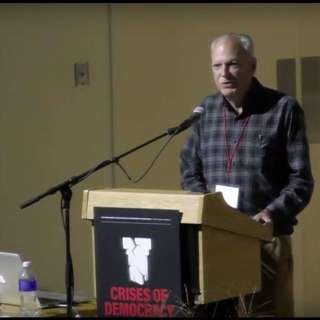

#51 - Martin Gurri on the revolt of the public & crisis of authority in the information age

#51 - Martin Gurri on the revolt of the public & crisis of authority in the information age

Politics in rich countries seems to be going nuts. What's the explanation? Rising inequality? The decline of manufacturing jobs? Excessive immigration?

Martin Gurri spent decades as a CIA analyst and in his 2014 book The Revolt of The Public and Crisis of Authority in the New Millennium, predicted political turbulence for an entirely different reason: new communication technologies were flipping the balance of power between the public and traditional authorities.

In 1959 the President could control the narrative by leaning on his friends at four TV stations, who felt it was proper to present the nation's leader in a positive light, no matter their flaws. Today, it's impossible to prevent someone from broadcasting any grievance online, whether it's a contrarian insight or an insane conspiracy theory.

Links to learn more, summary and full transcript.

According to Gurri, trust in society's institutions - police, journalists, scientists and more - has been undermined by constant criticism from outsiders, and exposed to a cacophony of conflicting opinions on every issue, the public takes fewer truths for granted. We are now free to see our leaders as the flawed human beings they always have been, and are not amused.

Suspicious they are being betrayed by elites, the public can also use technology to coordinate spontaneously and express its anger. Keen to 'throw the bastards out' protesters take to the streets, united by what they don't like, but without a shared agenda or the institutional infrastructure to figure out how to fix things. Some popular movements have come to view any attempt to exercise power over others as suspect.

If Gurri is to be believed, protest movements in Egypt, Spain, Greece and Israel in 2011 followed this script, while Brexit, Trump and the French yellow vests movement subsequently vindicated his theory.

In this model, politics won't return to its old equilibrium any time soon. The leaders of tomorrow will need a new message and style if they hope to maintain any legitimacy in this less hierarchical world. Otherwise, we're in for decades of grinding conflict between traditional centres of authority and the general public, who doubt both their loyalty and competence.

But how much should we believe this theory? Why do Canada and Australia remain pools of calm in the storm? Aren't some malcontents quite concrete in their demands? And are protest movements actually more common (or more nihilistic) than they were decades ago?

In today's episode we ask these questions and add an hour-long discussion with two of Rob's colleagues - Keiran Harris and Michelle Hutchinson - to further explore the ideas in the book.

The conversation covers:

* How do we know that the internet is driving this rather than some other phenomenon?
* How do technological changes enable social and political change?
* The historical role of television
* Are people also more disillusioned now with sports heroes and actors?
* Which countries are finding good ways to make politics work in this new era?
* What are the implications for the threat of totalitarianism?
* What is this is going to do to international relations? Will it make it harder for countries to cooperate and avoid conflict?

Get this episode by subscribing to our podcast on the world’s most pressing problems and how to solve them: type '80,000 Hours' into your podcasting app.

The 80,000 Hours Podcast is produced by Keiran Harris.

Avsnitt(317)

#138 Classic episode – Sharon Hewitt Rawlette on why pleasure and pain are the only things that intrinsically matter

#138 Classic episode – Sharon Hewitt Rawlette on why pleasure and pain are the only things that intrinsically matter

What in the world is intrinsically good — good in itself even if it has no other effects? Over the millennia, people have offered many answers: joy, justice, equality, accomplishment, loving god, wisd...

22 Jan 20252h 25min

#134 Classic episode – Ian Morris on what big-picture history teaches us

#134 Classic episode – Ian Morris on what big-picture history teaches us

Wind back 1,000 years and the moral landscape looks very different to today. Most farming societies thought slavery was natural and unobjectionable, premarital sex was an abomination, women should obe...

15 Jan 20253h 40min

#140 Classic episode – Bear Braumoeller on the case that war isn’t in decline

#140 Classic episode – Bear Braumoeller on the case that war isn’t in decline

Is war in long-term decline? Steven Pinker's The Better Angels of Our Nature brought this previously obscure academic question to the centre of public debate, and pointed to rates of death in war to a...

8 Jan 20252h 48min

2024 Highlightapalooza! (The best of The 80,000 Hours Podcast this year)

2024 Highlightapalooza! (The best of The 80,000 Hours Podcast this year)

"A shameless recycling of existing content to drive additional audience engagement on the cheap… or the single best, most valuable, and most insight-dense episode we put out in the entire year, depend...

27 Dec 20242h 50min

#211 – Sam Bowman on why housing still isn't fixed and what would actually work

#211 – Sam Bowman on why housing still isn't fixed and what would actually work

Rich countries seem to find it harder and harder to do anything that creates some losers. People who don’t want houses, offices, power stations, trains, subway stations (or whatever) built in their ar...

19 Dec 20243h 25min

#210 – Cameron Meyer Shorb on dismantling the myth that we can’t do anything to help wild animals

#210 – Cameron Meyer Shorb on dismantling the myth that we can’t do anything to help wild animals

"I really don’t want to give the impression that I think it is easy to make predictable, controlled, safe interventions in wild systems where there are many species interacting. I don’t think it’s eas...

29 Nov 20243h 21min

#209 – Rose Chan Loui on OpenAI’s gambit to ditch its nonprofit

#209 – Rose Chan Loui on OpenAI’s gambit to ditch its nonprofit

One OpenAI critic calls it “the theft of at least the millennium and quite possibly all of human history.” Are they right?Back in 2015 OpenAI was but a humble nonprofit. That nonprofit started a for-p...

27 Nov 20241h 22min

#208 – Elizabeth Cox on the case that TV shows, movies, and novels can improve the world

#208 – Elizabeth Cox on the case that TV shows, movies, and novels can improve the world

"I think stories are the way we shift the Overton window — so widen the range of things that are acceptable for policy and palatable to the public. Almost by definition, a lot of things that are going...

21 Nov 20242h 22min

Populärt inom Utbildning

rss-bara-en-till-om-missbruk-medberoende-2
historiepodden-se
det-skaver
alska-oss
nu-blir-det-historia
johannes-hansen-podcast
allt-du-velat-veta
harrisons-dramatiska-historia
sektledare
rss-sjalsligt-avkladd
not-fanny-anymore
roda-vita-rosen
sa-in-i-sjalen
i-vantan-pa-katastrofen
rss-max-tant-med-max-villman
rikatillsammans-om-privatekonomi-rikedom-i-livet
rss-om-vi-ska-vara-arliga
psykologsnack
rss-basta-livet
rss-beratta-alltid-det-har