Arun K. Singh on India-Pakistan Ceasefire

Arun K. Singh on India-Pakistan Ceasefire

Over the last three decades, cross-border violence between India and Pakistan has been interspersed with periods of relative peace. Until 2003, ceasefires along the Line of Control and International Border in Jammu and Kashmir (in 1949, 1965, and 1971) were preceded by war between India and Pakistan. On the night of November 23, 2003, an announcement of a unilateral ceasefire, starting on Eid-ul-Fitr, was made by then prime minister of Pakistan Mir Zafarullah Khan Jamali. Following this, during their weekly call, the Director Generals of Military Operations or DGMOs from the two countries agreed on a ceasefire along the Line of Control, International Border, and Actual Ground Position Line. And so, the ceasefire came into effect from 25 November 2003.

Given the violence of the previous 14 years, the ceasefire was a welcome move. The years between 1989 and 2003 saw cross-border violence touch record levels. 2001 and 2002 saw 4,134 and 5,767 ceasefire violations respectively by Pakistan, as reported by India. Thus, the ceasefire resulted in a stable border and immediate relief for civilians. According to some reports, there was not a single ceasefire violation between India and Pakistan between 2004 and 2006, while others report that the number was negligible. The larger change in India-Pakistan relations following the institution of the composite dialogue process also enabled different confidence-building measures on the LoC, such as the opening of passenger routes on the Poonch-Rawalakot and Srinagar-Muzaffarabad axes, enabling bus traffic and eventually cross-border trade. The period also saw the completion of border fencing on the LoC as a measure to prevent infiltration.

From 2007 onwards, ceasefire violations began to rise, intensifying after 2013. The larger relationship too started to see tensions due to terror attacks in India, civil-military dynamics in Pakistan, cross-border retaliatory actions such as the surgical strikes in 2016, and the Balakot airstrikes in 2019. In 2020, India reported 5,133 CFVs on the border. A reaffirmation of the ceasefire through a DGMO conversation and a subsequent joint statement by India and Pakistan in February 2021 was a major effort to arrest this trend.

--

Episode Contributors

Arun K. Singh is a nonresident senior fellow at Carnegie India. He has extensive experience across the globe, including as India’s ambassador to the United States, Israel, and France. Throughout his distinguished career in the Indian Foreign Service spanning thirty-seven years, he has served during pivotal periods in key global capitals and was instrumental in shaping India’s policies, notably the continued progress in the U.S.-India relationship, India’s closer ties to Israel, and the formulation and implementation of India’s policies related to Afghanistan, Pakistan, and Iran, including in the period following 9/11.

Surya Valliappan Krishna is the associate director of projects and operations at Carnegie India. His research interests are India-Pakistan relations, border security, and cross-border violence. In particular, he works on the nature and dynamics of cross-border violence and its impact on civilian communities.

--

Additional Reading

Bordering on Peace: Evaluating the impact of the India-Pakistan Ceasefire by Surya Valliappan Krishna

Caught in the Crossfire: Tension and Trade Along the Line of Control by Surya Valliappan Krishna

Sending the Right Signal: Telecom Connectivity along the Line of Control by Surya Valliappan Krishna

Mental Health on the Line (of Control) by Surya Valliappan Krishna

--

🎙️ Check out our podcast, Interpreting India available now on YouTube, Spotify, and iTunes!

Home: https://interpreting-india.simplecast.com/

Spotify: https://open.spotify.com/show/51yeOb8SimMIPe2KgIUQ8g

Apple Podcasts: https://podcasts.apple.com/in/podcast/interpreting-india/id1476357131

YouTube: https://www.youtube.com/playlist?list=PLeXQMWQXRkJXF71nDiX9LhlXiSkhR8JJT

--

Carnegie India Socials:

Instagram: https://www.instagram.com/carnegieindia/ (@CarnegieIndia)

Twitter: https://twitter.com/CarnegieIndia

Website: https://carnegieindia.org

YouTube: https://www.youtube.com/c/CarnegieIndia/

Every two weeks, Interpreting India brings you diverse voices from India and around the world to explore the critical questions shaping the nation's future. We delve into how technology, the economy, and foreign policy intertwine to influence India's relationship with the global stage.

As a Carnegie India production, hosted by Carnegie scholars, Interpreting India, a Carnegie India production, provides insightful perspectives and cutting-edge by tackling the defining questions that chart India's course through the next decade.

Stay tuned for thought-provoking discussions, expert insights, and a deeper understanding of India's place in the world.

Don't forget to subscribe, share, and leave a review to join the conversation and be part of Interpreting India's journey.

Det här avsnittet är hämtat från ett öppet RSS-flöde och publiceras inte av Podme. Det kan innehålla reklam.

Avsnitt(153)

India, Australia, and the Critical Minerals Opportunity

India, Australia, and the Critical Minerals Opportunity

The conversation opens with a useful baseline on both countries. Australia has world-class mining equipment, technology, and services capabilities, and its mining sector contributes roughly 10 to 15 p...

13 Aug 49min
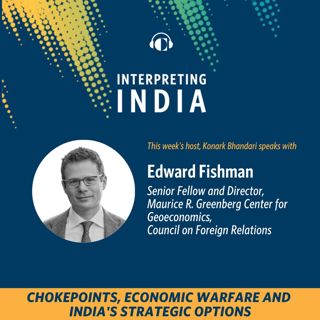
Chokepoints, Economic Warfare and India's Strategic Options

Chokepoints, Economic Warfare and India's Strategic Options

Edward lays out three criteria for what makes something a genuine choke point: dominant market share, difficulty to substitute, and the ability to weaponize it with asymmetric impact, hurting the adve...

10 Juli 33min
India's AI Ambitions and the Road to Viksit Bharat | AI Summit Special

India's AI Ambitions and the Road to Viksit Bharat | AI Summit Special

This is the final episode of our special series on the India AI Impact Summit, examining the conversations, decisions, and debates that are shaping global AI governance. This episode explores: India...

2 Juli 33min
Did India's AI Summit Get Safety Right? AI Summit Special

Did India's AI Summit Get Safety Right? AI Summit Special

This episode is part of our special series on the India AI Impact Summit, examining the conversations, decisions, and debates that are shaping global AI governance. Professor Ravindran addresses early...

19 Juni 40min
Subsea Cables, Trusted Networks, and India's Strategic Opportunity

Subsea Cables, Trusted Networks, and India's Strategic Opportunity

Pooja opens with a mismatch that frames the entire conversation. India consumes around 20% of global internet traffic but accounts for just 2% of global subsea cable infrastructure. Even with the expa...

4 Juni 46min
AI Literacy and the Future of Work in India

AI Literacy and the Future of Work in India

Jaspreet's framing for the AI and work debate is worth staying with. He is not dismissive of disruption: he thinks AI will destroy certain jobs, create new ones, and the rupture will be real. But he p...

26 Maj 44min
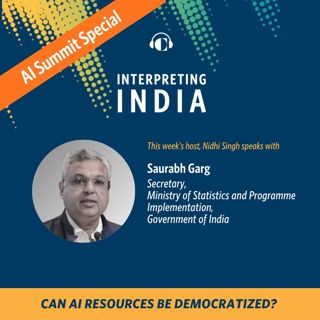
Can AI Resources Be Democratized? AI Summit Special

Can AI Resources Be Democratized? AI Summit Special

This episode is part of our special series on the India AI Impact Summit, examining the conversations, decisions, and debates that are shaping global AI governance. The working group was designed from...

15 Maj 28min
Space Security in the Age of AI

Space Security in the Age of AI

Almudena opens with a distinction that anchors the entire conversation: space security, unlike space safety, is about intentional harm. It concerns deliberate attempts to disrupt, deny, or destroy spa...

7 Maj 1h 7min

Populärt inom Politik & nyheter

aftonbladet-krim
p3-krim
aftonbladet-daily
svenska-fall
rss-expressen-dok
flashback-forever
rss-krimstad
rss-krimreportrarna
rss-sanning-konsekvens
motiv
svd-ledarredaktionen
rss-vad-fan-hande
spar
rss-flodet
rss-frandfors-horna
politiken
rss-aftonbladet-krim
mannen-utan-spar
fordomspodden
tv4-nyheterna-story