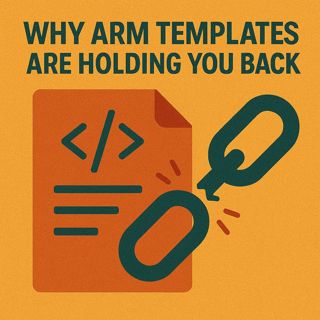
Why ARM Templates Are Holding You Back (And How Bicep Fixes Azure Deployments)

Why ARM Templates Are Holding You Back (And How Bicep Fixes Azure Deployments)

ARM templates look powerful on paper—but in real projects they grow into giant JSON blobs that are hard to read, harder to debug, and almost impossible to keep in sync with what’s actually running in Azure. One missing comma or brace can block a whole deployment, error messages are vague, and teams under pressure quietly “fix it in the portal,” leaving templates and reality out of sync. In this episode, we unpack why ARM collapses under its own weight as soon as you go beyond trivial examples, how configuration drift slowly destroys your “infrastructure as code,” and why so many ARM files end up as untrusted skeletons instead of a real source of truth.Bicep flips that experience: it gives you a cleaner, more readable language on top of the same ARM engine, with proper modules, reuse, and tooling support so you stop copy‑pasting JSON and start composing infrastructure like code. We walk through the same deployment written once in classic ARM and once in Bicep so you can see the difference side by side, then show how Bicep makes refactors, reviews, and DRY patterns realistic instead of painful.

WHY ARM TEMPLATES BREAK MORE THAN THEY BUILD

ARM was supposed to make deployments predictable: declare the end state, let Azure handle the rest. In practice, the declarative model gets buried under verbose JSON syntax, deeply nested structures, and duplicated parameter boilerplate, so even a “simple” VM or app service template quickly runs into hundreds of lines. We look at what that does to real teams: error messages that point to the wrong place, hours spent hunting for a missing brace, and pipelines blocked by templates nobody feels confident editing. The result is a familiar pattern: people start bypassing templates with quick portal changes “just this once,” and the more painful the JSON gets, the more often those one‑offs happen.

THE SILENT KILLER: CONFIGURATION DRIFT

Once you start fixing things directly in Azure instead of in code, configuration drift begins. Your template says one thing, your running environment says another, and over time the gap widens until the file you committed isn’t a reliable description of production anymore. We break down how that drift shows up: dev and prod no longer behaving the same even though they “came from the same template,” firewalls and access rules that exist only in the portal, and audits where nobody can explain why a live environment doesn’t match the code in Git. ARM’s bulk and friction make this worse—because editing templates is so painful, small fixes almost never make it back into JSON, so drift becomes the default instead of the exception.

WHERE ARM TEMPLATES COLLAPSE UNDER THEIR OWN WEIGHT

The real breaking point comes when you try to scale. ARM doesn’t give you clean, first‑class ways to build abstractions or reuse building blocks, so teams fall back to copy‑paste as soon as they need similar patterns across environments or stacks. Every copy increases size and complexity, introduces subtle differences, and makes future changes risky, because you’re now editing the same logic in five places instead of one. We talk through how this hits larger deployments—multi‑resource apps, shared components, cross‑region patterns—and why ARM’s design nudges you toward sprawling templates that nobody really owns.

HOW BICEP FIXES THE WORST ARM PAIN POINTS

Bicep keeps the underlying ARM engine but replaces unwieldy JSON with a concise, purpose‑built language for Azure infrastructure. You get readable syntax, proper modules for reuse, parameters and variables that don’t drown in quotes and commas, and tooling that can decompile existing ARM templates so you can migrate instead of starting from scratch. In the episode, we walk a real example: the same VM or app deployment first in ARM, then in Bicep, highlighting how many lines disappear, how much easier it is to spot logic errors, and how review comments suddenly become about architecture instead of bracket placement.

WHAT YOU’LL LEARN
  • Why ARM templates become cluttered, brittle and hard to debug as soon as you leave trivial examples.
  • How configuration drift erodes your “source of truth” when teams fix issues in the portal instead of in code.
  • How and why ARM collapses under its own weight when you try to reuse or scale patterns.
  • How Bicep’s cleaner syntax and modular design make Azure deployments simpler, faster and more consistent.
THE CORE INSIGHT

The core insight of this episode is that ARM’s problem isn’t what it promises, it’s how it forces you to express those promises. As long as your infrastructure is trapped in giant JSON templates, drift and duplication are almost guaranteed; once you switch to Bicep and treat infrastructure like real code—with modules, reuse and reviews—you finally get the predictable, repeatable deployments ARM was supposed to deliver in the first place.

WHO THIS EPISODE IS FOR
  • Azure engineers and DevOps teams stuck maintaining large, fragile ARM templates.
  • Architects and platform teams designing IaC standards for Azure environments.
  • Developers who’ve avoided ARM because of JSON pain but want a realistic path into IaC with Bicep.
ABOUT THE AUTHOR / HOST

Mirko Peters is a Microsoft 365, Azure and infrastructure‑as‑code consultant and host of the M365.FM podcast, helping organizations treat Azure, DevOps and IaC as one integrated operating system instead of a pile of ad‑hoc scripts and portal changes. He works with teams running on Microsoft 365, Azure and modern DevOps toolchains to replace brittle ARM templates with Bicep‑based deployments that are easier to read, review and keep in sync with reality.

Become a supporter of this podcast: https://www.spreaker.com/podcast/m365-fm-modern-work-security-and-productivity-with-microsoft-365--6704921/support.

Det här avsnittet är hämtat från ett öppet RSS-flöde och publiceras inte av Podme. Det kan innehålla reklam.

Avsnitt(780)

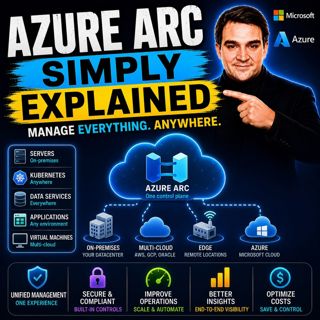
Azure Arc - Simply Explained

Azure Arc - Simply Explained

Modern IT environments rarely exist in a single cloud. Most organizations run Windows and Linux servers across on-premises data centers, Microsoft Azure, Amazon Web Services (AWS), Google Cloud Platfo...

17 Juli 17min
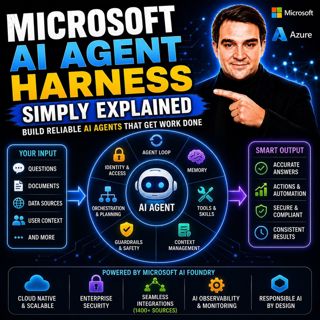
Microsoft AI Agent Harness - Simply Explained

Microsoft AI Agent Harness - Simply Explained

Writing the perfect AI prompt used to be the goal of every AI developer. But as businesses began asking AI to perform increasingly complex tasks—analyzing code, researching topics, coordinating workfl...

17 Juli 16min
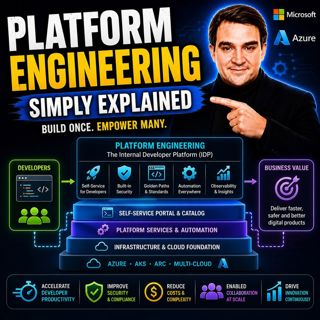
Platform Engineering - Simply Explained

Platform Engineering - Simply Explained

For years, DevOps promised to break down the barriers between development and operations by giving teams greater ownership over the software they build. While the idea was powerful, reality became far...

16 Juli 16min
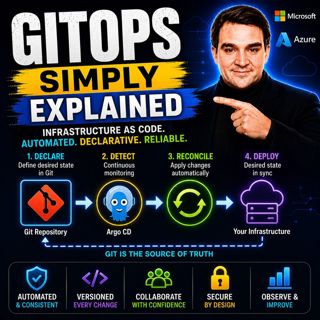
GitOps - Simply Explained

GitOps - Simply Explained

Managing Kubernetes manually quickly becomes a nightmare as environments grow. One engineer updates a deployment directly using kubectl, another changes a ConfigMap through the Azure portal, and sudde...

16 Juli 16min
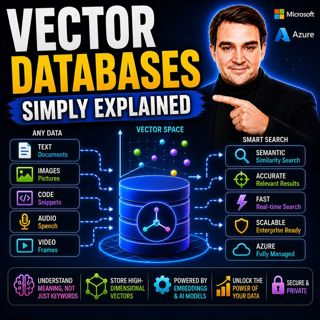
Vector Databases - Simply Explained

Vector Databases - Simply Explained

Large Language Models like GPT-4o, Microsoft Copilot, and ChatGPT are incredibly powerful, but they all depend on one critical technology that most people never hear about: vector databases. Tradition...

16 Juli 14min

RAG on Azure — Simply Explained

RAG on Azure — Simply Explained

Large Language Models like GPT-4o are incredibly powerful, but they have two major limitations. First, their knowledge is frozen in time, meaning they don't automatically know about recent events, cha...

16 Juli 13min

Azure AI Foundry - Simply Explained

Azure AI Foundry - Simply Explained

Artificial Intelligence is evolving faster than almost any other technology, and with new models, frameworks, and AI services appearing almost every month, it's becoming increasingly difficult to know...

16 Juli 14min
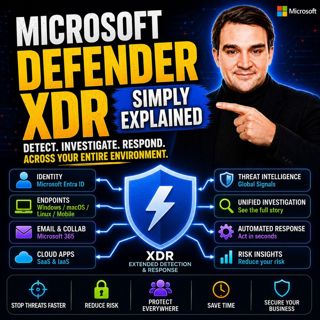
Microsoft Defender XDR - Simply Explained

Microsoft Defender XDR - Simply Explained

Modern cyberattacks rarely target a single system. An attack might begin with a phishing email, move to a compromised device, steal user credentials, access cloud applications, and finally exfiltrate ...

16 Juli 14min

Populärt inom Politik & nyheter

aftonbladet-krim
svenska-fall
p3-krim
rss-krimstad
tv4-nyheterna-story
aftonbladet-daily
flashback-forever
rss-sanning-konsekvens
motiv
de-fyras-gang
rss-krimreportrarna
mannen-utan-spar
rss-vad-fan-hande
rss-frandfors-horna
spar
rss-flodet
rss-aftonbladet-krim
politiken
olyckan-inifran
krimmagasinet