

Unit vs Integration vs Front-End Testing: Which Bugs Each Layer Catches (And Why Your Azure Apps Need All Three)

Unit vs Integration vs Front-End Testing: Which Bugs Each Layer Catches (And Why Your Azure Apps Need All Three)

You fix a tiny function, all unit tests go green, the pipeline smiles—and production still breaks in three different places. That’s not bad luck, it’s a missing test strategy: each layer (unit, integration, front‑end) catches a different class of failure, but most teams over‑invest in one and under‑invest in the others. In this episode, we use a real Azure Functions bug as the running example: how a harmless‑looking change in a helper method broke not just one endpoint, but also queue processing and UI flows. You’ll see exactly how unit tests could have protected the logic, how integration tests would have validated the chain between Function, queue and database, and how front‑end tests would have caught the broken user journey before go‑live.The goal isn’t “more tests”, it’s the right mix: a thin, fast unit‑test layer, focused integration tests at risky boundaries, and a handful of sharp end‑to‑end flows. That’s how you stop using production as your test environment and turn CI/CD from a “hope it’s fine” signal into a real quality gate.

WHAT UNIT TESTS REALLY COVER (AND WHAT THEY DON’T)

Unit tests are your first line of defense: they validate pure logic and small units with no external dependencies. They’re fast, cheap and perfect for calculations, decision rules, mappings and any function that deterministically turns input into output. We walk through typical patterns in Azure/backend apps—services with injected dependencies, pure helper functions, domain logic—and show where unit tests, in our Azure Functions example, would have caught the real bug (changed null handling, different default values, altered time logic) right at the source.The limits appear as soon as external systems show up: databases, queues, HTTP APIs, storage, feature flags. Unit tests never see missing connection strings, wrong auth headers, broken serialization or timeouts that kill your function. If you only rely on unit tests, you validate your code—but not whether your app actually works in the real Azure setup.

WHAT INTEGRATION TESTS CATCH THAT UNIT TESTS CAN’T

Integration tests don’t care if each function is “theoretically” correct; they check whether services and infrastructure work together. In our Azure Functions scenario, that means: a function calls an API, writes to a queue, a consumer reads the message, writes to a database and sets a status that another service or the UI reads. A good integration test for this chain would have shown that after the code change, certain inputs no longer hit the queue correctly or records never make it into the database—even though every unit test was green.We outline practical patterns: local test containers (SQL, storage emulators), small Azure test environments, pre‑provisioned resources, and how to keep integration tests reliable without slowing your pipeline to a crawl. Instead of “integrate everything or nothing”, you focus on a few business‑critical flows (orders, payments, registrations) where failure really hurts.

WHY FRONT-END / E2E TESTS ARE YOUR LAST LINE OF DEFENSE

Front‑end or end‑to‑end tests simulate what users actually do: open a page, fill a form, click a button, expect a result. They can’t see your service layer or queues—they only see “page doesn’t load”, “button does nothing” or “wrong error message shows up”. In the Azure Functions example, a simple E2E flow (for example with Playwright or Cypress) would have exposed the regression: user sends a request, the UI hangs or errors out, even though your unit tests were happy.We explain why E2E tests must be used sparingly: they’re slower and more fragile, but unbeatable as the final quality barrier before release. The trick is to pick 5–10 truly critical user journeys and automate those—not every tiny UI branch. Used this way, they keep obviously broken releases away from customers without turning your pipeline into a bottleneck.

WHAT YOU’LL LEARN
  • How a real Azure Functions bug slipped through green unit tests and how each test layer could have stopped it.
  • Which classes of bugs unit tests reliably catch (logic, calculations, pure functions)—and where they’re blind.
  • How integration tests validate services, queues, databases and APIs working together and surface infrastructure issues.
  • Why a small set of front‑end/E2E tests secures the real user journey and prevents production disasters.
  • How to build a pragmatic test pyramid for Azure/microservices without making your pipeline unusable.
THE CORE INSIGHT

The core insight is that this isn’t about whether unit, integration or front‑end tests are “best”—it’s about which risk you catch where. Unit tests protect your logic, integration tests protect your critical connections, and front‑end tests protect the real user experience; only together do they stop your customers from becoming your monitoring system.

WHO THIS EPISODE IS FOR
  • Dev teams who still see nasty production surprises despite having tests.
  • QA/QAOps teams that need to split test budget smartly between unit, integration and E2E.
  • Tech leads and architects who want a realistic test strategy for Azure Functions, APIs and microservices.
ABOUT THE AUTHOR / HOSTMirko Peters is a Microsoft 365 and backend architecture consultant and host of the M365.FM podcast. He helps teams treat testing, observability and deployment as one integrated operating system instead of three separate checklists in the CI/CD pipeline.

Become a supporter of this podcast: https://www.spreaker.com/podcast/m365-fm-modern-work-security-and-productivity-with-microsoft-365--6704921/support.

Det här avsnittet är hämtat från ett öppet RSS-flöde och publiceras inte av Podme. Det kan innehålla reklam.

Avsnitt(780)

Azure Arc - Simply Explained

Azure Arc - Simply Explained

Modern IT environments rarely exist in a single cloud. Most organizations run Windows and Linux servers across on-premises data centers, Microsoft Azure, Amazon Web Services (AWS), Google Cloud Platfo...

17 Juli 17min
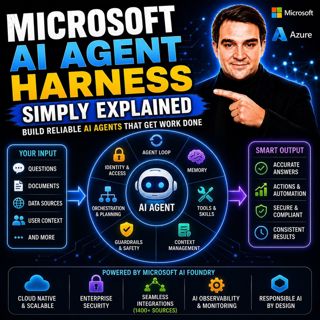
Microsoft AI Agent Harness - Simply Explained

Microsoft AI Agent Harness - Simply Explained

Writing the perfect AI prompt used to be the goal of every AI developer. But as businesses began asking AI to perform increasingly complex tasks—analyzing code, researching topics, coordinating workfl...

17 Juli 16min

Platform Engineering - Simply Explained

Platform Engineering - Simply Explained

For years, DevOps promised to break down the barriers between development and operations by giving teams greater ownership over the software they build. While the idea was powerful, reality became far...

16 Juli 16min

GitOps - Simply Explained

GitOps - Simply Explained

Managing Kubernetes manually quickly becomes a nightmare as environments grow. One engineer updates a deployment directly using kubectl, another changes a ConfigMap through the Azure portal, and sudde...

16 Juli 16min

Vector Databases - Simply Explained

Vector Databases - Simply Explained

Large Language Models like GPT-4o, Microsoft Copilot, and ChatGPT are incredibly powerful, but they all depend on one critical technology that most people never hear about: vector databases. Tradition...

16 Juli 14min

RAG on Azure — Simply Explained

RAG on Azure — Simply Explained

Large Language Models like GPT-4o are incredibly powerful, but they have two major limitations. First, their knowledge is frozen in time, meaning they don't automatically know about recent events, cha...

16 Juli 13min

Azure AI Foundry - Simply Explained

Azure AI Foundry - Simply Explained

Artificial Intelligence is evolving faster than almost any other technology, and with new models, frameworks, and AI services appearing almost every month, it's becoming increasingly difficult to know...

16 Juli 14min

Microsoft Defender XDR - Simply Explained

Microsoft Defender XDR - Simply Explained

Modern cyberattacks rarely target a single system. An attack might begin with a phishing email, move to a compromised device, steal user credentials, access cloud applications, and finally exfiltrate ...

16 Juli 14min

Populärt inom Politik & nyheter

aftonbladet-krim
svenska-fall
p3-krim
rss-krimstad
tv4-nyheterna-story
aftonbladet-daily
flashback-forever
rss-sanning-konsekvens
motiv
de-fyras-gang
rss-krimreportrarna
mannen-utan-spar
rss-vad-fan-hande
rss-frandfors-horna
spar
rss-flodet
rss-aftonbladet-krim
politiken
olyckan-inifran
krimmagasinet