Satellite megaconstellations will threaten space-based astronomy

Satellite megaconstellations will threaten space-based astronomy

The rapid expansion of Low Earth Orbit (LEO) satellite megaconstellations is creating a growing threat to space-based astronomy, challenging the long-held perception that space telescopes are immune to light contamination.


If all proposals for new telecommunication satellite launches are fulfilled, projections indicate that Earth could be orbited by **half a million artificial satellites by the end of the 2030s**. Currently, the total number of satellites is only a small fraction (less than 3%) of those planned for the next decade.


This episode delves into a study forecasting the devastating impact of these constellations on vital observatories:


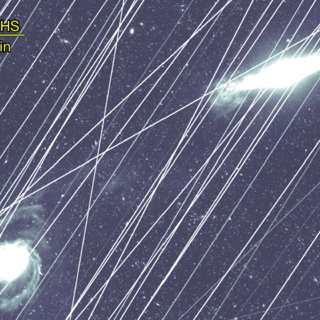
* **Current Impact:** Satellite trails already affect astronomical images across the complete electromagnetic spectrum. A recent study demonstrated that 4.3% of images obtained by the **Hubble Space Telescope** between 2018 and 2021 already contained artificial satellite trails.

* **Future Contamination:** If the planned constellations are completed (approximately 560,000 satellites), light contamination becomes critical for LEO observatories.

* The forecast shows that **more than one-third (39.6% $\pm$ 4.6%) of Hubble Space Telescope images will be contaminated**.

* Newer LEO telescopes, such as the SPHEREx, ARRAKIHS, and Xuntian space telescopes, are predicted to have **more than 96% of their exposures affected**.

* The Xuntian Space Telescope, due to its lower orbit (450 km), will be the most affected, potentially seeing 92 satellite trails per average exposure.

* **Trail Brightness:** Reflections from satellites are extremely bright for professional telescopes. The typical surface brightness of detectable trails is forecasted to range from $\mu = 18$ to $\mu = 23$ mag arcsec⁻². This is orders of magnitude above the detectability limit for these telescopes.


The scientific community is urging action to address this growing threat. Proposed mitigation measures include setting an optimal upper limit for large satellite constellations' orbits, maintaining updated and precise open archives of orbital solutions for active and derelict spacecraft (avoidance), and implementing correction techniques for unwanted light pollution.


***


**Reference to the article discussed:**

Borlaff, A. S., Marcum, P. M. & Howell, S. B. Satellite megaconstellations will threaten space-based astronomy. *Nature*. Published online 3 December 2025.


**DOI:** https://doi.org/10.1038/s41586-025-09759-5


Acknowledements: Podcast prepared with Google/NotebookLM. Illustration credits: Borlaff, A.S., Marcum, P.M. & Howell, S.B., Nature 648, 51–57 (2025)

Tämä jakso on lisätty Podme-palveluun avoimen RSS-syötteen kautta eikä se ole Podmen omaa tuotantoa. Siksi jakso saattaa sisältää mainontaa.

Jaksot(101)

Record-Breaker: Catching Gamma Rays from the Distant Quasar OP 313

Record-Breaker: Catching Gamma Rays from the Distant Quasar OP 313

In this episode, we dive into a groundbreaking astronomical discovery: the detection of very-high-energy (VHE) gamma rays from the quasar OP 313. Located at a redshift of $z = 0.997$, OP 313 has shatt...

1 Kesä 20min

Ripples in Spacetime: Unpacking the GWTC-5.0 Catalog

Ripples in Spacetime: Unpacking the GWTC-5.0 Catalog

In this episode, we dive into the monumental release of the Gravitational-Wave Transient Catalog version 5.0 (GWTC-5.0) and the open data from the second part of the fourth observing run (O4b) by the ...

29 Touko 21min

SN 2017egm : Fermi-LAT's Breakthrough Gamma-Ray Detection

SN 2017egm : Fermi-LAT's Breakthrough Gamma-Ray Detection

In today’s episode, we dive into the mystery of superluminous supernovae (SLSNe)—rare, extreme astronomical events that shine 10 to 100 times brighter than standard core-collapse supernovae. For years...

22 Touko 23min

Supernovae on the RISE: Why Dead Stars Wake Up Decades Later

Supernovae on the RISE: Why Dead Stars Wake Up Decades Later

In this episode, we explore the fascinating phenomenon of core-collapse supernovae that refuse to fade away quietly. Years, or even decades, after their initial explosion, some of these stellar deaths...

20 Touko 17min

The SVOM Satellite: A New Era in Multi-Messenger Astronomy

The SVOM Satellite: A New Era in Multi-Messenger Astronomy

In this episode, we dive into the fascinating world of gamma-ray bursts (GRBs) and high-energy transients through the lens of the SVOM (Space-based Multi-band Variable Object Monitor) mission. Launche...

29 Huhti 24min

Chasing the Flash: Hunting Neutron Star Mergers with CTAO

Chasing the Flash: Hunting Neutron Star Mergers with CTAO

In this episode, we dive into the thrilling world of multi-messenger astronomy! Ever since the historic detection of GW170817, scientists have known that binary neutron star (BNS) mergers can produce ...

14 Huhti 19min

Tiling the Sky: A New Strategy for Finding Elusive GRBs

Tiling the Sky: A New Strategy for Finding Elusive GRBs

In this episode, we dive into the intense and fast-paced world of **Gamma-ray bursts (GRBs)—the most luminous and rapidly evolving transients in the Universe**. While space-based instruments like the ...

13 Huhti 19min

Fast Radio Bursts & Magnetar X-Rays: A Peculiar Discovery

Fast Radio Bursts & Magnetar X-Rays: A Peculiar Discovery

In this episode, we dive into the deep cosmos to explore a recent astronomical breakthrough linking Fast Radio Bursts (FRBs)—enigmatic, millisecond-long cosmic transients—to extreme stellar objects kn...

7 Huhti 22min

Suosittua kategoriassa Tiede

rss-mita-tulisi-tietaa
rss-hereilla
utelias-mieli
rss-duodecim-lehti
rss-totuuden-liepeilla
tiedekulma-podcast
rss-radplus
docemilia
filocast-filosofian-perusteet
rss-laakaripodi
rss-tiedetta-vai-tarinaa
university-of-eastern-finland
sotataidon-ytimessa
radio-antro
rss-bios-podcast
rss-poliisin-mieli
rss-ilmasto-kriisissa
rss-ylistys-elaimille
rss-kasvikutsut