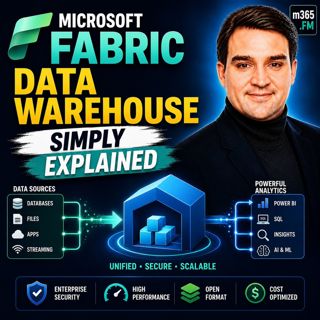
Microsoft Fabric Data Warehouse - Simply Explained

Microsoft Fabric Data Warehouse - Simply Explained

Welcome to another episode of Knowledge Nuggets with Mirko Peters. Today we're exploring Microsoft Fabric Data Warehouse, Microsoft's modern cloud-native data warehouse built as part of the unified Microsoft Fabric analytics platform. Most people hear the term data warehouse and immediately think of a traditional SQL database. They imagine tables, SQL queries, reports, and business intelligence. While Microsoft Fabric Data Warehouse certainly supports all of those familiar concepts, what happens behind the scenes is fundamentally different. Instead of storing data in proprietary database files tied to a specific server, Fabric stores everything in the open Delta Parquet format on OneLake, allowing the same data to be shared seamlessly across analytics, data engineering, machine learning, and Power BI. In this episode, we'll explain what a Fabric Data Warehouse really is, how it differs from traditional data warehouses, how data is stored and queried, and why Microsoft has reimagined the modern warehouse for the era of cloud analytics and artificial intelligence. WHAT IS A DATA WAREHOUSE? Before understanding Microsoft Fabric, it's important to understand what a data warehouse is. A data warehouse is a centralized repository designed to store clean, structured, and optimized business data for reporting and analytics. Rather than processing thousands of small transactions like an operational database, a warehouse is built to answer large business questions such as total sales, customer trends, financial performance, or operational KPIs across millions—or even billions—of records. Traditionally, organizations purchased dedicated servers, installed database software such as SQL Server or Oracle, and managed storage, backups, indexing, and hardware themselves. As business requirements grew, organizations expanded infrastructure by purchasing larger servers, additional disks, and more processing power. While this approach worked well for many years, it also created significant challenges. Data became isolated inside proprietary systems, storage and compute resources were tightly coupled, and organizations frequently copied the same information into multiple platforms to support reporting, analytics, and machine learning. Microsoft Fabric was designed to eliminate these traditional data silos by moving warehouse storage into a shared cloud architecture built on OneLake. HOW FABRIC DATA WAREHOUSE WORKS At first glance, Fabric Data Warehouse looks remarkably familiar. Users create schemas, tables, views, and write standard T-SQL queries exactly as they would inside SQL Server. However, beneath that familiar interface lies a completely different storage architecture. Instead of storing data inside proprietary database files, Fabric saves every table as Delta Parquet files inside OneLake. This means data is no longer locked inside a single database engine. The exact same files can be accessed simultaneously by Spark notebooks, Power BI, SQL queries, data pipelines, and machine learning workloads without creating duplicate copies. OneLake serves as the shared storage foundation for every Microsoft Fabric experience. Rather than maintaining separate copies of data for different workloads, organizations maintain one authoritative dataset that every Fabric service can access directly. This shared architecture dramatically reduces storage duplication, simplifies governance, and enables far greater collaboration across analytics teams. THE BUILDING BLOCKS OF A FABRIC WAREHOUSE Developers familiar with SQL Server will immediately recognize the core objects inside a Fabric Warehouse. Schemas organize related database objects into logical groups, making large environments easier to manage. Tables store structured business data using familiar rows and columns, while views simplify complex queries by presenting reusable virtual datasets. Stored procedures and functions provide reusable business logic that automates common processing tasks using standard T-SQL syntax. Although these objects behave much like their SQL Server equivalents, every table is actually backed by Delta tables stored in OneLake. This provides capabilities unavailable in traditional relational databases, including open storage formats, improved interoperability, and advanced version management. Microsoft also includes visual query tools for users who are less comfortable writing SQL manually, making Fabric Data Warehouse approachable for both database professionals and business analysts. LOADING DATA INTO THE WAREHOUSE Fabric provides several methods for loading data depending on user experience and business requirements. Data Pipelines offer a graphical approach where users connect to sources such as Azure SQL Database, Excel, CSV files, or cloud storage before mapping columns into warehouse tables through guided workflows. Dataflows Gen2 provide a familiar Power Query experience for performing transformations visually before loading cleaned data into warehouse tables. Developers can also use the COPY INTO command to import external files directly using T-SQL, while data engineers often leverage Spark notebooks for highly scalable transformation and ingestion processes. Unlike the SQL endpoint of a Lakehouse, which primarily supports read-only SQL queries, the Warehouse fully supports INSERT, UPDATE, DELETE, and MERGE operations. This makes it the preferred destination whenever structured business data requires ongoing maintenance and transactional updates after loading. QUERYING DATA WITH SQL Working with Fabric Warehouse feels very familiar for anyone who has used SQL Server. Users connect through SQL Server Management Studio, Azure Data Studio, or Fabric's built-in query editor using standard T-SQL syntax. SELECT statements, joins, filters, aggregations, and stored procedures all behave as expected. Where Fabric becomes significantly more powerful is its ability to query across multiple Fabric storage experiences. Because both Lakehouses and Warehouses access the same OneLake storage layer, SQL queries can join information across different databases without physically copying data between systems. Reports, notebooks, and warehouse queries all work from the same underlying files, ensuring every workload references a single source of truth. Rather than building isolated databases connected through complex ETL processes, Fabric enables organizations to query information wherever it already exists inside OneLake. TIME TRAVEL AND ZERO-COPY CLONING One of the biggest advantages of Delta storage is the ability to work with historical versions of data. Time Travel allows users to query tables exactly as they existed at a previous point in time. If data is accidentally modified or deleted, administrators can simply query an earlier version without restoring backups or interrupting production systems. Another impressive capability is Zero-Copy Cloning. Instead of physically duplicating large datasets, Fabric creates nearly instantaneous table clones that reference the existing data files already stored in OneLake. Because no additional storage is required initially, organizations can safely create development, testing, or backup environments without dramatically increasing storage costs. These capabilities provide flexibility that traditional database platforms typically achieve only through complex backup, restore, and replication strategies. PERFORMANCE AND POWER BI INTEGRATION Microsoft continues investing heavily in Fabric performance. Recent GPU acceleration capabilities allow warehouse queries to execute dramatically faster under heavy workloads without requiring database administrators to redesign indexes or rewrite SQL code. Organizations simply enable GPU acceleration and benefit from significantly improved throughput for analytical workloads. Equally important is Direct Lake for Power BI. Traditional reporting solutions often require importing data into Power BI or continuously executing live queries against databases. Direct Lake eliminates this compromise by allowing Power BI to read directly from Delta files already stored in OneLake. The result is near real-time reporting performance without maintaining scheduled refreshes or repeatedly querying the warehouse, reducing both latency and compute costs while keeping reports continuously synchronized with the underlying data. This deep integration demonstrates Microsoft's broader vision of creating one unified analytics platform rather than several disconnected services. WHEN SHOULD YOU USE A WAREHOUSE? Microsoft Fabric provides several storage experiences, each designed for different workloads. A Warehouse is the best choice when organizations require highly structured relational data, transactional SQL support, and consistent business reporting. It is ideal for curated datasets, financial reporting, business intelligence, and enterprise analytics. A Lakehouse is better suited for exploratory analytics, raw files, semi-structured information, data science, and large-scale data engineering where schemas continue evolving. An Eventhouse focuses on high-volume streaming scenarios such as telemetry, IoT devices, and operational event data arriving continuously over time. Rather than competing with one another, these storage experiences complement each other. Organizations often begin by landing raw information inside a Lakehouse before publishing cleaned, business-ready datasets into a Warehouse for reporting and executive dashboards. Because all three share OneLake, data flows naturally between them without unnecessary duplication. KEY TAKEAWAYS Microsoft Fabric Data Warehouse combines the familiar experience of a traditional SQL database with a modern cloud-native architecture built on Delta Parquet and OneLake. While users continue working with schemas, tables, views, stored procedures, and T-SQL, the underlying storage is shared across the entire Microsoft Fabric platform, eliminating data silos while en

Become a supporter of this podcast: https://www.spreaker.com/podcast/m365-fm-modern-work-security-and-productivity-with-microsoft-365--6704921/support.

Tämä jakso on lisätty Podme-palveluun avoimen RSS-syötteen kautta eikä se ole Podmen omaa tuotantoa. Siksi jakso saattaa sisältää mainontaa.

Jaksot(847)

Agent Governance Explained- How IT Can Enable the AI Agent Revolution with Thomas Zou [Microsoft]

Agent Governance Explained- How IT Can Enable the AI Agent Revolution with Thomas Zou [Microsoft]

Every organization is talking about AI agents, but very few have a strategy for governing them. In this episode of M365.fm, host Mirko Peters sits down with Thomas Zou, Product Marketing Manager for M...

23 Heinä 0s
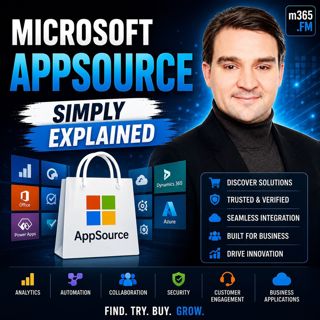
Microsoft AppSource - Simply Explained

Microsoft AppSource - Simply Explained

Welcome to another episode of Knowledge Nuggets with Mirko Peters. Today we're exploring Microsoft AppSource, Microsoft's marketplace for business applications, consulting services, and industry solut...

23 Heinä 0s

Agent Feed - Simply Explained

Agent Feed - Simply Explained

Welcome to another episode of Knowledge Nuggets with Mirko Peters. Today we're exploring Agent Feed, Microsoft's new supervision experience for AI agents inside Power Apps. As AI agents become capable...

23 Heinä 0s
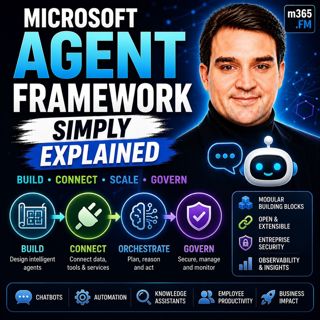
Microsoft Agent Framework - Simply Explained

Microsoft Agent Framework - Simply Explained

Welcome to another episode of Knowledge Nuggets with Mirko Peters. Today we're exploring the Microsoft Agent Framework, Microsoft's unified development framework for building enterprise-ready AI agent...

23 Heinä 0s
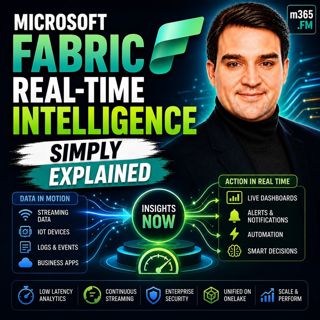
Microsoft Fabric Real-Time Intelligence - Simply Explained

Microsoft Fabric Real-Time Intelligence - Simply Explained

Welcome to another episode of Knowledge Nuggets with Mirko Peters. Today we're exploring Microsoft Fabric Real-Time Intelligence, one of the most exciting workloads inside Microsoft Fabric that enable...

23 Heinä 0s
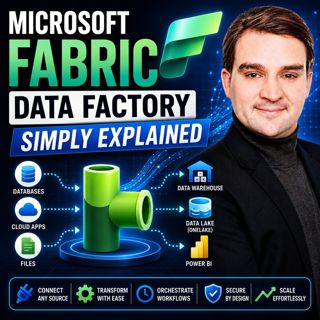
Microsoft Fabric Data Factory - Simply Explained

Microsoft Fabric Data Factory - Simply Explained

Moving data has always been one of the most complex parts of building a modern analytics platform. Organizations need to collect information from databases, cloud applications, APIs, files, and enterp...

23 Heinä 0s
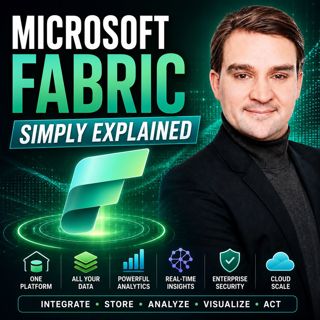
Microsoft Fabric - Simply Explained

Microsoft Fabric - Simply Explained

Data has become one of every organization's most valuable assets—but for many businesses, it's scattered across databases, cloud platforms, business applications, and analytics tools. Microsoft Fabric...

22 Heinä 0s

Suosittua kategoriassa Politiikka ja uutiset

aikalisa
uutiscast
ootsa-kuullut-tasta-2
rss-ootsa-kuullut-tasta
rss-seksicast
rss-vaalirankkurit-podcast
otetaan-yhdet
rss-podme-livebox
politiikan-puskaradio
aihe
rikosmyytit
rss-kovin-paikka
tervo-halme
rss-girls-finish-f1rst
et-sa-noin-voi-sanoo-esittaa
rss-kaikki-uusiksi
rss-varsinaista-puhetta