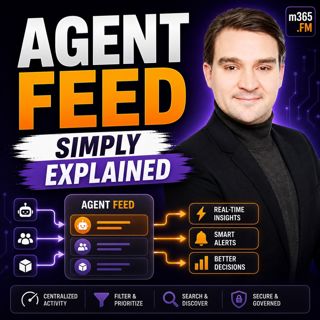
Agent Feed - Simply Explained
Welcome to another episode of Knowledge Nuggets with Mirko Peters. Today we're exploring Agent Feed, Microsoft's new supervision experience for AI agents inside Power Apps. As AI agents become capable of processing emails, reviewing documents, creating records, and automating entire business processes, a new challenge emerges. How do you actually supervise them? If an AI agent processes hundreds of insurance claims, procurement requests, or customer service cases every day, how do you know it made the right decisions? More importantly, what happens when the agent encounters something it doesn't understand? Blind automation may increase speed, but without oversight it also increases risk. Microsoft created Agent Feed to solve exactly this problem. Instead of hiding AI agents behind the scenes, Agent Feed brings their work directly into the business applications people already use every day. It allows business users—not just IT administrators—to monitor agents, review their actions, and step in whenever human judgment is required. In this episode, we'll explain how Agent Feed works, how it connects to Power Apps and Copilot Studio, and why human supervision remains one of the most important parts of enterprise AI.

WHY AI AGENTS NEED SUPERVISION
An AI agent is very different from a chatbot. A chatbot waits for instructions, answers questions, and ends the conversation. An AI agent receives a goal and begins working independently. It can read emails, create records, update databases, process documents, and complete entire business workflows without requiring constant user interaction. That autonomy is incredibly powerful. However, real business processes are rarely perfect. Documents arrive with missing information. Policies contain exceptions. Customers provide incomplete details. Regulations sometimes conflict with business rules. An agent cannot simply guess. Without supervision, it may create incorrect records, approve requests that should be rejected, or become stuck without anyone realizing there's a problem. Traditionally, IT departments were expected to monitor these systems, but IT teams rarely possess the business expertise necessary to make policy decisions or resolve complex exceptions. Microsoft's solution is straightforward: allow business users—the people who understand the process best—to supervise AI agents directly inside the applications where they already work.

WHAT IS AGENT FEED?
Agent Feed is Microsoft's supervision hub for AI agents running inside model-driven Power Apps. Instead of opening a separate administration portal or AI dashboard, business users see agent activity directly alongside the applications they already use throughout the day. The interface typically contains three important areas. One section displays the AI agents currently working within the application. Another presents tasks generated by those agents, while an insights panel provides visibility into completed work, pending reviews, and overall agent activity. The most important concept is that users don't need to search for agents. The agents bring work directly to them. Whenever an AI agent completes a task, encounters an exception, or requires a business decision, the activity automatically appears inside Agent Feed. This transforms Power Apps into much more than a business application. It becomes the central command center where humans and AI agents collaborate throughout the workday.

THE THREE SUPERVISION TOOLS
Agent Feed provides three primary supervision patterns that balance automation with human oversight. The first is Log for Review. This is the most passive supervision model. The agent completes its work independently and simply records what happened for later inspection. Users can review the activity whenever convenient without interrupting the automated workflow. The second is Request Assistance. Here the agent recognizes that it has encountered a situation beyond its capabilities. Instead of guessing, it pauses execution and creates a task requesting human input. The workflow resumes only after the user provides guidance, ensuring complex business decisions always remain under human control. The third tool is Invoke Data Entry. Rather than automatically creating business records, the agent extracts information from emails, documents, or attachments, pre-populates fields inside Dataverse, and presents the proposed values for approval. Users simply review the suggestions, make corrections if necessary, and approve the final record before it becomes official. Together, these three approaches provide varying levels of supervision depending on the sensitivity of the business process.

HOW THE POWER APPS MCP SERVER MAKES IT WORK
Behind Agent Feed sits the Power Apps MCP Server, where MCP stands for Model Context Protocol. Rather than requiring every AI agent to implement custom integrations with every application, MCP provides a standardized communication protocol that allows agents and business applications to work together consistently. You can think of MCP as a universal adapter. Agents send standardized requests through the protocol, while the Power Apps MCP Server handles communication with Dataverse and the model-driven application. This standardization dramatically reduces integration complexity while allowing developers to build agents that work consistently across different business systems. Instead of creating custom connectors for every new application, agents simply communicate through MCP using a shared language understood throughout Microsoft's AI ecosystem.

A REAL-WORLD INSURANCE CLAIMS EXAMPLE
One of the clearest demonstrations of Agent Feed involves insurance claims processing. Imagine a Claim Intake Agent monitoring a shared mailbox. Whenever a customer submits a new insurance claim, the agent reads the email, extracts customer details, identifies policy numbers, determines the reported incident, and prepares a new Dataverse record. Rather than immediately creating the claim, the agent uses Invoke Data Entry to present its suggested values inside Agent Feed. The claims adjuster compares the extracted information with the original email and simply approves the proposed record if everything looks correct. Next, a Coverage Determination Agent analyzes the customer's insurance policy. Most claims can be processed automatically. However, suppose water entered a customer's basement, and the available information doesn't clearly indicate whether the source was groundwater or a broken window. The policy treats those situations differently. Recognizing the ambiguity, the agent doesn't make an assumption. Instead, it creates a Request Assistance task asking the adjuster to investigate. Once the human decision has been made, the agent immediately continues processing the claim and finally records its completed work using Log for Review. Throughout the entire process, automation handled repetitive work while human expertise remained responsible for policy interpretation and judgment.

WHY HUMAN-IN-THE-LOOP MATTERS
Microsoft designed Agent Feed around an important principle known as human-in-the-loop AI. The goal isn't to replace people. The goal is to allow AI agents to perform repetitive, predictable work while humans focus exclusively on situations requiring experience, judgment, empathy, or business expertise. Agents process documents faster than people. They can review thousands of records, classify emails, and perform routine validation almost instantly. Humans, however, remain responsible for interpreting ambiguous situations, making exceptions, approving sensitive decisions, and ensuring organizational policies are followed correctly. Agent Feed creates a practical collaboration model where automation handles volume while people maintain responsibility for business outcomes. Instead of competing with each other, humans and AI become complementary members of the same operational workflow.

HOW AGENT FEED FITS INTO THE MICROSOFT AI ECOSYSTEM
Agent Feed represents only one component of Microsoft's broader vision for enterprise AI. Agents themselves are typically created using Microsoft Copilot Studio, where organizations build AI-powered business assistants using low-code or code-first approaches. Power Automate enables those agents to trigger workflows across hundreds of connected business systems, while Dataverse stores the business information agents read and update throughout their work. Microsoft has also announced broader governance capabilities that will eventually provide centralized administration, policy management, monitoring, and activity tracking for enterprise AI agents across entire organizations. Within this ecosystem, Agent Feed serves as the daily operational interface where business users collaborate with the AI agents supporting their work. Rather than introducing yet another application, Microsoft embeds AI supervision directly into Power Apps, allowing organizations to adopt intelligent automation without disrupting existing business workflows.

WHY THIS MATTERS FOR BUSINESS USERS
One of the most important aspects of Agent Feed is that it isn't designed primarily for developers. It's designed for business experts. Claims adjusters understand insurance policies. Procurement managers understand purchasing rules. HR professionals understand employment policies. Customer service teams understand their customers. These are the people best positioned to supervise AI agents. Instead of spending hours manually entering data, reviewing routine documents, or processing repetitive requests, business users allow agents to perform most of the operational work while they concentrate on decisions requiring genuine expertise.

Become a supporter of this podcast: https://www.spreaker.com/podcast/m365-fm-modern-work-security-and-productivity-with-microsoft-365--6704921/support.

Tämä jakso on lisätty Podme-palveluun avoimen RSS-syötteen kautta eikä se ole Podmen omaa tuotantoa. Siksi jakso saattaa sisältää mainontaa.

Jaksot(847)

Agent Governance Explained- How IT Can Enable the AI Agent Revolution with Thomas Zou [Microsoft]

Agent Governance Explained- How IT Can Enable the AI Agent Revolution with Thomas Zou [Microsoft]

Every organization is talking about AI agents, but very few have a strategy for governing them. In this episode of M365.fm, host Mirko Peters sits down with Thomas Zou, Product Marketing Manager for M...

23 Heinä 0s
Microsoft AppSource - Simply Explained

Microsoft AppSource - Simply Explained

Welcome to another episode of Knowledge Nuggets with Mirko Peters. Today we're exploring Microsoft AppSource, Microsoft's marketplace for business applications, consulting services, and industry solut...

23 Heinä 0s
Microsoft Agent Framework - Simply Explained

Microsoft Agent Framework - Simply Explained

Welcome to another episode of Knowledge Nuggets with Mirko Peters. Today we're exploring the Microsoft Agent Framework, Microsoft's unified development framework for building enterprise-ready AI agent...

23 Heinä 0s
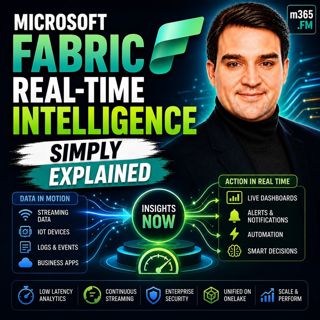
Microsoft Fabric Real-Time Intelligence - Simply Explained

Microsoft Fabric Real-Time Intelligence - Simply Explained

Welcome to another episode of Knowledge Nuggets with Mirko Peters. Today we're exploring Microsoft Fabric Real-Time Intelligence, one of the most exciting workloads inside Microsoft Fabric that enable...

23 Heinä 0s
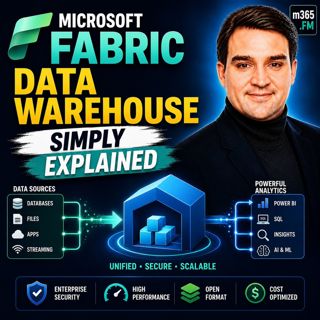
Microsoft Fabric Data Warehouse - Simply Explained

Microsoft Fabric Data Warehouse - Simply Explained

Welcome to another episode of Knowledge Nuggets with Mirko Peters. Today we're exploring Microsoft Fabric Data Warehouse, Microsoft's modern cloud-native data warehouse built as part of the unified Mi...

23 Heinä 0s

Microsoft Fabric Data Factory - Simply Explained

Microsoft Fabric Data Factory - Simply Explained

Moving data has always been one of the most complex parts of building a modern analytics platform. Organizations need to collect information from databases, cloud applications, APIs, files, and enterp...

23 Heinä 0s
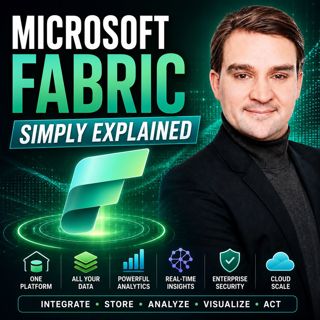
Microsoft Fabric - Simply Explained

Microsoft Fabric - Simply Explained

Data has become one of every organization's most valuable assets—but for many businesses, it's scattered across databases, cloud platforms, business applications, and analytics tools. Microsoft Fabric...

22 Heinä 0s

Suosittua kategoriassa Politiikka ja uutiset

aikalisa
uutiscast
ootsa-kuullut-tasta-2
rss-ootsa-kuullut-tasta
rss-seksicast
rss-vaalirankkurit-podcast
otetaan-yhdet
rss-podme-livebox
politiikan-puskaradio
aihe
rikosmyytit
rss-kovin-paikka
tervo-halme
rss-girls-finish-f1rst
et-sa-noin-voi-sanoo-esittaa
rss-kaikki-uusiksi
rss-varsinaista-puhetta