Microsoft Agent Framework - Simply Explained

Microsoft Agent Framework - Simply Explained

Welcome to another episode of Knowledge Nuggets with Mirko Peters. Today we're exploring the Microsoft Agent Framework, Microsoft's unified development framework for building enterprise-ready AI agents. If you've been following AI over the last year, you've almost certainly heard the word agent. It's everywhere. Blog posts, conference sessions, LinkedIn discussions, Microsoft announcements, and product launches all seem to revolve around AI agents. But ask ten people what an agent actually is, and you'll probably receive ten different answers. Many people assume an agent is simply a chatbot with a more impressive name. In reality, they're fundamentally different. Microsoft created the Agent Framework to solve another growing problem. Developers were forced to choose between multiple AI frameworks, each with different capabilities, APIs, and programming models. Rather than continuing this fragmented approach, Microsoft combined its best technologies into one production-ready framework that makes building intelligent, secure, and enterprise-scale AI agents significantly easier. In this episode, we'll explain what an AI agent really is, why Microsoft built the Agent Framework, how it works, and why it will likely become one of the most important development platforms for the future of enterprise AI.

WHAT IS AN AI AGENT?
Before discussing the framework itself, it's important to understand what actually makes something an AI agent. A traditional chatbot is reactive. You ask a question, it generates an answer, and then waits for the next prompt. Every interaction is largely independent, with the user guiding every step of the conversation. An AI agent works very differently. Instead of simply responding, an agent receives a goal. It reasons about what needs to happen, creates a plan, chooses the appropriate tools, performs the required actions, and only returns once the work has been completed or additional information is required. A useful way to think about the difference is comparing a library receptionist with a personal assistant. A receptionist tells you where a book is located. A personal assistant finds the information, organizes it, prepares a summary, and hands you exactly what you need. Three capabilities separate an AI agent from a chatbot: reasoning, tools, and memory. The language model provides reasoning, tools allow the agent to interact with external systems, and memory enables it to remember previous conversations, preferences, and ongoing work. Together, these capabilities allow agents to complete tasks instead of merely answering questions.

WHY MICROSOFT CREATED THE AGENT FRAMEWORK
Building intelligent agents wasn't always straightforward. Microsoft originally provided Semantic Kernel, which offered enterprise-grade AI integration capabilities, and AutoGen, an experimental framework developed by Microsoft Research for coordinating multiple collaborating agents. Both frameworks were powerful, but they solved different problems. Semantic Kernel focused on stability and enterprise development, while AutoGen explored advanced orchestration and multi-agent collaboration. Developers often had to choose between them while also evaluating numerous third-party frameworks such as LangChain and CrewAI. This fragmented landscape created unnecessary complexity. Every framework introduced different concepts, APIs, programming models, and communities. Microsoft's answer was simple. Rather than maintaining separate frameworks, the company merged Semantic Kernel and AutoGen into one unified development platform known as the Microsoft Agent Framework, providing developers with one consistent way to build production-ready AI agents. This dramatically simplifies learning while giving organizations confidence that they're building upon Microsoft's long-term strategic platform.

WHAT IS THE MICROSOFT AGENT FRAMEWORK?
The Microsoft Agent Framework is an open-source SDK for building intelligent AI agents using enterprise-ready architecture. Released as a production platform after combining Microsoft's previous AI frameworks, it supports both Python and .NET, allowing developers to work in the language they already know. One particularly important advantage is model flexibility. Rather than locking organizations into a single AI provider, the framework supports Azure OpenAI, Azure AI Foundry, OpenAI, Anthropic Claude, Google Gemini, Amazon Bedrock, Ollama, and several additional model providers. Developers write their agent logic once while remaining free to change the underlying language model whenever business requirements evolve. This separation between application logic and AI provider helps organizations avoid vendor lock-in while protecting long-term software investments. The framework is also designed specifically for enterprise environments, incorporating security, governance, observability, approvals, and compliance directly into its architecture rather than requiring custom implementations later.

THE FOUR CORE BUILDING BLOCKS
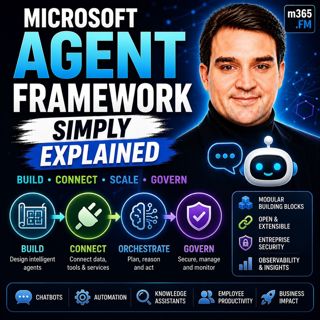
Understanding the framework becomes much easier by focusing on its four primary building blocks. Everything begins with the Agent itself. An agent receives instructions describing its purpose, reasoning capabilities, available tools, and expected behavior. It acts as an intelligent worker responsible for completing specific tasks. The second building block is Tools. Tools allow agents to interact with external systems such as Microsoft Graph, calendars, databases, APIs, weather services, CRM platforms, or business applications. Microsoft also supports the Model Context Protocol (MCP), enabling standardized integration with external services without requiring custom connectors for every system. The third component is Memory. Short-term session memory allows agents to maintain conversations naturally, while long-term context providers preserve information across multiple interactions. This enables agents to remember preferences, previous discussions, and ongoing work rather than treating every conversation as completely new. The final building block is Workflows. Workflows coordinate multiple agents working together through sequential, parallel, or conditional execution patterns. They also support checkpointing and human approval processes, allowing complex business operations to pause for review before continuing automatically.

BUILDING AGENTS FOR THE ENTERPRISE
The Microsoft Agent Framework wasn't designed only for demonstrations or research projects. It was built specifically for enterprise environments. Organizations require far more than intelligent conversations. They need authentication, authorization, auditing, governance, cost management, deployment pipelines, monitoring, and security controls. The framework integrates directly with Microsoft Entra ID for identity management while supporting enterprise governance practices including version-controlled YAML configurations, approval workflows, observability, and CI/CD deployment processes. Developers define agent behavior declaratively, allowing configuration changes to be reviewed, tested, and deployed using the same DevOps practices already used throughout modern software engineering. Rather than creating isolated AI experiments, organizations can manage AI agents using the same enterprise standards applied to every other business application.

HOW IT FITS INTO THE MICROSOFT AI ECOSYSTEM
The Agent Framework represents only one part of Microsoft's broader AI platform. Azure AI Foundry provides the production hosting environment where agents execute securely at scale. Microsoft Copilot Studio offers a low-code alternative that enables business users to create agents visually without writing software. Microsoft 365 Copilot becomes the user-facing experience where employees interact with many of these agents directly inside Teams and Microsoft 365 applications. Meanwhile, Microsoft Work IQ, Foundry IQ, and Fabric IQ provide contextual information from personal productivity data, organizational knowledge, and business analytics, allowing agents to make far more intelligent decisions than traditional chatbots ever could. The Agent Framework connects all these services together, giving developers complete control while still integrating naturally into the wider Microsoft AI ecosystem.

WHY THIS MATTERS FOR ORGANIZATIONS
Many organizations are already experiencing what Microsoft describes as agent sprawl. Departments independently build AI assistants using different platforms, different security models, and different governance practices. Over time this becomes difficult to manage, expensive to maintain, and increasingly risky from a compliance perspective. The Microsoft Agent Framework addresses these challenges by providing a standardized development platform that integrates directly with Microsoft's existing security, governance, and identity services. Organizations gain centralized visibility into their agents, understand operating costs, apply consistent security policies, and ensure sensitive company information remains protected. Instead of preventing employees from adopting AI, IT departments can provide secure enterprise agents that work inside Microsoft Teams and Microsoft 365 using approved organizational data. This balance between innovation and governance is becoming increasingly important as AI adoption accelerates across every business function.

Become a supporter of this podcast: https://www.spreaker.com/podcast/m365-fm-modern-work-security-and-productivity-with-microsoft-365--6704921/support.

Tämä jakso on lisätty Podme-palveluun avoimen RSS-syötteen kautta eikä se ole Podmen omaa tuotantoa. Siksi jakso saattaa sisältää mainontaa.

Jaksot(847)

Agent Governance Explained- How IT Can Enable the AI Agent Revolution with Thomas Zou [Microsoft]

Agent Governance Explained- How IT Can Enable the AI Agent Revolution with Thomas Zou [Microsoft]

Every organization is talking about AI agents, but very few have a strategy for governing them. In this episode of M365.fm, host Mirko Peters sits down with Thomas Zou, Product Marketing Manager for M...

23 Heinä 0s
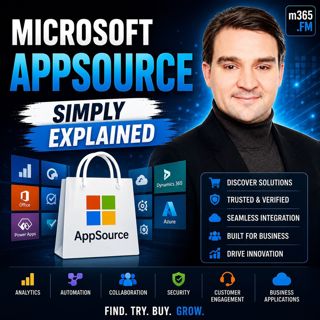
Microsoft AppSource - Simply Explained

Microsoft AppSource - Simply Explained

Welcome to another episode of Knowledge Nuggets with Mirko Peters. Today we're exploring Microsoft AppSource, Microsoft's marketplace for business applications, consulting services, and industry solut...

23 Heinä 0s
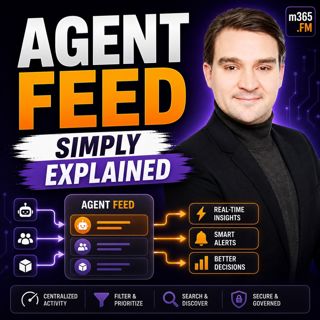
Agent Feed - Simply Explained

Agent Feed - Simply Explained

Welcome to another episode of Knowledge Nuggets with Mirko Peters. Today we're exploring Agent Feed, Microsoft's new supervision experience for AI agents inside Power Apps. As AI agents become capable...

23 Heinä 0s
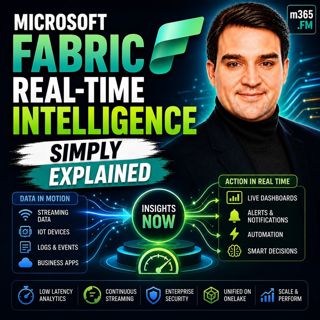
Microsoft Fabric Real-Time Intelligence - Simply Explained

Microsoft Fabric Real-Time Intelligence - Simply Explained

Welcome to another episode of Knowledge Nuggets with Mirko Peters. Today we're exploring Microsoft Fabric Real-Time Intelligence, one of the most exciting workloads inside Microsoft Fabric that enable...

23 Heinä 0s
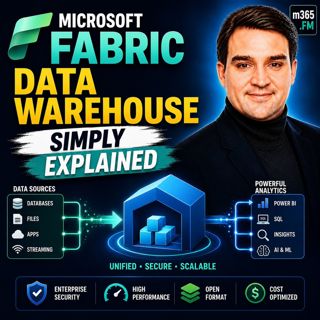
Microsoft Fabric Data Warehouse - Simply Explained

Microsoft Fabric Data Warehouse - Simply Explained

Welcome to another episode of Knowledge Nuggets with Mirko Peters. Today we're exploring Microsoft Fabric Data Warehouse, Microsoft's modern cloud-native data warehouse built as part of the unified Mi...

23 Heinä 0s
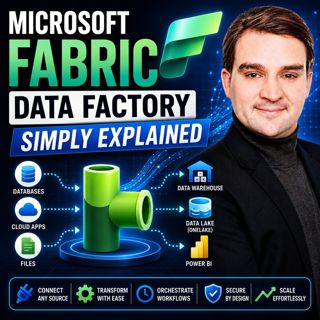
Microsoft Fabric Data Factory - Simply Explained

Microsoft Fabric Data Factory - Simply Explained

Moving data has always been one of the most complex parts of building a modern analytics platform. Organizations need to collect information from databases, cloud applications, APIs, files, and enterp...

23 Heinä 0s
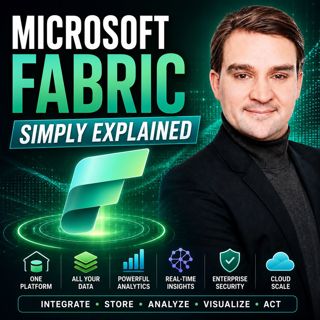
Microsoft Fabric - Simply Explained

Microsoft Fabric - Simply Explained

Data has become one of every organization's most valuable assets—but for many businesses, it's scattered across databases, cloud platforms, business applications, and analytics tools. Microsoft Fabric...

22 Heinä 0s

Suosittua kategoriassa Politiikka ja uutiset

aikalisa
uutiscast
ootsa-kuullut-tasta-2
rss-ootsa-kuullut-tasta
rss-seksicast
rss-vaalirankkurit-podcast
otetaan-yhdet
rss-podme-livebox
politiikan-puskaradio
aihe
rikosmyytit
rss-kovin-paikka
tervo-halme
rss-girls-finish-f1rst
et-sa-noin-voi-sanoo-esittaa
rss-kaikki-uusiksi
rss-varsinaista-puhetta