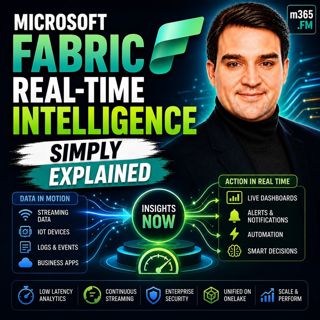
Microsoft Fabric Real-Time Intelligence - Simply Explained

Microsoft Fabric Real-Time Intelligence - Simply Explained

Welcome to another episode of Knowledge Nuggets with Mirko Peters. Today we're exploring Microsoft Fabric Real-Time Intelligence, one of the most exciting workloads inside Microsoft Fabric that enables organizations to analyze, visualize, and act on streaming data the moment it arrives. When most people hear the term real-time analytics, they immediately think of faster Power BI dashboards or reports that refresh every few minutes. While that's certainly part of the story, it misses the real purpose of Real-Time Intelligence. This workload isn't about making traditional reporting faster—it's about shortening the time between an event occurring and the business taking action. Whether it's detecting equipment failures, preventing fraud, monitoring live inventory, or responding to IoT sensor data, Real-Time Intelligence allows organizations to react within seconds instead of hours. In this episode, we'll explain what Real-Time Intelligence actually is, explore its four major building blocks, understand how it differs from traditional batch analytics, and discover when real-time processing truly delivers business value. FROM BATCH PROCESSING TO REAL-TIME DECISIONS Traditional business analytics has always relied on batch processing. Data is collected throughout the day, stored inside databases, transformed overnight, and finally appears in reports the next morning. For many business scenarios—monthly sales reporting, financial analysis, marketing performance, or executive dashboards—this approach works perfectly well because the data remains valuable even hours or days after it was created. However, some information loses value almost immediately. Imagine a production machine beginning to overheat. Waiting until tomorrow's report means the equipment may already have failed. A stolen credit card used for a fraudulent purchase must be detected immediately—not during tomorrow's financial reconciliation. A refrigerated delivery truck carrying food needs instant monitoring because waiting even thirty minutes may result in spoiled products and significant financial loss. The key difference isn't simply speed. Batch analytics answers questions about what happened, while Real-Time Intelligence enables organizations to react to what is happening right now. Instead of waiting for someone to review a dashboard, the platform continuously monitors incoming events and immediately triggers actions whenever predefined conditions occur. That shift from reporting to action is what defines Real-Time Intelligence. WHAT IS MICROSOFT FABRIC REAL-TIME INTELLIGENCE? Microsoft Fabric Real-Time Intelligence is a collection of services designed to ingest, process, analyze, visualize, and respond to streaming data continuously. Rather than existing as a separate Azure solution requiring multiple independent services, Microsoft combines proven technologies such as Azure Event Hubs, Azure Stream Analytics, and Azure Data Explorer into a unified experience directly inside Microsoft Fabric. A useful analogy is to imagine a traditional database as a library where information waits patiently on shelves until someone comes looking for it. Real-Time Intelligence is completely different. Instead of a library, imagine an airport control tower constantly monitoring incoming flights. Information never stops arriving. The system watches every event, analyzes each situation, and immediately responds whenever action becomes necessary. Streaming data flows continuously through the platform rather than waiting inside storage until someone decides to query it later. Because Real-Time Intelligence is fully integrated with OneLake, Power BI, Spark, notebooks, and every other Fabric workload, organizations no longer need to stitch together multiple Azure services manually to build enterprise streaming solutions. BUILDING BLOCK ONE: EVENTSTREAMS Everything begins with Eventstreams. An Eventstream serves as the entry point for streaming data entering Microsoft Fabric. Whether information originates from IoT sensors, Azure Event Hubs, Kafka clusters, SQL databases, PostgreSQL, Cosmos DB, REST APIs, or custom business applications, Eventstreams provide a unified ingestion pipeline that brings everything into Fabric. Microsoft currently supports dozens of connectors, allowing organizations to begin collecting live information with very little custom development. Once events begin arriving, Eventstreams can immediately process the data while it is still moving. Incoming events can be filtered, transformed, enriched, aggregated, or validated before they reach downstream systems. Developers who prefer SQL can process events using familiar query syntax, while business users benefit from visual drag-and-drop processing experiences requiring little or no coding. Instead of simply transporting information, Eventstreams become intelligent pipelines that prepare streaming data for analytics before it ever reaches permanent storage. This dramatically simplifies the creation of modern streaming architectures while reducing the need for custom integration code. BUILDING BLOCK TWO: EVENTHOUSE Once streaming events arrive, they need somewhere to live. That's the responsibility of Eventhouse. Built on Microsoft's proven Kusto engine, Eventhouse is optimized specifically for enormous volumes of streaming information. Rather than handling thousands of business transactions like a traditional SQL database, Eventhouse is designed to ingest billions of events while still delivering sub-second query performance. Unlike relational databases that require carefully designed schemas before loading data, Eventhouse comfortably handles JSON, telemetry, logs, sensor information, and rapidly changing data structures without constant redesign. Another significant advantage is automatic indexing. Instead of requiring database administrators to tune indexes manually, Eventhouse automatically optimizes incoming data as it arrives, allowing organizations to focus on analytics rather than database maintenance. Organizations can also expose Eventhouse data through OneLake, making streaming information immediately available for Spark notebooks, historical analytics, Power BI, and every other Microsoft Fabric workload without additional copying or synchronization. This combination of speed, scalability, and integration makes Eventhouse the analytical engine behind Real-Time Intelligence. BUILDING BLOCK THREE: REAL-TIME DASHBOARDS Collecting and storing live information is valuable, but organizations also need to understand what's happening as events unfold. Real-Time Dashboards provide exactly that capability. Unlike traditional Power BI reports that refresh according to scheduled intervals, Real-Time Dashboards update automatically as new events enter Eventhouse. Charts, maps, tables, and visual indicators change continuously without requiring users to manually refresh reports or wait for scheduled dataset updates. This makes Real-Time Dashboards particularly valuable for operational monitoring scenarios such as manufacturing facilities, logistics operations, transportation systems, security monitoring, retail environments, and smart buildings. Because dashboards query Eventhouse directly, organizations receive immediate visibility into live operational conditions while still maintaining access to Power BI whenever deeper historical analysis becomes necessary. Rather than replacing Power BI, Real-Time Dashboards complement it by focusing specifically on operational awareness and continuous monitoring. BUILDING BLOCK FOUR: ACTIVATOR Perhaps the most powerful capability within Real-Time Intelligence is Activator. Instead of simply displaying information, Activator watches streaming events continuously and automatically performs actions whenever specified conditions occur. Imagine a temperature sensor exceeding forty degrees, a payment transaction appearing suspicious, or a manufacturing machine beginning to vibrate outside normal operating ranges. Rather than expecting employees to notice these situations manually, Activator immediately detects the condition and responds automatically. Actions might include sending Microsoft Teams notifications, triggering Power Automate workflows, launching Fabric pipelines, executing notebooks, calling external APIs, or generating business events for additional downstream processing. Activator also includes anomaly detection capabilities that learn historical patterns and automatically identify unusual behavior without requiring organizations to build complex machine learning models. This transforms Real-Time Intelligence from a monitoring platform into an automated operational decision engine capable of responding continuously without human intervention. WHEN SHOULD YOU USE REAL-TIME INTELLIGENCE? One of the biggest mistakes organizations make is assuming every analytics workload needs real-time processing. In reality, real-time should be reserved for situations where immediate action creates measurable business value. Monitoring industrial equipment, detecting financial fraud, tracking logistics, monitoring cybersecurity events, managing IoT devices, supervising healthcare systems, and responding to live operational incidents are excellent candidates because delays directly increase business risk. On the other hand, monthly financial reporting, quarterly business reviews, employee performance dashboards, marketing analysis, and long-term trend reporting rarely require millisecond responses. Real-Time Intelligence complements traditional analytics rather than replacing it. Many organizations adopt a hybrid architecture where streaming data supports immediate operational decisions while historical information continues flowing into OneLake for long-term reporting, Power BI dashboards, Spark analytics, and AI workloads. Choosing the correct architecture depends entirely on how quickly the business must respond once new information arrives. HOW REAL-TIME INTELLIGENCE FI

Become a supporter of this podcast: https://www.spreaker.com/podcast/m365-fm-modern-work-security-and-productivity-with-microsoft-365--6704921/support.

Tämä jakso on lisätty Podme-palveluun avoimen RSS-syötteen kautta eikä se ole Podmen omaa tuotantoa. Siksi jakso saattaa sisältää mainontaa.

Jaksot(847)

Agent Governance Explained- How IT Can Enable the AI Agent Revolution with Thomas Zou [Microsoft]

Agent Governance Explained- How IT Can Enable the AI Agent Revolution with Thomas Zou [Microsoft]

Every organization is talking about AI agents, but very few have a strategy for governing them. In this episode of M365.fm, host Mirko Peters sits down with Thomas Zou, Product Marketing Manager for M...

23 Heinä 0s
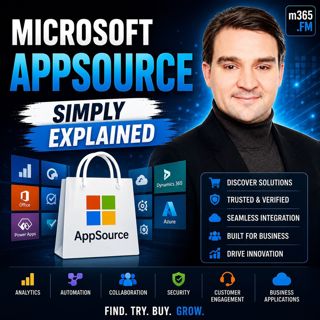
Microsoft AppSource - Simply Explained

Microsoft AppSource - Simply Explained

Welcome to another episode of Knowledge Nuggets with Mirko Peters. Today we're exploring Microsoft AppSource, Microsoft's marketplace for business applications, consulting services, and industry solut...

23 Heinä 0s
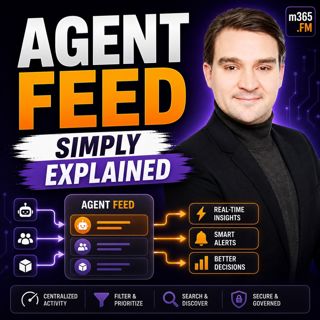
Agent Feed - Simply Explained

Agent Feed - Simply Explained

Welcome to another episode of Knowledge Nuggets with Mirko Peters. Today we're exploring Agent Feed, Microsoft's new supervision experience for AI agents inside Power Apps. As AI agents become capable...

23 Heinä 0s
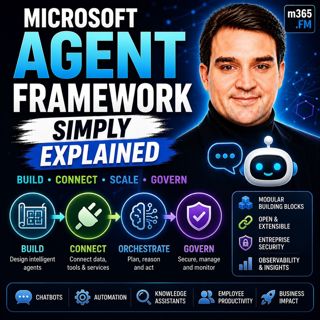
Microsoft Agent Framework - Simply Explained

Microsoft Agent Framework - Simply Explained

Welcome to another episode of Knowledge Nuggets with Mirko Peters. Today we're exploring the Microsoft Agent Framework, Microsoft's unified development framework for building enterprise-ready AI agent...

23 Heinä 0s
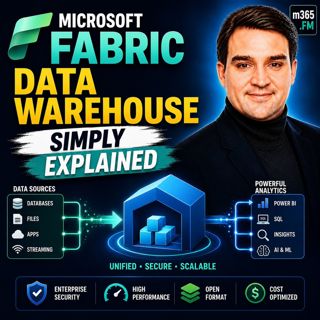
Microsoft Fabric Data Warehouse - Simply Explained

Microsoft Fabric Data Warehouse - Simply Explained

Welcome to another episode of Knowledge Nuggets with Mirko Peters. Today we're exploring Microsoft Fabric Data Warehouse, Microsoft's modern cloud-native data warehouse built as part of the unified Mi...

23 Heinä 0s
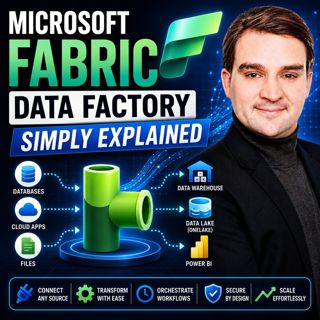
Microsoft Fabric Data Factory - Simply Explained

Microsoft Fabric Data Factory - Simply Explained

Moving data has always been one of the most complex parts of building a modern analytics platform. Organizations need to collect information from databases, cloud applications, APIs, files, and enterp...

23 Heinä 0s
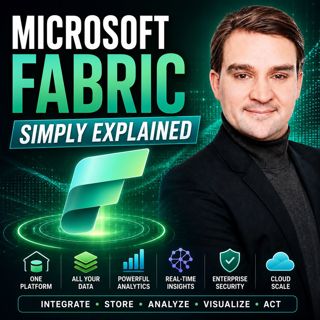
Microsoft Fabric - Simply Explained

Microsoft Fabric - Simply Explained

Data has become one of every organization's most valuable assets—but for many businesses, it's scattered across databases, cloud platforms, business applications, and analytics tools. Microsoft Fabric...

22 Heinä 0s

Suosittua kategoriassa Politiikka ja uutiset

aikalisa
uutiscast
ootsa-kuullut-tasta-2
rss-ootsa-kuullut-tasta
rss-seksicast
rss-vaalirankkurit-podcast
otetaan-yhdet
rss-podme-livebox
politiikan-puskaradio
aihe
rikosmyytit
rss-kovin-paikka
tervo-halme
rss-girls-finish-f1rst
et-sa-noin-voi-sanoo-esittaa
rss-kaikki-uusiksi
rss-varsinaista-puhetta