
#126 – Bryan Caplan on whether lazy parenting is OK, what really helps workers, and betting on beliefs

#126 – Bryan Caplan on whether lazy parenting is OK, what really helps workers, and betting on beliefs

Everybody knows that good parenting has a big impact on how kids turn out. Except that maybe they don't, because it doesn't.

Incredible though it might seem, according to today's guest — economist Bryan Caplan, the author of Selfish Reasons To Have More Kids, The Myth of the Rational Voter, and The Case Against Education — the best evidence we have on the question suggests that, within reason, what parents do has little impact on how their children's lives play out once they're adults.

Links to learn more, summary and full transcript.

Of course, kids do resemble their parents. But just as we probably can't say it was attentive parenting that gave me my mother's nose, perhaps we can't say it was attentive parenting that made me succeed at school. Both the social environment we grow up in and the genes we receive from our parents influence the person we become, and looking at a typical family we can't really distinguish the impact of one from the other.

But nature does offer us up a random experiment that can let us tell the difference: identical twins share all their genes, while fraternal twins only share half their genes. If you look at how much more similar outcomes are for identical twins than fraternal twins, you see the effect of sharing 100% of your genetic material, rather than the usual 50%. Double that amount, and you've got the full effect of genetic inheritance. Whatever unexplained variation remains is still up for grabs — and might be down to different experiences in the home, outside the home, or just random noise.

The crazy thing about this research is that it says for a range of adult outcomes (e.g. years of education, income, health, personality, and happiness), it's differences in the genes children inherit rather than differences in parental behaviour that are doing most of the work. Other research suggests that differences in “out-of-home environment” take second place. Parenting style does matter for something, but it comes in a clear third.

Bryan is quick to point out that there are several factors that help reconcile these findings with conventional wisdom about the importance of parenting.

First, for some adult outcomes, parenting was a big deal (i.e. the quality of the parent/child relationship) or at least a moderate deal (i.e. drug use, criminality, and religious/political identity).

Second, parents can and do influence you quite a lot — so long as you're young and still living with them. But as soon as you move out, the influence of their behaviour begins to wane and eventually becomes hard to spot.

Third, this research only studies variation in parenting behaviour that was common among the families studied.

And fourth, research on international adoptions shows they can cause massive improvements in health, income and other outcomes.

But the findings are still remarkable, and imply many hyper-diligent parents could live much less stressful lives without doing their kids any harm at all. In this extensive interview Rob interrogates whether Bryan can really be right, or whether the research he's drawing on has taken a wrong turn somewhere.

And that's just one topic we cover, some of the others being:

• People’s biggest misconceptions about the labour market
• Arguments against open borders
• Whether most people actually vote based on self-interest
• Whether philosophy should stick to common sense or depart from it radically
• Personal autonomy vs. the possible benefits of government regulation
• Bryan's perfect betting record
• And much more

Chapters:

  • Rob’s intro (00:00:00)
  • The interview begins (00:01:15)
  • Labor Econ Versus the World (00:04:55)
  • Open Borders (00:20:30)
  • How much parenting matters (00:35:49)
  • Self-Interested Voter Hypothesis (01:00:31)
  • Why Bryan and Rob disagree so much on philosophy (01:12:04)
  • Libertarian free will (01:25:10)
  • The effective altruism community (01:38:46)
  • Bryan’s betting record (01:48:19)
  • Individual autonomy vs. welfare (01:59:06)
  • Arrogant hedgehogs (02:10:43)

Producer: Keiran Harris
Audio mastering: Ben Cordell
Transcriptions: Katy Moore

Jaksot(325)

#35 - Tara Mac Aulay on the audacity to fix the world without asking permission

#35 - Tara Mac Aulay on the audacity to fix the world without asking permission

"You don't need permission. You don't need to be allowed to do something that's not in your job description. If you think that it's gonna make your company or your organization more successful and mor...

21 Kesä 20181h 22min

Rob Wiblin on the art/science of a high impact career

Rob Wiblin on the art/science of a high impact career

Today's episode is a cross-post of an interview I did with The Jolly Swagmen Podcast which came out this week. I recommend regular listeners skip to 24 minutes in to avoid hearing things they already ...

8 Kesä 20181h 31min

#34 - We use the worst voting system that exists. Here's how Aaron Hamlin is going to fix it.

#34 - We use the worst voting system that exists. Here's how Aaron Hamlin is going to fix it.

In 1991 Edwin Edwards won the Louisiana gubernatorial election. In 2001, he was found guilty of racketeering and received a 10 year invitation to Federal prison. The strange thing about that election?...

1 Kesä 20182h 18min

#33 - Anders Sandberg on what if we ended ageing, solar flares & the annual risk of nuclear war

#33 - Anders Sandberg on what if we ended ageing, solar flares & the annual risk of nuclear war

Joseph Stalin had a life-extension program dedicated to making himself immortal. What if he had succeeded?  According to our last guest, Bryan Caplan, there’s an 80% chance that Stalin would still be ...

29 Touko 20181h 24min
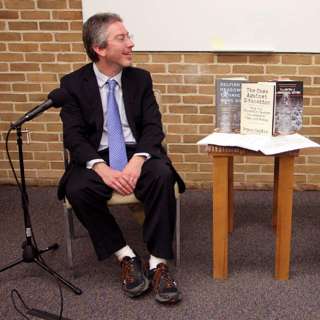
#32 - Bryan Caplan on whether his Case Against Education holds up, totalitarianism, & open borders

#32 - Bryan Caplan on whether his Case Against Education holds up, totalitarianism, & open borders

Bryan Caplan’s claim in *The Case Against Education* is striking: education doesn’t teach people much, we use little of what we learn, and college is mostly about trying to seem smarter than other peo...

22 Touko 20182h 25min

#31 - Allan Dafoe on defusing the political & economic risks posed by existing AI capabilities

#31 - Allan Dafoe on defusing the political & economic risks posed by existing AI capabilities

The debate around the impacts of artificial intelligence often centres on ‘superintelligence’ - a general intellect that is much smarter than the best humans, in practically every field. But according...

18 Touko 201848min

#30 - Eva Vivalt on how little social science findings generalize from one study to another

#30 - Eva Vivalt on how little social science findings generalize from one study to another

If we have a study on the impact of a social program in a particular place and time, how confident can we be that we’ll get a similar result if we study the same program again somewhere else? Dr Eva V...

15 Touko 20182h 1min

#29 - Anders Sandberg on 3 new resolutions for the Fermi paradox & how to colonise the universe

#29 - Anders Sandberg on 3 new resolutions for the Fermi paradox & how to colonise the universe

Part 2 out now: #33 - Dr Anders Sandberg on what if we ended ageing, solar flares & the annual risk of nuclear war The universe is so vast, yet we don’t see any alien civilizations. If they exist, whe...

8 Touko 20181h 21min

Suosittua kategoriassa Koulutus

rss-murhan-anatomia
voi-hyvin-meditaatiot-2
rss-narsisti
adhd-podi
psykopodiaa-podcast
rss-rahamania
rss-uskonto-on-tylsaa
rss-valo-minussa-2
mielipaivakirja
rss-vapaudu-voimaasi
rss-niinku-asia-on
rss-duodecim-lehti
rahapuhetta
ilona-rauhala
aamukahvilla
aloita-meditaatio
kesken
dear-ladies
rss-eron-alkemiaa
rss-arkea-ja-aurinkoa-podcast-espanjasta