15-year-old Chloe Amen Reveals Strategies on how to "Change Your Brain, Change Your Grades"

15-year-old Chloe Amen Reveals Strategies on how to "Change Your Brain, Change Your Grades"

Welcome back to the “Neuroscience Meets SEL Podcast” this is Andrea Samadi. This interview will be broadcast on YouTube as well as on the regular podcast channel, so be sure to look for the YouTube link in the show notes if you would like to view the video.

Today I want to welcome our special guest, Chloe Amen. If you follow Tana and Dr. Daniel Amen’s work on their Brain Warrior’s Way Podcast[i], she doesn’t need an introduction, because the past couple of weeks she’s been speaking about the soon to be released book that was written by her Dad, Dr. Daniel Amen, who draws on his experience as a neuroscientist and psychiatrist as well as the latest brain science to help you study more effectively, learn faster, and understand how your brain works to optimize results (whether we are talking about academic results or results in the boardroom) they both begin with an understanding of our brain. Chloe and her cousin Alizé Castellanos are major contributors to this book, offering modern day strategies that students and adults will relate to (Coming Sept 17th…you can pre-order it on AMAZON)[ii] “Change Your Brain, Change Your Grades.”

Here’s more about Chloe so you can see the vast experience that has led her to be an expert and role model for others in this field at such a young age.

Chloe Amen, now a junior in high school (a straight A student who has just finished sophomore classes) has been a part of the National Honor Society for the past three years. She was a guest star on the popular public television show Feel Better Fast[iii] (with Dr. Daniel Amen), and contributor and guest star in the high school program Brain Thrive by Twenty Five,[iv] which is designed to help teens improve brain function and performance. (This is the most thorough and engaging online course that I have ever taken, teaching the theories of brain development as it relates to life success) and has been used in forward thinking schools looking to give their students the leading edge that comes with these strategies. She is an intern for the Mayor’s Youth Council of Newport Beach, which participates in local government and community service. Chloe also has a passion for service and is an active volunteer for Girls Inc., an afterschool girl’s empowerment program. Chloe has a passion for performing arts, where she is currently pursuing a career. Volunteering at church in activities such as student leadership and campus cleanup has been an ongoing devotion. With her free time Chloe enjoys practicing martial arts, dance, songwriting and singing, and the arts. In elementary and early junior high, Chloe struggled with anxiety and organization which affected her academic performance. Through the techniques she has learned and shared in Change Your Brain, Change Your Grades, she has transformed her mindset and work ethic. As a result, she now has a 4.0 GPA and thoroughly enjoys learning.

Welcome Chloe! It’s an honor to have you here today.

Q1: Can you give us some background of growing up with brain strategies infused into your household and how you got involved with the modern version of this book, Change Your Brain, Change Your Life?

Before your involvement with this new book, that’s coming out September 17th, you were already actively involved with helping others understand the power involved with their brain’s function as it relates to achievement. I took the Brain Thrive by 25 Course[v] at least 2 years ago, so am I correct to say that you were 13 when you filmed that? One of the biggest lessons I learned from watching you in the teen panel of was that your brain is not fully developed until age 25 for females and 28 for males.

Q2: Can you give us some thoughts of how this fact has changed your decision-making process and perhaps some thoughts of things you know you will do differently with this knowledge as a young adult? Chloe mentions that she has always been taught to make decisions with her brain health in mind being raised by Dr. Daniel Amen and Tana Amen, leaders and pioneers in this industry.[vi]

Q3: Let’s talk about this NEW book “Change Your Brain, Change Your Grades” that is not just for students. It also contains tips and strategies that can be applicable for anyone looking to improve their results in life (how to get a raise at work)…it’s about learning new things to make yourself more valuable. What interested you to get involved with writing and adding tips into the newer version of this book?

Q4: When it comes to study habits, organization, productivity and results, there’s a knack for finding the right balance that can set you up for success in life…or failure. Can you explain the 3 brain types that “Change Your Brain, Change Your Grades” outlines? What’s your brain type? What are the other types so listeners can figure out what their brain type might be, whether they are a student in the classroom, or an adult looking for a competitive advantage?

Q5: I remember one of my mentors always quoting that “Fear of public speaking is America’s biggest phobia—before death (that’s at #5) meaning that many of us would rather die than make a fool of ourselves in front of others. What tips do you have for public speaking, with the brain in mind? Can you cover why practice before a presentation is so important?

Q6: Nutrition plays a huge role in determining success in the classroom, as well as the boardroom. For those who have not been following your parents’ work, (on the Brain Warrior’s Way Podcast) can you give some tips on how you began to implement healthy nutrition into your life for improved results? Can you talk a bit about how you handle this as a teen when all your friends might be choosing less healthy food options? How did understanding your brain type help you to choose the best diet to optimize your productivity and results?

Q7: With social media emerging as a means of communication the past 22 years with AOL messenger being my first memory of online communication starting in 1997 (a bit before you were born) the world is so different now for teens growing up using technology and social media. How has not taking things personally helped you at age 15 and how do you stay focused on your academics/away from drama that can emerge online?

Q8: Any final thoughts/tips on how you can “Change Your Brain, Change Your Grades” that we might have missed.

Thank you for taking the time out of your Monday that I know includes school work and many other activities to speak with us today. I think you are brilliant beyond your years and I just wish I had an understanding of this information when I was 15. I’m looking forward to the release of this book and what you will create next.

REFERENCES:

[i] https://brainwarriorswaypodcast.com/

[ii] https://www.amazon.com/Change-Your-Brain-Grades-Science-Based/dp/1948836858/ref=sr_1_1?keywords=change+your+brain+change+your+grades&qid=1565049736&s=gateway&sr=8-1

[iii] https://www.kpbs.org/news/2019/mar/18/feel-better-fast-and-make-it-last-daniel-amen-md/

[iv] https://www.brainmdhealth.com/brainthriveby25

[v] https://www.brainmdhealth.com/brainthriveby25

[vi] http://danielamenmd.com/

Tämä jakso on lisätty Podme-palveluun avoimen RSS-syötteen kautta eikä se ole Podmen omaa tuotantoa. Siksi jakso saattaa sisältää mainontaa.

Jaksot(405)

Trust as the Foundation with Greg Hill: How Great Leaders Create the Conditions for Learning, Growth and Performance

Trust as the Foundation with Greg Hill: How Great Leaders Create the Conditions for Learning, Growth and Performance

In episode 401 Andrea Samadi welcomes Greg Hill to explore why trust is the essential foundation for learning, growth, and high performance. They discuss how trust creates psychological safety, encour...

27 Kesä 37min

Episode 400: Sales Leadership Under Pressure with Majid Samadi: 7 Lessons Learned from 7 Years of Neuroscience

Episode 400: Sales Leadership Under Pressure with Majid Samadi: 7 Lessons Learned from 7 Years of Neuroscience

In this milestone episode (400), Andrea Samadi celebrates seven years of the Neuroscience Meets SEL Podcast with her husband Majid Samadi. They reflect on the journey of translating neuroscience into ...

20 Kesä 47min

Phase 2 Review: The Motivation Loop: How to Keep Effort Worthwhile

Phase 2 Review: The Motivation Loop: How to Keep Effort Worthwhile

Episode 399 reviews Phase 2 of Season 15 and introduces the Motivation Loop — the sequence of meaning, belief, attention, action, reward, and recovery that drives sustained effort. The episode explain...

14 Kesä 28min

Fun, Fear, Focus: Closing the Motivation Loop with Friederike Fabritius

Fun, Fear, Focus: Closing the Motivation Loop with Friederike Fabritius

Episode 398 revisits neuroscientist Friederike Fabritius (from November 2022) to explain how three ingredients — fun (dopamine), fear (productive challenge), and focus — create the neurochemical condi...

9 Kesä 23min

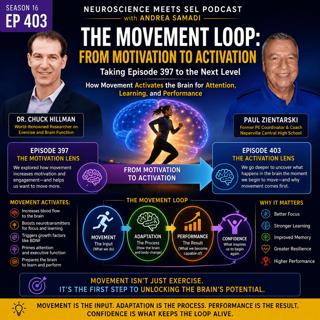
Move to Learn: How Movement Activates the Brain and Fuels Motivation (with Dr. Chuck Hillman and Paul Zientarski)

Move to Learn: How Movement Activates the Brain and Fuels Motivation (with Dr. Chuck Hillman and Paul Zientarski)

Season 15, Episode 397 revisits research and real-world practice showing movement is more than fitness: it activates the brain, boosts attention, enhances learning, and sustains motivation. Dr. Chuck ...

31 Touko 35min

Dopamine, Motivation and Why the Brain Repeats Behavior with Dr. Anna Lembke

Dopamine, Motivation and Why the Brain Repeats Behavior with Dr. Anna Lembke

Host Andrea Samadi welcomes Dr. Anna Lembke to explain how pleasure and pain share the same neural circuitry and how dopamine governs motivation. The episode explores why overconsumption of easy rewar...

24 Touko 23min

Theory of Mind: The Missing Link Between Attention, Reward, and Motivation with John Medina

Theory of Mind: The Missing Link Between Attention, Reward, and Motivation with John Medina

Episode 395 explores how theory of mind — our ability to understand others' intentions — drives attention, emotional relevance, and reward, shaping motivation and behavior. Dr. John Medina explains wh...

17 Touko 37min

Thought Patterns & Neurochemistry — The Hidden Drivers of Your Life (Revisiting Dr. Caroline Leaf)

Thought Patterns & Neurochemistry — The Hidden Drivers of Your Life (Revisiting Dr. Caroline Leaf)

In this episode Andrea Samadi revisits her October 2022 interview with Dr. Caroline Leaf about how our thought patterns act as biological instructions that shape brain chemistry, behavior, and results...

26 Huhti 25min

Suosittua kategoriassa Koulutus

rss-murhan-anatomia
psykopodiaa-podcast
rss-narsisti
rss-liian-kuuma-peruna
rss-arkea-ja-aurinkoa-podcast-espanjasta
voi-hyvin-meditaatiot-2
kesken
rahapuhetta
adhd-podi
filocast-filosofian-perusteet
jari-sarasvuo-podcast
rss-psykalab
rss-valo-minussa-2
rss-vuosikymmenen-ilmastoteko
rss-vapaudu-voimaasi
rss-niinku-asia-on
psykologia
ihminen-tavattavissa-tommy-hellsten-instituutti
rss-tripsteri
rss-positiivisesti-vittumainen