Brain Network Theory: Using Neuroscience to Stay Productive During Times of Change and Chaos

Brain Network Theory: Using Neuroscience to Stay Productive During Times of Change and Chaos

This is episode #48. Welcome to the Neuroscience Meets Social and Emotional Learning podcast, my name is Andrea Samadi, I’m a former educator whose been fascinated with understanding the science behind high performance strategies in schools, sports and the workplace for the past 20 years. I’ve always loved this quote, and it just seems relevant today.

“In a time of drastic change, (like our world today) it is the learners who inherit the future. The learned (those who think they know it all) usually find themselves beautifully equipped to live in a world that no longer exists.” (Eric Hoffer, Philosopher)

Today’s episode will focus on some strategies to help you to remain productive at work, whether you are working from home, or home schooling your children, AND working, let’s take a look at some evidence-based strategies with the application of the most current, fascinating brain research to help you to stay focused, so when all of this chaos that’s happening in our world today comes to an end, (because it will) you will emerge as stronger, more efficient and knowledgeable, with perhaps a different outlook of some new and improved ways of living your life. I just learned some new ways of thinking from Jim Bunch, who is known as “The Ultimate Life Entrepreneur” –he spent years working side-by-side with Tony Robbins. Jim’s mission is to inspire happiness, health, and wealth worldwide. He is the founder of The Ultimate Game of Life app[i] that I have been using for the past 504 days. I’m counting only because my plan was to use the app for 30 days to recover from a surgery and get my workouts back on track—and 504 days later, I realized there was much more to the app than meets the eye. This week, Jim was talking about some new ways of thinking and reminded us that during these strange times, you’ll notice some things that you have been doing that give you energy and make you stronger.[ii] Think about what they are and amplify those activities. Do more of what gives you energy, and less of what is draining. You’ll notice some things that are becoming obsolete in your life. Notice them and take note of what is replacing them. Are these new ways better than the old way? Be aware of your new way of living and see what you can learn from this time to improve life when it returns to its new normal. What will you keep doing more of, and what will you think about changing or deleting? What new strategies and knowledge can you gain? This can be a powerful time of renewal.

Brain Network Theory: The New Brain Science of Reducing Stress

Before we dive deep into this week’s episode, let’s take a closer look at the new brain science of overcoming stress and avoiding work burnout called Brain Network Theory—that we should all be aware of to increase positivity, reduce stress and anxiety and increase our work productivity and results. Remember, just like Theory of Mind from EPISODE 46[iii], this is also a theory. Brain Network Theory is now being talked about all over the place, so if you follow the most current neuroscience research, I’m sure you will have heard about it. There are many books being written on this NEW Brain Network Theory (I’ve mentioned Dr. Srini Pillay and his book about the power of the unfocused mind in past episodes). I’ve been working closely with Mark Waldman (from EPISODE 30)[iv] this past week and know that applying Brain Network Theory to our life at this point in time can be powerful. With any theory, just keep an open mind, listen to the ideas, and see how they can fit into your life.

So what is Brain Network Theory? If you were to go to www.pubmed.gov and search for the most recent studies on the brain, instead of looking at different parts of the brain, like we used to do, we now know and study different networks in the brain to gain understanding, and we can measure and see the activity in each of these brain networks. Some people use fMRI scans, others use SPECT image scans, but I am sure you have seen these images that show how different parts of our brain light up when we are doing different things. You will no longer see studies that talk only about the individual parts of the brain—like the thalamus or hippocampus, you will now see images that describe brain networks, nodes and connectivity. This is a fascinating discovery that comes to life with these images. Just imagine, at any particular time, you might be resting, thinking or daydreaming and a different network in your brain will light up.

We have hundreds of these networks, but most of them are non-conscious (we are not aware of them). We are only going to talk about 3 of these networks for this strategy of increasing productivity. I will include an image in the show notes (that is so far the ONLY visual created on Brain Network Theory) that can be used as a tool for those of us who, like me, prefer a visual of what we are learning. Think of this image as a map or a tool that you can use to organize the networks. Let’s take a look at these 3 Networks so you can start to use and apply Brain Network Theory in your daily life.

IMAGE: © 2019 Mark Robert Waldman and Monica Evason

We have the Default Mode Network, (imagination processes like daydreaming, creative problem solving, and mind wandering. This area is significantly larger than the other networks possibly because it develops so early in life and plays such an important role in child and brain development). Marty Seligman, the founder of positive psychology calls this the Imagination Network (because who would ever remember Default Mode Network anyway) and involves those thought processes that can include worry, doubts and fears like “don’t try that, it didn’t work out last time” and so on. Swiss Psychologist Piaget called this “inner speech” that can be positive or negative, depending on what you are thinking. This network is important to tap into, as it also contains your ability for creative problem solving, so it doesn’t just contain our worries and fears, but our ability to move past them. We just need to be mindful of what we are thinking about, to prevent the negativity bias from taking over our mind (when we get stuck ruminating on negative thoughts instead of positive creative thoughts). Be sure that we are thinking positive thoughts, so we don’t default into this negative cycle of thinking. This takes practice, but with time, does become a habit and so does the ability to tap into the creative mind-wandering zone to solve problems. If you have ever stepped away from your desk to take a break and got an instant flash of insight to add something else to your presentation, this is the Imagination Network at work. I’ve also talked about the Default Mode Network in other episodes, as Einstein used it when he created his Theory of Relativity that came to him first in a dream, through his imagination, and then he moved these ideas into the next Network.

Next we have the Central Executive Network (which holds our conscious decision-making processes like thinking, planning, concentration, taking action in an organized way and focused attention). This area is in our prefrontal cortex and is also known as our Executive Functions—all of our task-oriented thoughts. If we are NOT performing a task, and do NOT have focused attention, this area turns off, and we can go into the Imagination Network into daydreaming, worrying or creating, depending on what we are allowing into our thoughts. When this network is turned on, when we are working and using our focused attention, and the Imagination Network is turned off. We can only be in one network at a time. That’s why it is so important to take breaks to prevent burnout, and to allow for creative thoughts to flow into your mind when working on difficult tasks.

Finally, there’s the Salience Network that doesn’t fully develop until we are around 28-30 years old, (which holds our awareness, intuition and compassion processes that integrate and stabilize the other two networks helping us to develop social awareness, empathy and our values). This network puts the importance of what we are thinking, weighs what is important, and helps to balance the other networks.

To benefit from Brain Network Theory, we should all develop a deeper understanding of how to go back and forth between the Imagination or Default Mode Network and Central Executive Network of focused attention so that we are using our focused attention for a bit, and then taking a break to allow for creativity. By taking breaks from our focused work and using mindful awareness where we become aware of our thoughts and feelings in the present moment, and observe them without judgement, like Jon Kabat Zinn[v], American professor and founder of the Center of Mindfulness in Medicine suggests, we will be at our highest level of productivity.

How to Apply Brain Network Theory at Work:

Imagine you are working on a presentation, and you have been at your desk for an hour, the most current brain research says that you must learn to give your brain a break at least for one minute each hour. I’m sure you’ve heard this before. We know our brain needs breaks. If you are able to set a timer on your phone to remind you to get up, stand, stretch, walk around, get a glass of water, go outside for a minute, when you return to your desk to work, you will feel refreshed and will be better prepared mentally to continue your focused attention on completing your work. Think about the map, and that you must jump from the thinking/focused central executive network, (in your prefrontal cortex) to the imagination default mode network (with rest) to achieve the balance you need in the salience network where stabilization takes place. When you finish your presentation, you should feel energized and not drained.

Applying Brain Network Theory with your Children While Working from Home:

A quick glance at my social networks today and I have seen countless images of families who are on day 1 of working with their children from home while schools are closed due to the corona virus pandemic. I have seen posts from good friends saying things like, “I’m not sure what I am doing, I’m lost on how to make a lesson plan and looking for ways to make our days filled with wonder and excitement.” If you can relate, I sure can, so be sure to listen to EPISODE 47 with Erik Francis on “Transitioning Teaching and Learning in the Classroom to the Home.”[vi] He offers some stress free strategies on working with our children at home, while sticking to educational pedagogy in the classroom. We are going to try some of Erik’s strategies a bit later today, and I will be sure to post how they go.

Just remember, when we are asking our children to give their focused attention, think about Brain Network Theory. Focus will cause brain fatigue, and too much of it depletes your brain of glucose and depletes you. Be sure to allow your children the time to shift back to their Imagination network so they can gain insights that are impossible during focused times. Allow them time to get up, walk around, go outside and take short breaks every hour to keep them as productive as they can be.

Some final thoughts, as we are navigating new and unchartered territory in our lives, just remember that this time will pass, and that we can make use of the time we have been given during these difficult times to figure out what will we enhance and do more of? What will we find to be obsolete? Don’t get caught up into thinking we have to do everything perfectly. Todd Woodcroft, the assistant coach to the Winnipeg Jets mentioned in episode #38[vii] that “when we are embracing the daily grind (which right now is our new normal) it’s not going to be a pretty game, or a pretty classroom…and it’s not going to be easy. It’s going to be a daily grind. But at the end of the rainbow, the success is worth all that mud, all that grease (and effort).” When things become difficult, just keep the bigger picture in mind. I’m looking forward to your thoughts of applying Brain Network Theory to your daily life, and hearing what is working that you will amplify moving forward and what is becoming obsolete?

RESOURCES:

Access the Top 10 Social and Emotional Learning Podcasts You Must Follow in 2020 here https://blog.feedspot.com/social_emotional_learning_podcasts/

REFERENCES:

[i] https://theultimategameoflife.com/

[ii] Jim Bunch Facebook Live March 19, 2020 “The Tetrad Model: How to Deal with Massive Change.” https://www.facebook.com/itsjimbunch/videos/623575255156367/?comment_id=623590708488155¬if_id=1584632259347084¬if_t=feedback_reaction_generic

[iii] “Neuroscience Meets SEL Podcast” EPISODE 46 “As Close to Mind Reading as Brain Science Gets: Developing and Using Theory of Mind in Your Daily Life” with Andrea Samadi

https://podcasts.apple.com/us/podcast/as-close-to-mind-reading-as-brain-science-gets-developing/id1469683141?i=1000468491005

[iv] Neuroscience Meets SEL Podcast Episode #30 Neuroscience Researcher Mark Robert Waldman on “12 Brain-Based Experiential Learning and Living Principles.” https://podcasts.apple.com/us/podcast/neuroscience-researcher-mark-robert-waldman-on-12-brain/id1469683141?i=1000458597396

[v] Jon Kabat Zinn https://www.mindfulnesscds.com/pages/about-us

[vi] Neuroscience Meets SEL Podcast Episode #47 ASCD Author Erik Francis on "Transitioning Teaching and Learning in the Classroom to the Home" https://podcasts.apple.com/us/podcast/ascd-author-erik-francis-on-transitioning-teaching/id1469683141?i=1000469152382

[vii] Neuroscience Meets SEL Podcast Episode #38 Assistant Coach to the Winnipeg Jets, Todd Woodcroft on "the Daily Grind" in the NHL https://podcasts.apple.com/us/podcast/assistant-coach-to-winnipeg-jets-todd-woodcroft-on/id1469683141?i=1000464224487

Tämä jakso on lisätty Podme-palveluun avoimen RSS-syötteen kautta eikä se ole Podmen omaa tuotantoa. Siksi jakso saattaa sisältää mainontaa.

Jaksot(405)

Trust as the Foundation with Greg Hill: How Great Leaders Create the Conditions for Learning, Growth and Performance

Trust as the Foundation with Greg Hill: How Great Leaders Create the Conditions for Learning, Growth and Performance

In episode 401 Andrea Samadi welcomes Greg Hill to explore why trust is the essential foundation for learning, growth, and high performance. They discuss how trust creates psychological safety, encour...

27 Kesä 37min
Episode 400: Sales Leadership Under Pressure with Majid Samadi: 7 Lessons Learned from 7 Years of Neuroscience

Episode 400: Sales Leadership Under Pressure with Majid Samadi: 7 Lessons Learned from 7 Years of Neuroscience

In this milestone episode (400), Andrea Samadi celebrates seven years of the Neuroscience Meets SEL Podcast with her husband Majid Samadi. They reflect on the journey of translating neuroscience into ...

20 Kesä 47min
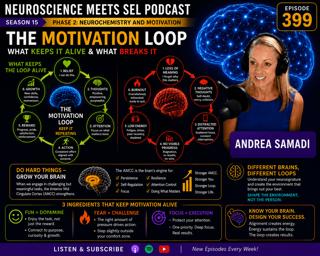
Phase 2 Review: The Motivation Loop: How to Keep Effort Worthwhile

Phase 2 Review: The Motivation Loop: How to Keep Effort Worthwhile

Episode 399 reviews Phase 2 of Season 15 and introduces the Motivation Loop — the sequence of meaning, belief, attention, action, reward, and recovery that drives sustained effort. The episode explain...

14 Kesä 28min
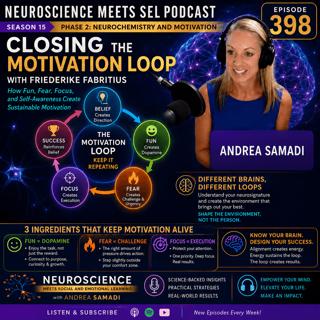
Fun, Fear, Focus: Closing the Motivation Loop with Friederike Fabritius

Fun, Fear, Focus: Closing the Motivation Loop with Friederike Fabritius

Episode 398 revisits neuroscientist Friederike Fabritius (from November 2022) to explain how three ingredients — fun (dopamine), fear (productive challenge), and focus — create the neurochemical condi...

9 Kesä 23min
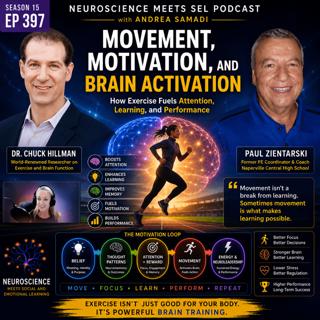
Move to Learn: How Movement Activates the Brain and Fuels Motivation (with Dr. Chuck Hillman and Paul Zientarski)

Move to Learn: How Movement Activates the Brain and Fuels Motivation (with Dr. Chuck Hillman and Paul Zientarski)

Season 15, Episode 397 revisits research and real-world practice showing movement is more than fitness: it activates the brain, boosts attention, enhances learning, and sustains motivation. Dr. Chuck ...

31 Touko 35min
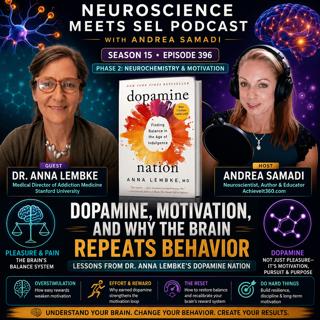
Dopamine, Motivation and Why the Brain Repeats Behavior with Dr. Anna Lembke

Dopamine, Motivation and Why the Brain Repeats Behavior with Dr. Anna Lembke

Host Andrea Samadi welcomes Dr. Anna Lembke to explain how pleasure and pain share the same neural circuitry and how dopamine governs motivation. The episode explores why overconsumption of easy rewar...

24 Touko 23min
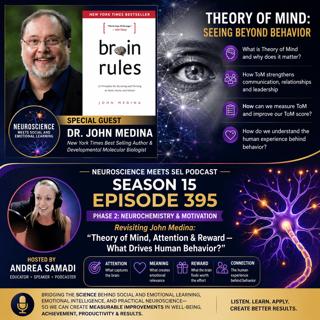
Theory of Mind: The Missing Link Between Attention, Reward, and Motivation with John Medina

Theory of Mind: The Missing Link Between Attention, Reward, and Motivation with John Medina

Episode 395 explores how theory of mind — our ability to understand others' intentions — drives attention, emotional relevance, and reward, shaping motivation and behavior. Dr. John Medina explains wh...

17 Touko 37min
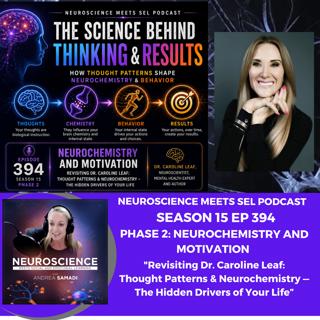
Thought Patterns & Neurochemistry — The Hidden Drivers of Your Life (Revisiting Dr. Caroline Leaf)

Thought Patterns & Neurochemistry — The Hidden Drivers of Your Life (Revisiting Dr. Caroline Leaf)

In this episode Andrea Samadi revisits her October 2022 interview with Dr. Caroline Leaf about how our thought patterns act as biological instructions that shape brain chemistry, behavior, and results...

26 Huhti 25min

Suosittua kategoriassa Koulutus

rss-murhan-anatomia
psykopodiaa-podcast
rss-narsisti
rss-arkea-ja-aurinkoa-podcast-espanjasta
rss-liian-kuuma-peruna
voi-hyvin-meditaatiot-2
adhd-podi
kesken
rahapuhetta
filocast-filosofian-perusteet
rss-vuosikymmenen-ilmastoteko
jari-sarasvuo-podcast
ihminen-tavattavissa-tommy-hellsten-instituutti
rss-vapaudu-voimaasi
aamukahvilla
salainen-paivakirja
psykologia
rss-psykalab
rss-ai-mita-siskopodcast
rss-luonnollinen-synnytys-podcast