"The Wise Emotional Fitness Program" Delivered via Virtual Reality with James MacDiarmid and Natasha Davis

"The Wise Emotional Fitness Program" Delivered via Virtual Reality with James MacDiarmid and Natasha Davis

This is episode #58 with James MacDiarmid and Natasha Davis. Thanks for tuning into the podcast today! I’m always excited about the guests we bring on here, as each person has achieved high levels of success in their field and I know they can help others by sharing their knowledge. Our guests today hit a chord with me when I saw their work because their vision, and my vision are 100% aligned. You can watch the interview on YouTube here.

A few years ago, I couldn’t stop thinking about a thought I had of teaching social and emotional learning skills via virtual reality. I had some prominent virtual reality companies that I had been following and put up on my wall, with the vision that maybe someday, we would see students learning SEL via these new modes of learning that were highly engaging. I had an image of what the lessons would look like (I could see a forest with students choosing different paths and learning new skills with each pathway that they took). For example, if they made a life decision, it would give them the opportunity to see the effects of this decision and see the reality of “if I do this, this will happen” showing them the consequences of their actions. After my interview with David Adams[i], (episode #54) I received a message on LinkedIn from James MacDiarmid (who had heard David’s podcast) about a potential next guest for the show with a video link for me to learn more about what our next guest had created. When I finally had a chance to watch the video, I have to say, I was blown away. This was the vision I had for SEL brought to life. I watched a walkthrough of a virtual reality lesson from the Wise: Emotional Fitness program and there was even a forest in the video. I wrote back to James with tears in my eyes, that yes, I want to learn more and before I know it, I’m speaking with James from Curiious[ii] - that’s with two ii’s- in Australia via video conference about the Wise program.

And here we are today. Let me give you more background on James and Natasha.

James has extensive experience in education, learning design and consultancy, with a passion for new technologies and enacting transformational change across whole-school systems.

He is a published author, contributing writer for TEDx and was a co-creator for PlayFutures, with the LEGO Foundation[iii] where they focus on bringing learning through play to children around the world. After a few minutes of speaking with James, his passion for building authentic learning opportunities and inspiring future generations came through loud and clear.

Natasha[iv], who James explained was the heart and sole of the program, is a clinical psychologist with over 15 years experience designing, researching and implementing emotion regulation and relationship building programs for adolescents and adults. She is the Director of a community-based clinic and has held many leadership positions in private and non-profit sectors. Natasha was the lead subject-matter expert during the development of this truly innovative program.

Welcome James and Natasha.

Thank you so much for being here, and sharing what you have created, all the way from Australia where it’s already Monday morning over there for you.

I wanted to learn more about the Wise Program and have some questions for you.

Q1: The first question is for Natasha. First of all, congratulations on what you have created. I think it is purely brilliant. Can you explain where this vision began for you?

Q2: What is the methodology behind this program?

'Designed for impact, Wise uses an Inside-Out methodology which equips participants with the practical skills to build strong connections from themselves (Inside) to others and the world around them (Outside). This is enhanced by the blended learning context whereby learning within virtual reality (Inside) is reinforced through the verbal and written self-reflective process, and teaching others the techniques (Outside). By using the principles of behavior change, and reinforcing the development of self- awareness and the empowerment to make change within ourselves, we are then guided to be able to change how we interact with others and the world around us.

With our emotions being like the engine of the car, individuals are shown how to adjust and “steer” their reactions by understanding how to “tune into” their emotions, better understand the “mechanics” of their emotional system and know how to “rev up” or “slow down” their emotional responses where needed, or even “brake” if they are about to do something dangerous or damaging. These skills are practiced and reinforced to build confidence in managing more complex emotional and relational situations.

Students are further supported through the Wise adult programs and resources which provide skills and resources to the adults in their lives. Educators, coaches, mentors, parents, guardians or other caring adults can learn skills and strategies through the program. Educators have additional training through professional development programs which assist them to learn the skills and facilitate student learning. Adults can take these skills and strategies into the home, workplace and broader community activities.

This whole system approach ensures that each individual’s learning is supported by and contributes to the systems that they live in. This is the Wise Learning Ecosystem.'

Q3: James, I know you are the educational advisor to the program, can you give some background of all that you are doing to ensure that Wise is evidence-based, aligned to Casel.org’s SEL competencies, and universal curriculum requirements?

Q4: Who are some of the influencers of this program that you have spoken with? How have they influenced your work?

Q5: What has been the feedback you are receiving from educators/students using the program?

Research with FM Labs at ICA. Preliminary results/study with students during the initial development phase have indicated that there is a great amount that can be taken from this not just this approach but also the material covered throughout the program itself.

Q6: What is your vision for the Wise program?

All kids, parents, teachers, coaches have access to these emotional regulation skills to improve the emotional fitness of each individual and those who support them. Whole school systemic change.

Q7: Can you give us some more background on the company Curiious? If someone wants to learn more, what’s the best way?

'Curiious is a creative communication company. For more than 20 years, we have used creativity & technology to solve problems, grow businesses and challenge traditional methods of communication. With offices in Sydney, Hong Kong, Los Angeles and New York, we create story-driven immersive experiences, backed by the latest technology, innovative design and strategic thinking to captivate, inspire and educate audiences.'

To contact James you can email him at james.m@curiious.com and Natasha is natasha.d@curriious.com

Thank you both so much for taking the time to speak with me today, and for creating such an innovative program to help young people develop into the responsible citizens that we all hope for our next generation. We do look forward to following your progress and hope this interview will lead as an introduction to connect you with schools and educators who want to learn more about this innovative VR emotional fitness program. Thanks so much.

RESOURCES:

The Wise SEL/ Emotional Fitness Program Walk-Through

REFERENCES:

[i] Neuroscience Meets SEL Podcast EPISODE #54 David Adams on “A New Vision of Education: Living Up to the Values We Want for Our Next Generation” https://podcasts.apple.com/us/podcast/director-sel-david-adams-on-new-vision-education-living/id1469683141?i=1000471762331

[ii] https://curiious.com/about-us/

[iii] https://www.legofoundation.com/en/what-we-do/playfutures/

[iv] https://clinpsychcentre.com.au/profile/natasha-davis/

Tämä jakso on lisätty Podme-palveluun avoimen RSS-syötteen kautta eikä se ole Podmen omaa tuotantoa. Siksi jakso saattaa sisältää mainontaa.

Jaksot(414)

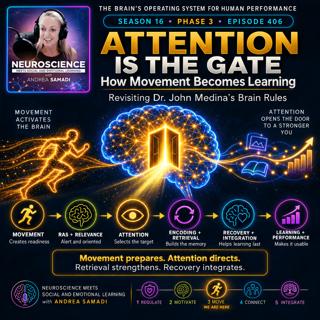
Attention Is the Gate—How Movement Becomes Lasting Learning with Dr. John Medina

Attention Is the Gate—How Movement Becomes Lasting Learning with Dr. John Medina

Episode 406 explains how movement prepares the brain but does not guarantee learning. It traces the full sequence—movement, RAS-driven readiness, salience and relevance, focused attention, encoding, r...

6 Syys 46min
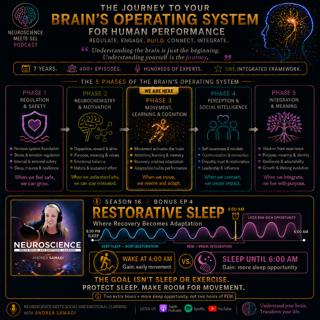
The 4:00 AM Tradeoff: Movement, REM and Recovery (Bonus Episode)

The 4:00 AM Tradeoff: Movement, REM and Recovery (Bonus Episode)

In this episode Andrea Samadi explores how movement and sleep work together in a "brain operating system" for human performance, focusing on restorative sleep (deep + REM), personal WHOOP data, and th...

30 Elo 29min
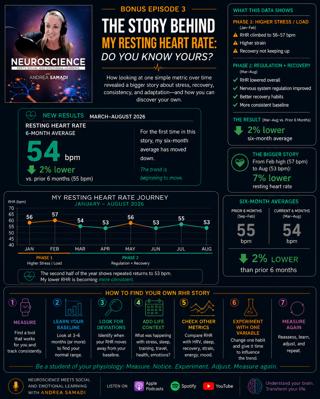
The Hidden Story Behind Your Resting Heart Rate: What Your RHR Can Reveal About Stress, Recovery & Adaptation (Bonus Episode)

The Hidden Story Behind Your Resting Heart Rate: What Your RHR Can Reveal About Stress, Recovery & Adaptation (Bonus Episode)

Andrea Samadi shares her personal resting heart rate data to show why measuring over time matters more than fixating on a single score. She explains how trends reveal stress, recovery, and adaptation,...

23 Elo 30min
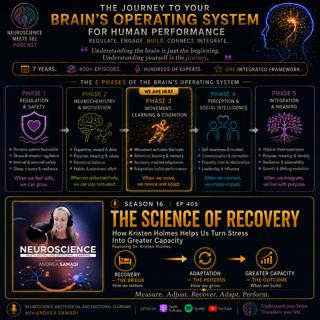
The Science of Recovery—How Dr. Kristen Holmes Helps Us Turn Stress Into Greater Capacity

The Science of Recovery—How Dr. Kristen Holmes Helps Us Turn Stress Into Greater Capacity

In this episode Andrea Samadi explores Phase 3 of the Brain's Operating System—movement, learning, and cognition—focusing on the recovery and adaptation side of the "movement loop." She revisits Dr. K...

16 Elo 45min
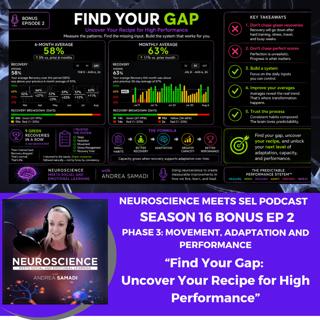
Find Your Gap: How Recovery Unlocks Predictable Performance (Bonus Episode)

Find Your Gap: How Recovery Unlocks Predictable Performance (Bonus Episode)

In this bonus episode Andrea Samadi introduces the Predictable Performance System, a practical roadmap from her Brain’s Operating System. She shows how measuring patterns—not chasing daily scores—plus...

9 Elo 30min
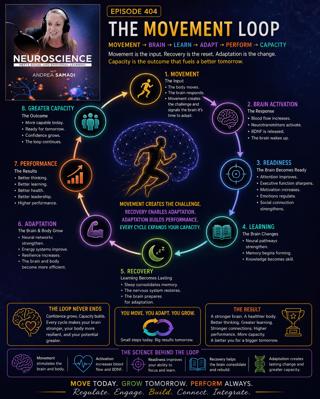
Dr. John Ratey and The Movement Loop: How Movement Becomes Human Performance

Dr. John Ratey and The Movement Loop: How Movement Becomes Human Performance

In this episode Andrea Samadi explores Phase Three of the Brain’s Operating System — how movement acts as the essential input that activates the brain, sharpens attention, boosts learning, and improve...

2 Elo 21min
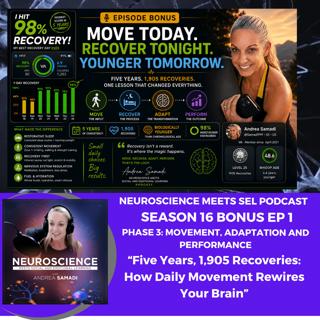
Five Years, 1,905 Recoveries: How Daily Movement Rewires Your Brain (Bonus Episode)

Five Years, 1,905 Recoveries: How Daily Movement Rewires Your Brain (Bonus Episode)

Andrea Samadi shares a five-year self-experiment using a WHOOP wearable to track sleep, recovery, movement, and biological age. She reveals how daily low-intensity movement and consistent recovery—not...

25 Heinä 16min
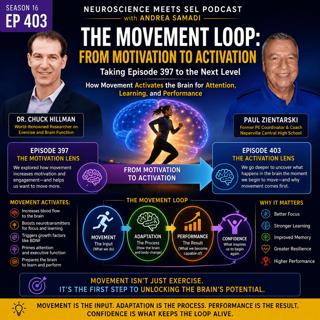
The Movement Loop: How Movement Activates the Brain for Learning, Adaptation & Performance

The Movement Loop: How Movement Activates the Brain for Learning, Adaptation & Performance

Welcome back to Season 16 of the Neuroscience Meets Social and Emotional Learning Podcast. I'm Andrea Samadi, and this is where we bridge neuroscience, social and emotional learning, and human perform...

19 Heinä 34min

Suosittua kategoriassa Koulutus

rss-murhan-anatomia
aamukahvilla
psykopodiaa-podcast
voi-hyvin-meditaatiot-2
rss-luonnollinen-synnytys-podcast
adhd-podi
rss-rahamania
rss-liian-kuuma-peruna
ihminen-tavattavissa-tommy-hellsten-instituutti
psykologia
rss-arkea-ja-aurinkoa-podcast-espanjasta
koulu-podcast-2
kesken
rss-uskonto-on-tylsaa
rss-niinku-asia-on
rss-duodecim-lehti
rss-spessu
rss-valo-minussa-2
rss-psykalab
taytta-tavaraa