Discovering the Secret to a Clear, Fog-Free Brain with Dr. Sui Wong

Discovering the Secret to a Clear, Fog-Free Brain with Dr. Sui Wong

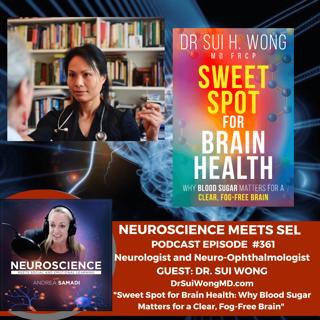
Welcome to episode 361 of the Neuroscience Meets Social and Emotional Learning Podcast, where we reconnect with Dr. Sui Wong, a leading neuro-ophthalmologist, for an enlightening discussion on her new book, Sweet Spot for Brain Health: Why Blood Sugar Matters for a Clear, Fog-Free Brain. Join host Andrea Samadi as she dives deep into Dr. Wong's research that unveils the powerful link between our blood sugar levels and brain health.

Discover practical tips and a 12-week challenge designed to help maintain optimal brain function by stabilizing blood sugar. This episode sheds light on Dr. Wong's holistic approach to patient care and her dedication to sharing knowledge that empowers individuals to enhance their health and well-being through informed lifestyle choices.

Watch our interview on YouTube here https://youtu.be/MoQT39pXHhE

Welcome back to SEASON 13 of The Neuroscience Meets Social and Emotional Learning Podcast, where we connect the science-based evidence behind social and emotional learning and emotional intelligence training for improved well-being, achievement, productivity and results—using what I saw as the missing link (since we weren’t taught this when we were growing up in school), the application of practical neuroscience. I’m Andrea Samadi, an author, and an educator with a passion for learning and launched this podcast 6 years ago with the goal of bringing ALL the leading experts together (in one place) to help us to APPLY this research in our daily lives.

For today’s episode #361, we meet with a returning guest, Dr. Sui Wong, a Leading Neuro-Ophthalmologist, who we met on EP 343[i], last August where we looked at:

✔ Dr. Sui Wong's career path in medicine, that led her to write 4 books to help her patients (and the world) improve their brain health.

✔ How understanding our eye health can help us to prevent neurological disorders (like Alzheimer's Disease) in the future.

✔ What common neuro-ophthalmology cases she sees.

On today’s EP 361, we will dive deep into her NEW book, Sweet Spot for Brain Health: Why Blood Sugar Matters for a Clear, Fog-Free Brain.[ii]

✔ What is the brain-glucose connection?

✔ How does glucose impact cognitive performance?

✔ How can we better prepare to eat food that we know will spike our blood sugar levels?

✔ What health problems can too much sugar lead to?

✔ Helpful tools to create a brain-healthy diet.

✔ Supplements that are important for brain health and cognition.

Just a reminder:

Dr. Sui H. Wong, is a Neurologist and Neuro-Ophthalmologist based in London, United Kingdom. In addition to her clinical work as a medical doctor and physician, Dr. Wong is an active neuroscience researcher, who translates pertinent and clinically relevant questions into research, to improve person-centered patient outcomes. Additionally, she has the qualifications and experience to consider a broader spectrum of lifestyle-specific interventions. Dr. Wong’s holistic approach in empowering patients has been recognized with many awards, and this is just the beginning for her.

When I was introduced to Dr. Wong, an active neuroscience researcher with a mission of translating important clinically relevant questions into research for improved person-centred patient outcomes, I knew I had to speak with her. She is a widely-published author and researcher with over 110+ peer-reviewed publications in medical journals, chapters and conference abstracts, to date.

Let’s meet Dr. Sui Wong, for the second time on our podcast, and see what we can learn together about what she has uncovered with her research of the importance of understanding our blood sugar levels, for a fog-free brain.

Welcome Dr. Sui Wong! It’s wonderful to see you again. What’s been going on with you since we met last August?

Well, let’s get straight to your new book, Sweet Spot for Brain Health: Why Blood Sugar Matters for a Clear, Fog-Free Brain. I absolutely love this topic, and I’ve covered a few episodes where we looked at the impact of sugar on our health and wellness, with EP 275[iii] The Damaging Effects of Sugar on the Brain and Body. I’m open that while I will eat chocolate, (sparingly) I watch the sugar content in EVERYTHING I eat, because it just doesn’t make me feel good to have a sugar-rush to the brain. Besides chocolate, I’d say I live a sugar-free lifestyle, (since around 2005, so for the past 20 years) and it’s not something I even think about anymore. So when I see just how damaging sugar is to our health, I want to do what I can to help others to try this lifestyle, and see how they feel.

INTRO Q: What was it for you that made you want to cover this topic, even with tips for a 12-week challenge at the end of the book?

Q1: In the very beginning of your book, you ask the question “have you ever wondered about the hidden connection between what you eat and how your brain works” and I honestly had not, until I was at my foot doctor, telling him that my feet were going numb with exercise, and he had just written a book, called Sugar Crush: How to Reduce Inflammation, Reverse Nerve Damage and Reclaim Good Health[iv] and he handed me a piece of paper that would involve my pathway to a sugar-free diet.

When was it that you began to connect the dots with how our brains work, connected to sugar? What is the brain-glucose connection?

Q2: Just thinking back to my sugar-free diet, that began 20 years ago, my doctor had me stop eating high glucose fruits like pineapple, and replace them with low glycemic fruits. I remember us both laughing as we realized that bananas were not on the list, and I remember thinking “what can I eat?” and it was a massive mindset shift. You’ve broken your book into Themes and theme 1 that covers Chapters 1-4 covers how glucose helps your brain to work, as well as how your body breaks down food to give us energy.

Can you tell us what we should all know about glucose, how it impacts cognitive performance, and how we can balance the sugar we ingest so it’s not too much, or too little?

Q2B: Is the only way to REALLY know this, to measure what we eat with a blood glucose monitor to see how what we are eating impacts our blood sugar levels?

Q2C: How can we better prepare to eat foods we know will spike our blood sugar?

Q3: Then you cover Theme 2, in chapter 5, When Things Go Wrong with what happens when you blood sugar levels aren’t right. We all have heard this, but can you tell us the problems too much sugar can lead us to? (like diabetes, insulin resistance, deteriorating vascular health, in addition to the impact on our brain health and overall well-being)?

Q4: Then you cover Theme 3, what to do about it, in chapters 6-11 with practical tips to keep your blood sugar steady, and our brain in top shape.

It’s here that you cover diet, and this is a huge one, as many of us like eating, or cooking things in a certain way. I remember my doctor asking me to write down EVERYTHING I was eating, and what was in the sauces I was cooking things in. For example, I remember I liked this Fajita sauce, that was really high is sugar. So I had to find a replacement for it. Or learning what food were high glycemic.

Or don’t even get me started when I realized how bad alcohol is for the brain, especially when I had cut out so many things. I remember thinking “what is left for me to eat/drink” until I found replacements for everything that we know to be bad for the brain.

What are the most helpful tools you have found for getting our heads around a brain-healthy diet?

Q5: What natural remedies or supplements are important for brain health and cognition?

Q6: What is your goal for us with this book?

Q7: What are some challenges you see with people in your practice, or obstacles that get in the way?

Q8: What have I missed that’s important?

Dr. Sui Wong, I want to thank you for coming back on the podcast for a second time. It was wonderful to catch up, and learn more about ways to improve our brain health and cognition, by finding this Sweet Spot for Brain Health. I will link your information for people to learn more about you in the show notes. What is next for you?

FINAL THOUGHTS

I couldn’t end this episode without really thinking about this topic of the importance of finding our own “Sweet Spot for Brain Health.” I know that during the recording, I could think of a few ways that I can improve my own habits immediately, (like by making sure I am taking fish oil, and as well, will add some flax seed to my shakes or morning breakfast) or like Dr. Wong mentioned, to improve ourselves just a little bit, make a shift that’s only about 1-3% and we can make a significant change in our future health.

I hope you enjoyed this episode, and have written down some ideas to improve your health in ways that these small shifts will over time, help us all to keep our brains sharp, and fight off cognitive decline.

And with that thought, I’’ll close out this episode and will see you in May, with more interviews that will dive deeper into brain health and wellbeing.

RESOURCES AND CONNECT WITH DR. SUI WONG

Sweet Spot for Brain Health Book books2read.com/u/br2l8z

Thursday Tips-Bitesize brain health tips to thrive: bit.ly/drwongbrainhealth

Website for Dr. Wong’s books: https://www.drsuiwongmd.com/books

Instagram: https://www.instagram.com/drsuiwong.neurologist/

LinkedIn: https://www.linkedin.com/in/dr-sui-wong-neurologist/

Mindfulness for Brain Health (in paperback/ hardcover/ Kindle/ audiobook) https://books2read.com/u/4XNXAg Break Free from Migraines Naturally (in paperback/ hardcover/ Kindle/ audiobook) https://books2read.com/u/bwgG5Z Sleep Better to Thrive (in paperback/ Kindle/ audiobook) books2read.com/u/mv0XQ2 Quit Ultra-Processed Foods Now (in paperback/ Kindle/ audiobook) https://books2read.com/u/m27M21

Email office@neuroeye.co.uk

RESOURCES

Freestyle Libre Patch https://www.freestyle.abbott/us-en/home.html

Attia’s Rule https://podclips.com/c/attias-rule-avoid-arguing-about-supplements-nutrition-until-you-can-deadlift-your-body-weight-for-10?ss=r&ss2=hubermanlab&d=2022-08-15&m=true

REFERENCES:

[i] Neuroscience Meets Social and Emotional Learning Podcast EPISODE #343 with Dr. Sui Wong https://andreasamadi.podbean.com/e/unlocking-brain-health-insights-from-a-leading-neuro-ophthalmologist/

[ii]Sweet Spot for Brain Health: Why Blood Sugar Matters for a Clear, Fog-Free Brain by Dr. Sui Wong, Published Nov 11, 2024 https://www.amazon.com/Sweet-Spot-Brain-Health-Well-being/dp/1917353855

[iii]Neuroscience Meets Social and Emotional Learning Podcast EPISODE #275 https://andreasamadi.podbean.com/e/brain-fact-friday-the-damaging-impacts-of-sugar-on-the-brain-and-body/

[iv] Sugar Crush: How to Reduce Inflammation, Reverse Nerve Damage and Reclaim Good Health by Dr. Richard Jacoby (April 2014) https://www.amazon.com/dp/B00KPVB4OA/ref=dp-kindle-redirect?_encoding=UTF8&btkr=1

Tämä jakso on lisätty Podme-palveluun avoimen RSS-syötteen kautta eikä se ole Podmen omaa tuotantoa. Siksi jakso saattaa sisältää mainontaa.

Jaksot(405)

Trust as the Foundation with Greg Hill: How Great Leaders Create the Conditions for Learning, Growth and Performance

Trust as the Foundation with Greg Hill: How Great Leaders Create the Conditions for Learning, Growth and Performance

In episode 401 Andrea Samadi welcomes Greg Hill to explore why trust is the essential foundation for learning, growth, and high performance. They discuss how trust creates psychological safety, encour...

27 Kesä 37min

Episode 400: Sales Leadership Under Pressure with Majid Samadi: 7 Lessons Learned from 7 Years of Neuroscience

Episode 400: Sales Leadership Under Pressure with Majid Samadi: 7 Lessons Learned from 7 Years of Neuroscience

In this milestone episode (400), Andrea Samadi celebrates seven years of the Neuroscience Meets SEL Podcast with her husband Majid Samadi. They reflect on the journey of translating neuroscience into ...

20 Kesä 47min

Phase 2 Review: The Motivation Loop: How to Keep Effort Worthwhile

Phase 2 Review: The Motivation Loop: How to Keep Effort Worthwhile

Episode 399 reviews Phase 2 of Season 15 and introduces the Motivation Loop — the sequence of meaning, belief, attention, action, reward, and recovery that drives sustained effort. The episode explain...

14 Kesä 28min

Fun, Fear, Focus: Closing the Motivation Loop with Friederike Fabritius

Fun, Fear, Focus: Closing the Motivation Loop with Friederike Fabritius

Episode 398 revisits neuroscientist Friederike Fabritius (from November 2022) to explain how three ingredients — fun (dopamine), fear (productive challenge), and focus — create the neurochemical condi...

9 Kesä 23min

Move to Learn: How Movement Activates the Brain and Fuels Motivation (with Dr. Chuck Hillman and Paul Zientarski)

Move to Learn: How Movement Activates the Brain and Fuels Motivation (with Dr. Chuck Hillman and Paul Zientarski)

Season 15, Episode 397 revisits research and real-world practice showing movement is more than fitness: it activates the brain, boosts attention, enhances learning, and sustains motivation. Dr. Chuck ...

31 Touko 35min

Dopamine, Motivation and Why the Brain Repeats Behavior with Dr. Anna Lembke

Dopamine, Motivation and Why the Brain Repeats Behavior with Dr. Anna Lembke

Host Andrea Samadi welcomes Dr. Anna Lembke to explain how pleasure and pain share the same neural circuitry and how dopamine governs motivation. The episode explores why overconsumption of easy rewar...

24 Touko 23min

Theory of Mind: The Missing Link Between Attention, Reward, and Motivation with John Medina

Theory of Mind: The Missing Link Between Attention, Reward, and Motivation with John Medina

Episode 395 explores how theory of mind — our ability to understand others' intentions — drives attention, emotional relevance, and reward, shaping motivation and behavior. Dr. John Medina explains wh...

17 Touko 37min

Thought Patterns & Neurochemistry — The Hidden Drivers of Your Life (Revisiting Dr. Caroline Leaf)

Thought Patterns & Neurochemistry — The Hidden Drivers of Your Life (Revisiting Dr. Caroline Leaf)

In this episode Andrea Samadi revisits her October 2022 interview with Dr. Caroline Leaf about how our thought patterns act as biological instructions that shape brain chemistry, behavior, and results...

26 Huhti 25min

Suosittua kategoriassa Koulutus

rss-murhan-anatomia
psykopodiaa-podcast
rss-narsisti
rss-arkea-ja-aurinkoa-podcast-espanjasta
rss-liian-kuuma-peruna
voi-hyvin-meditaatiot-2
adhd-podi
kesken
rahapuhetta
filocast-filosofian-perusteet
rss-vuosikymmenen-ilmastoteko
jari-sarasvuo-podcast
ihminen-tavattavissa-tommy-hellsten-instituutti
rss-vapaudu-voimaasi
aamukahvilla
salainen-paivakirja
psykologia
rss-psykalab
rss-ai-mita-siskopodcast
rss-luonnollinen-synnytys-podcast