Unveiling the Milky Way's Hidden Glow: Diffuse Gamma Rays measured by LHAASO

Unveiling the Milky Way's Hidden Glow: Diffuse Gamma Rays measured by LHAASO

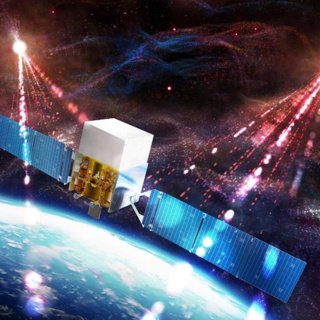
In this episode, we explore the fascinating world of diffuse gamma rays emanating from the Galactic plane. A new study using the Large High Altitude Air Shower Observatory's Water Cherenkov Detector Array (LHAASO-WCDA) has provided unprecedented insights into these mysterious emissions.


What are diffuse gamma rays? These high-energy photons are produced when cosmic rays, energetic particles that constantly bombard our galaxy, interact with interstellar gas and radiation. Studying these gamma rays provides valuable information about the distribution and behavior of cosmic rays, helping us unravel their origins and propagation throughout the Milky Way.


LHAASO-WCDA's groundbreaking observations: The LHAASO-WCDA has detected diffuse gamma-ray emissions across a wide energy range, from 1 TeV to 25 TeV, bridging a crucial gap between previous observations by space-based and ground-based detectors.


Mapping the Galactic plane: The study focused on two distinct regions of the Galactic plane: the inner region (15° < l < 125°, |b| < 5°) and the outer region (125° < l < 235°, |b| < 5°). This wide coverage allowed scientists to create detailed maps of the diffuse gamma-ray emission, revealing intriguing patterns.


Surprising findings: The LHAASO-WCDA measurements show that the diffuse gamma-ray fluxes are significantly higher than predicted by conventional models that consider only interactions between cosmic rays and interstellar gas. This excess suggests the presence of additional, as yet unidentified sources of gamma rays in the Milky Way.


Possible explanations: Several hypotheses have been proposed to explain the unexpected gamma-ray excess.

  • One leading contender is the existence of a population of unresolved sources, such as pulsar wind nebulae or pulsar halos, that emit gamma rays at energies below tens of TeV.
  • Other possibilities include contributions from young massive star clusters or modifications to our understanding of cosmic ray propagation.


Future directions: Combining LHAASO-WCDA's observations with data from other experiments, such as neutrino detectors, will be crucial to pinpoint the origin of the diffuse gamma-ray excess and further illuminate the mysteries of cosmic rays and their journey through our galaxy.


Reference: Zhen Cao et al. "Measurement of Very-high-energy Diffuse Gamma-ray Emissions from the Galactic Plane with LHAASO-WCDA" (arXiv:2411.16021v1)


Acknowledements: Podcast prepared with Google/NotebookLM. Illustration credits: LHAASO Collaboration

Tämä jakso on lisätty Podme-palveluun avoimen RSS-syötteen kautta eikä se ole Podmen omaa tuotantoa. Siksi jakso saattaa sisältää mainontaa.

Jaksot(101)

Record-Breaker: Catching Gamma Rays from the Distant Quasar OP 313

Record-Breaker: Catching Gamma Rays from the Distant Quasar OP 313

In this episode, we dive into a groundbreaking astronomical discovery: the detection of very-high-energy (VHE) gamma rays from the quasar OP 313. Located at a redshift of $z = 0.997$, OP 313 has shatt...

1 Kesä 20min

Ripples in Spacetime: Unpacking the GWTC-5.0 Catalog

Ripples in Spacetime: Unpacking the GWTC-5.0 Catalog

In this episode, we dive into the monumental release of the Gravitational-Wave Transient Catalog version 5.0 (GWTC-5.0) and the open data from the second part of the fourth observing run (O4b) by the ...

29 Touko 21min

SN 2017egm : Fermi-LAT's Breakthrough Gamma-Ray Detection

SN 2017egm : Fermi-LAT's Breakthrough Gamma-Ray Detection

In today’s episode, we dive into the mystery of superluminous supernovae (SLSNe)—rare, extreme astronomical events that shine 10 to 100 times brighter than standard core-collapse supernovae. For years...

22 Touko 23min

Supernovae on the RISE: Why Dead Stars Wake Up Decades Later

Supernovae on the RISE: Why Dead Stars Wake Up Decades Later

In this episode, we explore the fascinating phenomenon of core-collapse supernovae that refuse to fade away quietly. Years, or even decades, after their initial explosion, some of these stellar deaths...

20 Touko 17min

The SVOM Satellite: A New Era in Multi-Messenger Astronomy

The SVOM Satellite: A New Era in Multi-Messenger Astronomy

In this episode, we dive into the fascinating world of gamma-ray bursts (GRBs) and high-energy transients through the lens of the SVOM (Space-based Multi-band Variable Object Monitor) mission. Launche...

29 Huhti 24min

Chasing the Flash: Hunting Neutron Star Mergers with CTAO

Chasing the Flash: Hunting Neutron Star Mergers with CTAO

In this episode, we dive into the thrilling world of multi-messenger astronomy! Ever since the historic detection of GW170817, scientists have known that binary neutron star (BNS) mergers can produce ...

14 Huhti 19min

Tiling the Sky: A New Strategy for Finding Elusive GRBs

Tiling the Sky: A New Strategy for Finding Elusive GRBs

In this episode, we dive into the intense and fast-paced world of **Gamma-ray bursts (GRBs)—the most luminous and rapidly evolving transients in the Universe**. While space-based instruments like the ...

13 Huhti 19min

Fast Radio Bursts & Magnetar X-Rays: A Peculiar Discovery

Fast Radio Bursts & Magnetar X-Rays: A Peculiar Discovery

In this episode, we dive into the deep cosmos to explore a recent astronomical breakthrough linking Fast Radio Bursts (FRBs)—enigmatic, millisecond-long cosmic transients—to extreme stellar objects kn...

7 Huhti 22min

Suosittua kategoriassa Tiede

rss-mita-tulisi-tietaa
rss-hereilla
utelias-mieli
rss-duodecim-lehti
rss-radplus
rss-totuuden-liepeilla
docemilia
rss-poliisin-mieli
tiedekulma-podcast
radio-antro
rss-laakaripodi
university-of-eastern-finland
sotataidon-ytimessa
filocast-filosofian-perusteet
rss-bios-podcast
rss-tiedetta-vai-tarinaa
rss-ilmasto-kriisissa
rss-ylistys-elaimille
rss-lihavuudesta-podcast
rss-kasvikutsut