Deep Sea Discovery: KM3NeT Detects Record-Breaking Neutrino Event

Deep Sea Discovery: KM3NeT Detects Record-Breaking Neutrino Event

* **Introduction**: A recent groundbreaking discovery by the KM3NeT Collaboration has detected an exceptionally high-energy cosmic neutrino. This event, named KM3-230213A, is significant because its energy far exceeds any neutrino previously observed.


* **What are Cosmic Neutrinos?**: Cosmic neutrinos are electrically neutral particles that travel vast distances without being deflected by magnetic fields or significantly absorbed by matter. They are produced when cosmic rays interact with matter or photons, making their detection a key to understanding high-energy astrophysical processes.


* **The KM3NeT Experiment**: The KM3NeT is a deep-sea neutrino telescope located in the Mediterranean Sea. It consists of two detector arrays: ARCA, optimized for high-energy cosmic neutrinos, and ORCA, for neutrino oscillations. These detectors utilize optical sensors to detect Cherenkov light produced by charged particles resulting from neutrino interactions.


* **The Ultra-High-Energy Event**: The detected event, KM3-230213A, is a muon with an estimated energy of **120 PeV**. The neutrino that produced this muon is estimated to have had an even higher energy. The muon was detected traversing the ARCA detector on February 13, 2023.


* **How it was Detected**: The muon's trajectory was reconstructed using the arrival times and positions of the first hits recorded on the photomultiplier tubes (PMTs). The energy was estimated by counting the number of PMTs that triggered. The large amount of light detected saturated the PMTs closest to the muon trajectory, and large showers resulting from energy loss processes were observed along the track.


* **Significance**: This event may indicate a different source of cosmic neutrinos or could be the first detection of a cosmogenic neutrino, produced by interactions of ultra-high-energy cosmic rays with background photons. The detected energy significantly exceeds previous detections, suggesting new astrophysical phenomena.


* **Background and Analysis**: The possibility of the event being caused by atmospheric muons or neutrinos was considered. The probability of an atmospheric origin is extremely low, especially given the near-horizontal direction and high energy. The direction of the neutrino matches expectations for an isotropic flux of ultra-high-energy neutrinos, where downgoing neutrinos are obscured by atmospheric muons, and upgoing neutrinos are absorbed by the Earth.


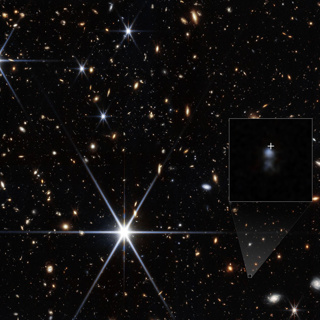
* **Searches for Source**: Extensive searches were conducted for a source counterpart within a 3° radius of the event using multiwavelength data. Various catalogs of gamma-ray, X-ray, infrared, and radio sources were examined, but no conclusive source association has been made.


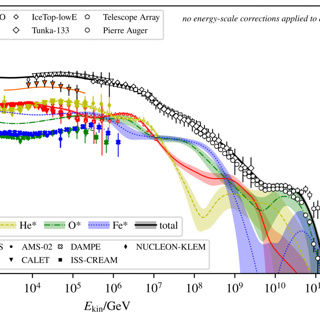
* **Flux Measurement:** The steady isotropic flux that would produce one event like KM3-230213A is **5.8 x 10^-8 GeV cm^-2 s^-1 sr^-1**. This flux measurement exceeds current limits from IceCube and Auger, possibly indicating an upward fluctuation or a new component in the flux. This event could be from cosmogenic neutrino production or from transient emitters such as gamma-ray bursts or tidal-disruption events.


* **Conclusion**: The detection of KM3-230213A provides significant evidence for the existence of ultra-high-energy neutrinos and enhances our understanding of the universe's most energetic phenomena.


* **Reference**: The KM3NeT Collaboration. "Observation of an ultra-high-energy cosmic neutrino with KM3NeT." *Nature* (2025).


Acknowledements: Podcast prepared with Google/NotebookLM. Illustration credits: KM3NeT

Tämä jakso on lisätty Podme-palveluun avoimen RSS-syötteen kautta eikä se ole Podmen omaa tuotantoa. Siksi jakso saattaa sisältää mainontaa.

Jaksot(101)

Record-Breaker: Catching Gamma Rays from the Distant Quasar OP 313

Record-Breaker: Catching Gamma Rays from the Distant Quasar OP 313

In this episode, we dive into a groundbreaking astronomical discovery: the detection of very-high-energy (VHE) gamma rays from the quasar OP 313. Located at a redshift of $z = 0.997$, OP 313 has shatt...

1 Kesä 20min

Ripples in Spacetime: Unpacking the GWTC-5.0 Catalog

Ripples in Spacetime: Unpacking the GWTC-5.0 Catalog

In this episode, we dive into the monumental release of the Gravitational-Wave Transient Catalog version 5.0 (GWTC-5.0) and the open data from the second part of the fourth observing run (O4b) by the ...

29 Touko 21min

SN 2017egm : Fermi-LAT's Breakthrough Gamma-Ray Detection

SN 2017egm : Fermi-LAT's Breakthrough Gamma-Ray Detection

In today’s episode, we dive into the mystery of superluminous supernovae (SLSNe)—rare, extreme astronomical events that shine 10 to 100 times brighter than standard core-collapse supernovae. For years...

22 Touko 23min

Supernovae on the RISE: Why Dead Stars Wake Up Decades Later

Supernovae on the RISE: Why Dead Stars Wake Up Decades Later

In this episode, we explore the fascinating phenomenon of core-collapse supernovae that refuse to fade away quietly. Years, or even decades, after their initial explosion, some of these stellar deaths...

20 Touko 17min

The SVOM Satellite: A New Era in Multi-Messenger Astronomy

The SVOM Satellite: A New Era in Multi-Messenger Astronomy

In this episode, we dive into the fascinating world of gamma-ray bursts (GRBs) and high-energy transients through the lens of the SVOM (Space-based Multi-band Variable Object Monitor) mission. Launche...

29 Huhti 24min

Chasing the Flash: Hunting Neutron Star Mergers with CTAO

Chasing the Flash: Hunting Neutron Star Mergers with CTAO

In this episode, we dive into the thrilling world of multi-messenger astronomy! Ever since the historic detection of GW170817, scientists have known that binary neutron star (BNS) mergers can produce ...

14 Huhti 19min

Tiling the Sky: A New Strategy for Finding Elusive GRBs

Tiling the Sky: A New Strategy for Finding Elusive GRBs

In this episode, we dive into the intense and fast-paced world of **Gamma-ray bursts (GRBs)—the most luminous and rapidly evolving transients in the Universe**. While space-based instruments like the ...

13 Huhti 19min

Fast Radio Bursts & Magnetar X-Rays: A Peculiar Discovery

Fast Radio Bursts & Magnetar X-Rays: A Peculiar Discovery

In this episode, we dive into the deep cosmos to explore a recent astronomical breakthrough linking Fast Radio Bursts (FRBs)—enigmatic, millisecond-long cosmic transients—to extreme stellar objects kn...

7 Huhti 22min

Suosittua kategoriassa Tiede

rss-mita-tulisi-tietaa
rss-hereilla
utelias-mieli
rss-duodecim-lehti
rss-radplus
rss-totuuden-liepeilla
docemilia
rss-poliisin-mieli
tiedekulma-podcast
radio-antro
rss-laakaripodi
university-of-eastern-finland
sotataidon-ytimessa
filocast-filosofian-perusteet
rss-bios-podcast
rss-tiedetta-vai-tarinaa
rss-ilmasto-kriisissa
rss-ylistys-elaimille
rss-lihavuudesta-podcast
rss-kasvikutsut