V1723 Sco and V6598 Sgr: Decoding the Fastest and Brightest Gamma-Ray Eruptions

V1723 Sco and V6598 Sgr: Decoding the Fastest and Brightest Gamma-Ray Eruptions

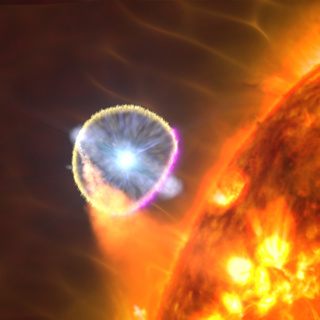
Classical novae, thermonuclear eruptions on the surface of a white dwarf in a binary system, are known sources of high-energy gamma-rays detected by the Fermi-LAT. This episode explores a multi-wavelength analysis of two recent novae, **V1723 Sco 2024** and **V6598 Sgr 2023**, aiming to constrain the mechanism behind this intense gamma-ray emission.


**V1723 Sco** proved to be a very bright gamma-ray source, with emission lasting 15 days, allowing scientists to constrain the total energy and spectral properties of accelerated protons. Intriguingly, V1723 Sco also showed unexpected gamma-ray and thermal hard X-ray emission more than 40 days after its initial outburst, suggesting that particle acceleration can occur even several weeks post-eruption.


In contrast, **V6598 Sgr** was detected by Fermi-LAT for only two days, marking one of the shortest gamma-ray emission durations ever recorded for a classical nova. Its brief gamma-ray signal coincided with a rapid decline in optical brightness. V6598 Sgr also exhibits peculiar characteristics, including no significant gamma-ray emission below 1 GeV and the possibility that it is an Intermediate Polar (IP) system, which may hint at a different particle acceleration region due to potentially strong magnetic fields.


The detailed analysis, which combined Fermi-LAT data with optical (AAVSO) and X-ray (NuSTAR) observations, strongly supports the hypothesis that the gamma-ray generation in both novae is more consistent with the **hadronic scenario** (involving accelerated protons) than the leptonic scenario. However, the long-standing challenge remains: no non-thermal X-ray emission has been detected simultaneously with the gamma-rays.


**Article Reference:**


Fauverge, P., Jean, P., Sokolovsky, K., et al. (2025). *Fermi-LAT detections of the classical novae V1723 Sco and V6598 Sgr in a multi-wavelength context.* submitted to Astronomy & Astrophysics, arXiv: 2512.14198


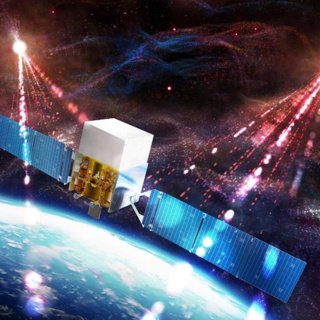
Acknowledements: Podcast prepared with Google/NotebookLM. Illustration credits: NASA's Goddard Space Flight Center/S. Wiessinger

Denne episoden er hentet fra en åpen RSS-feed og er ikke publisert av Podme. Den kan derfor inneholde annonser.

Episoder(101)

Record-Breaker: Catching Gamma Rays from the Distant Quasar OP 313

Record-Breaker: Catching Gamma Rays from the Distant Quasar OP 313

In this episode, we dive into a groundbreaking astronomical discovery: the detection of very-high-energy (VHE) gamma rays from the quasar OP 313. Located at a redshift of $z = 0.997$, OP 313 has shatt...

1 Jun 20min

Ripples in Spacetime: Unpacking the GWTC-5.0 Catalog

Ripples in Spacetime: Unpacking the GWTC-5.0 Catalog

In this episode, we dive into the monumental release of the Gravitational-Wave Transient Catalog version 5.0 (GWTC-5.0) and the open data from the second part of the fourth observing run (O4b) by the ...

29 Mai 21min

SN 2017egm : Fermi-LAT's Breakthrough Gamma-Ray Detection

SN 2017egm : Fermi-LAT's Breakthrough Gamma-Ray Detection

In today’s episode, we dive into the mystery of superluminous supernovae (SLSNe)—rare, extreme astronomical events that shine 10 to 100 times brighter than standard core-collapse supernovae. For years...

22 Mai 23min

Supernovae on the RISE: Why Dead Stars Wake Up Decades Later

Supernovae on the RISE: Why Dead Stars Wake Up Decades Later

In this episode, we explore the fascinating phenomenon of core-collapse supernovae that refuse to fade away quietly. Years, or even decades, after their initial explosion, some of these stellar deaths...

20 Mai 17min

The SVOM Satellite: A New Era in Multi-Messenger Astronomy

The SVOM Satellite: A New Era in Multi-Messenger Astronomy

In this episode, we dive into the fascinating world of gamma-ray bursts (GRBs) and high-energy transients through the lens of the SVOM (Space-based Multi-band Variable Object Monitor) mission. Launche...

29 Apr 24min

Chasing the Flash: Hunting Neutron Star Mergers with CTAO

Chasing the Flash: Hunting Neutron Star Mergers with CTAO

In this episode, we dive into the thrilling world of multi-messenger astronomy! Ever since the historic detection of GW170817, scientists have known that binary neutron star (BNS) mergers can produce ...

14 Apr 19min

Tiling the Sky: A New Strategy for Finding Elusive GRBs

Tiling the Sky: A New Strategy for Finding Elusive GRBs

In this episode, we dive into the intense and fast-paced world of **Gamma-ray bursts (GRBs)—the most luminous and rapidly evolving transients in the Universe**. While space-based instruments like the ...

13 Apr 19min

Fast Radio Bursts & Magnetar X-Rays: A Peculiar Discovery

Fast Radio Bursts & Magnetar X-Rays: A Peculiar Discovery

In this episode, we dive into the deep cosmos to explore a recent astronomical breakthrough linking Fast Radio Bursts (FRBs)—enigmatic, millisecond-long cosmic transients—to extreme stellar objects kn...

7 Apr 22min

Populært innen Vitenskap

fastlegen
tingenes-tilstand
jss
rekommandert
liberal-halvtime
sinnsyn
forskningno
tomprat-med-gunnar-tjomlid
villmarksliv
rss-paradigmepodden
fjellsportpodden
kvinnehelsepodden
tidlose-historier
dekodet-2
rss-zahid-ali-hjelper-deg
rss-overskuddsliv
hva-er-greia-med
rss-rekommandert
rss-inn-til-kjernen-med-sunniva-rose
grunnstoffene