Fear of Uncertainty in Eating Disorder Recovery: Why It Feels So Terrifying + 5 Practical Skills That Help

Fear of Uncertainty in Eating Disorder Recovery: Why It Feels So Terrifying + 5 Practical Skills That Help

Eating disorder recovery can feel frightening for reasons that go far deeper than food, weight, or body image. One of the most powerful drivers of eating disorder behaviors is fear of uncertainty. When recovery removes rigid rules and predictable routines, the nervous system can interpret that loss of certainty as danger.

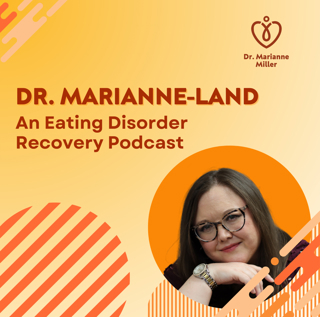
In this episode, Dr. Marianne explores how fear of uncertainty operates underneath many eating disorder behaviors and why letting go of control can feel destabilizing. She explains the psychology of intolerance of uncertainty and how eating disorders such as anorexia, bulimia, binge eating disorder, and ARFID can develop as attempts to create predictability in an overwhelming world.

Intolerance of Uncertainty and Eating Disorders

Many people with eating disorders experience what psychologists call intolerance of uncertainty. This means the brain interprets ambiguity and unpredictability as unsafe. Instead of thinking “I don’t know what will happen but I can cope,” the nervous system may assume that something bad will happen if there is not a clear plan or outcome.

Eating disorder behaviors can temporarily reduce this distress. Restrictive eating, binge eating, purging, body checking, and rigid food rules can create the illusion of certainty. These patterns often lower anxiety in the short term, which reinforces the cycle and makes recovery feel more intimidating.

Dr. Marianne explains how this dynamic shows up in eating disorder recovery and why the loss of rigid control can trigger powerful anxiety responses.

Why Uncertainty Feels Especially Hard for Neurodivergent People

For many listeners, fear of uncertainty is intensified by neurodivergence, trauma history, or systemic stress. Changes in routine, fluctuating internal cues, sensory differences, and executive functioning challenges can all make unpredictability feel overwhelming.

Dr. Marianne discusses how autism, ADHD, and other neurodivergent experiences can interact with eating disorders and recovery. She also highlights how weight stigma, ableism, racism, and other systemic pressures can make uncertainty in eating disorder recovery feel even riskier.

Understanding these contexts helps shift the conversation from shame to compassion.

Microdosing Uncertainty in Eating Disorder Recovery

A key concept introduced in this episode is microdosing uncertainty. Instead of forcing dramatic change, recovery can involve practicing small, manageable exposures to unpredictability.

Dr. Marianne explains how gradually introducing small shifts in eating patterns, routines, or body-related behaviors can help retrain the nervous system. These repeated experiences allow the brain to learn that uncertainty does not automatically lead to catastrophe.

Microdosing uncertainty can help expand the window of tolerance and make eating disorder recovery feel more sustainable.

Five Practical Skills for Managing Fear of Uncertainty

This episode also explores five practical skills that can help people tolerate uncertainty in eating disorder recovery.

Dr. Marianne discusses the importance of practicing small exposures to uncertainty, accurately naming nervous system reactions, creating compassionate structure that reduces overwhelm, regulating anxiety through body-based techniques, and cultivating contextual self-compassion.

These skills help widen emotional capacity so recovery does not feel like stepping into chaos. Instead, listeners can gradually build confidence in their ability to navigate unpredictability.

Related Episodes

An Open Letter to the Body: Listening to the Part That Fears Getting Better on Apple and Spotify.

Eating Disorders as Safety Systems: Why Letting Go Can Trigger Fear on Apple and Spotify.

If Recovery Feels Unsafe Right Now: A Guided Moment for Eating Disorder Recovery Fear on Apple and Spotify.

Expanding Freedom Beyond Eating Disorder Rules

Eating disorders often promise certainty, but they narrow life in the process. Recovery may introduce unpredictability, yet it also expands possibilities for nourishment, flexibility, connection, and autonomy.

Dr. Marianne emphasizes that recovery is not about eliminating uncertainty. The goal is to build the capacity to live meaningfully alongside it.

Therapy and Self-Paced Eating Disorder Recovery Courses

If this episode resonates with you and you are looking for additional support, you can visit Dr. Marianne’s website to learn more about therapy and self-paced recovery courses.

Dr. Marianne is a Licensed Marriage and Family Therapist specializing in eating disorders, including ARFID, binge eating disorder, anorexia, and bulimia. She offers therapy services in California, Texas, and Washington DC and provides virtual courses for people seeking flexible recovery resources.

You can learn more about therapy and courses at drmariannemiller.com.

Denne episoden er hentet fra en åpen RSS-feed og er ikke publisert av Podme. Den kan derfor inneholde annonser.

Episoder(351)

Have a Chronic Eating Disorder? Why Late-Diagnosed ADHD May Have Been the Issue All Along

Have a Chronic Eating Disorder? Why Late-Diagnosed ADHD May Have Been the Issue All Along

ADHD and eating disorders often overlap in ways that treatment misses. For adults with late-diagnosed ADHD, chronic restriction, binge eating, bulimia, ARFID, food inconsistency, and repeated eating d...

23 Sep 20min

Eating Disorders in Midlife: Rebuilding Trust With Food & Your Body With Amber Caudle

Eating Disorders in Midlife: Rebuilding Trust With Food & Your Body With Amber Caudle

Binge eating recovery requires more than changing what or how you eat. Chef, eating psychology coach, and author Amber Caudle joins Dr. Marianne to discuss her 30-year struggle with binge eating, rest...

21 Sep 33min

ARFID & PDA: Why Eating Can Feel Like a Demand Even When No One Is Pressuring You

ARFID & PDA: Why Eating Can Feel Like a Demand Even When No One Is Pressuring You

ARFID and PDA can make eating feel difficult even when no one is telling you what, when, or how much to eat. For autistic and neurodivergent people with Avoidant/Restrictive Food Intake Disorder (ARFI...

18 Sep 15min

Tradwives, Disordered Eating, & the Thin Ideal: Why Young Women Are Being Told to Shrink Again

Tradwives, Disordered Eating, & the Thin Ideal: Why Young Women Are Being Told to Shrink Again

Tradwife culture is having a moment, but what happens when traditional femininity, purity culture, the thin ideal, and disordered eating begin to overlap? In this SOLO episode, Dr. Marianne Miller exa...

16 Sep 20min

Is Eating Disorder Recovery a Form of Neurodivergence? Diet Culture, Hunger, & Body Trust With Shira Collings, LPC

Is Eating Disorder Recovery a Form of Neurodivergence? Diet Culture, Hunger, & Body Trust With Shira Collings, LPC

Eating disorder recovery often requires developing a relationship with food, hunger, movement, and body size that differs sharply from what society considers “normal.” In this conversation, Dr. Marian...

14 Sep 27min

Autism, Food Rigidity, & Eating Disorders: How Autistic Traits Can Help & Hinder Recovery

Autism, Food Rigidity, & Eating Disorders: How Autistic Traits Can Help & Hinder Recovery

Autism and eating disorders can create a complicated relationship with food rigidity, routines, sensory needs, and predictability. For autistic people recovering from anorexia, ARFID, bulimia, or othe...

11 Sep 19min

Why Is Eating Disorder Recovery So Scary? Understanding Fear, Safety, & Letting Go

Why Is Eating Disorder Recovery So Scary? Understanding Fear, Safety, & Letting Go

Eating disorder recovery can feel surprisingly scary, even when you genuinely want to get better. Letting go of restriction, binge eating, purging, compulsive exercise, food rules, or body checking ca...

9 Sep 15min

How to Help Your Child With an Eating Disorder: Replacing Control With Connection With Dr. Tom Wooldridge

How to Help Your Child With an Eating Disorder: Replacing Control With Connection With Dr. Tom Wooldridge

Supporting a child or teen with an eating disorder can leave parents caught between the urgency to help them eat and the fear that increasing control will create more conflict around food. In this epi...

7 Sep 32min

Populært innen Helse

fastlegen
rss-gukild-johaug
psykodrama
hvordan-har-du-det-mann
relasjonspodden-med-dora-thorhallsdottir-kjersti-idem
leger-om-livet
rss-skravla-gar
foreldreradet
g-punktet
morten-ramm-lar-kakla-ga-til-du-sovner
rss-loping-for-nybegynnere
klimaks
bak-fasaden-en-reise-i-livet-med-sykepleier-ine
rss-dagen-for-dagen
treningsprat
rss-lopedrommen
hjernesterk
kjed-deg-i-sovn-verdens-kjedeligste-podcast
rss-kunsten-a-leve
helsetipspodden