Echoes of Annihilation: Solving the 10 MeV Mystery of GRB 221009A

Echoes of Annihilation: Solving the 10 MeV Mystery of GRB 221009A

In this episode, we dive into the fascinating astrophysics surrounding GRB 221009A, the brightest gamma-ray burst observed to date. While its sheer energy is staggering, we focus on an even more intriguing puzzle: an unprecedented, narrow emission line at around 10 MeV discovered shortly after the burst's brightest peak.


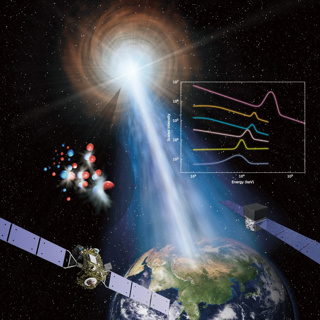
We explore a groundbreaking new study that explains this 10 MeV line as the result of a massive annihilation of electron-positron pairs. We break down the proposed scenario in which the GRB's precursor blastwave was illuminated by the burst's main event, triggering copious pair creation that resulted in a "pair bubble bursting". Because this annihilation happened so quickly as the shell expanded relativistically, the resulting line evolution is dominated by what astrophysicists call the high-latitude emission (HLE) effect.


Furthermore, we examine what this means for the actual star that caused the burst. To make this model work, the progenitor star must have been surrounded by an incredibly dense circum-stellar medium (CSM) extending out to a few $10^{15}$ cm, reminiscent of the dense environments found around Type IIn supernovae. Finally, we'll connect these findings to the sharp rise in the TeV afterglow observed by the LHAASO observatory, which the researchers attribute to the main ejecta colliding with this pair-enriched blastwave.


Key Takeaways:

  • The 10 MeV Emission Line: How high-latitude emission from a geometrically thin, relativistically expanding shell explains this rare spectral feature.
  • Pair Production and Annihilation: The mechanism where gamma-rays from the main event interact with a precursor blastwave to create extreme numbers of electron-positron pairs.
  • Clues About the Progenitor Star: Why the presence of a dense circum-stellar medium suggests the dying star underwent an intense mass-loss phase in the years just prior to its explosion.
  • Solving the LHAASO Afterglow Mystery: How the collision between the main event ejecta and the pair-loaded blastwave perfectly accounts for the sudden, sharp rise in the TeV afterglow.


Episode Reference:

Salafia, O. S., Celotti, A., Sobacchi, E., Nava, L., Oganesyan, G., Ghirlanda, G., Boula, S., Ravasio, M. E., & Ghisellini, G. (2026). A self-consistent explanation of the MeV line in GRB 221009A unveils a dense circum-stellar medium. Astronomy & Astrophysics.


Acknowledements: Podcast prepared with Google/NotebookLM. Illustration credits: Jingchuan Yu

Denne episoden er hentet fra en åpen RSS-feed og er ikke publisert av Podme. Den kan derfor inneholde annonser.

Episoder(104)

Decoding the BOAT: GRB 221009A and the Hunt for High-Energy Neutrinos

Decoding the BOAT: GRB 221009A and the Hunt for High-Energy Neutrinos

In this episode, we dive into the astrophysics behind GRB 221009A, an event widely known as the Brightest-Of-All-Time (BOAT) gamma-ray burst. Detected in October 2022, this extraordinary explosion sha...

16 Jun 20min

FRB 20191221A or "the telescope that hallucinated in the rain"

FRB 20191221A or "the telescope that hallucinated in the rain"

In 2022, the astronomy community was buzzing about FRB 20191221A, an unusual Fast Radio Burst that made headlines for exhibiting a highly significant 217-millisecond periodicity. But what if this grou...

10 Jun 20min

Record-Breaker: Catching Gamma Rays from the Distant Quasar OP 313

Record-Breaker: Catching Gamma Rays from the Distant Quasar OP 313

In this episode, we dive into a groundbreaking astronomical discovery: the detection of very-high-energy (VHE) gamma rays from the quasar OP 313. Located at a redshift of $z = 0.997$, OP 313 has shatt...

1 Jun 20min

Ripples in Spacetime: Unpacking the GWTC-5.0 Catalog

Ripples in Spacetime: Unpacking the GWTC-5.0 Catalog

In this episode, we dive into the monumental release of the Gravitational-Wave Transient Catalog version 5.0 (GWTC-5.0) and the open data from the second part of the fourth observing run (O4b) by the ...

29 Mai 21min

SN 2017egm : Fermi-LAT's Breakthrough Gamma-Ray Detection

SN 2017egm : Fermi-LAT's Breakthrough Gamma-Ray Detection

In today’s episode, we dive into the mystery of superluminous supernovae (SLSNe)—rare, extreme astronomical events that shine 10 to 100 times brighter than standard core-collapse supernovae. For years...

22 Mai 23min

Supernovae on the RISE: Why Dead Stars Wake Up Decades Later

Supernovae on the RISE: Why Dead Stars Wake Up Decades Later

In this episode, we explore the fascinating phenomenon of core-collapse supernovae that refuse to fade away quietly. Years, or even decades, after their initial explosion, some of these stellar deaths...

20 Mai 17min

The SVOM Satellite: A New Era in Multi-Messenger Astronomy

The SVOM Satellite: A New Era in Multi-Messenger Astronomy

In this episode, we dive into the fascinating world of gamma-ray bursts (GRBs) and high-energy transients through the lens of the SVOM (Space-based Multi-band Variable Object Monitor) mission. Launche...

29 Apr 24min

Populært innen Vitenskap

fastlegen
tingenes-tilstand
jss
liberal-halvtime
forskningno
rekommandert
sinnsyn
tomprat-med-gunnar-tjomlid
villmarksliv
rss-nysgjerrige-norge
rss-overskuddsliv
rss-paradigmepodden
rss-inn-til-kjernen-med-sunniva-rose
dekodet-2
noen-har-snakket-sammen
nevropodden
rss-ingeniorpodden
vett-og-vitenskap-med-gaute-einevoll
utenrikshospitalet
hva-er-greia-med