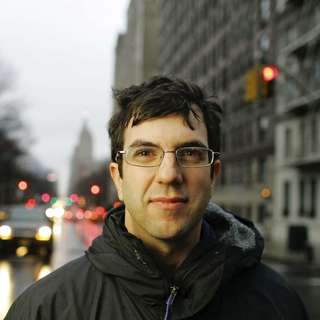

#79 – A.J. Jacobs on radical honesty, following the whole Bible, and reframing global problems as puzzles

#79 – A.J. Jacobs on radical honesty, following the whole Bible, and reframing global problems as puzzles

Today’s guest, New York Times bestselling author A.J. Jacobs, always hated Judge Judy. But after he found out that she was his seventh cousin, he thought, "You know what? She's not so bad."

Hijacking this bias towards family and trying to broaden it to everyone led to his three-year adventure to help build the biggest family tree in history.

He’s also spent months saying whatever was on his mind, tried to become the healthiest person in the world, read 33,000 pages of facts, spent a year following the Bible literally, thanked everyone involved in making his morning cup of coffee, and tried to figure out how to do the most good. His next book will ask: if we reframe global problems as puzzles, would the world be a better place?

Links to learn more, summary and full transcript.

This is the first time I’ve hosted the podcast, and I’m hoping to convince people to listen with this attempt at clever show notes that change style each paragraph to reference different A.J. experiments. I don’t actually think it’s that clever, but all of my other ideas seemed worse. I really have no idea how people will react to this episode; I loved it, but I definitely think I’m more entertaining than almost anyone else will. (Radical Honesty.)

We do talk about some useful stuff — one of which is the concept of micro goals. When you wake up in the morning, just commit to putting on your workout clothes. Once they’re on, maybe you’ll think that you might as well get on the treadmill — just for a minute. And once you’re on for 1 minute, you’ll often stay on for 20. So I’m not asking you to commit to listening to the whole episode — just to put on your headphones. (Drop Dead Healthy.)

Another reason to listen is for the facts:

  • The Bayer aspirin company invented heroin as a cough suppressant
  • Coriander is just the British way of saying cilantro
  • Dogs have a third eyelid to protect the eyeball from irritants
  • A.J. read all 44 million words of the Encyclopedia Britannica from A to Z, which drove home the idea that we know so little about the world (although he does now know that opossums have 13 nipples) (The Know-It-All.)

One extra argument for listening: If you interpret the second commandment literally, then it tells you not to make a likeness of anything in heaven, on earth, or underwater — which rules out basically all images. That means no photos, no TV, no movies. So, if you want to respect the Bible, you should definitely consider making podcasts your main source of entertainment (as long as you’re not listening on the Sabbath). (The Year of Living Biblically.)

I’m so thankful to A.J. for doing this. But I also want to thank Julie, Jasper, Zane and Lucas who allowed me to spend the day in their home; the construction worker who told me how to get to my subway platform on the morning of the interview; and Queen Jadwiga for making bagels popular in the 1300s, which kept me going during the recording. (Thanks a Thousand.)

We also discuss:
• Blackmailing yourself
• The most extreme ideas A.J.’s ever considered
• Doing good as a writer
• And much more.

Chapters:

  • Rob’s intro (00:00:00)
  • The interview begins (00:01:51)
  • Puzzles (00:05:41)
  • Radical honesty (00:12:18)
  • The Year of Living Biblically (00:24:17)
  • Thanks A Thousand (00:38:04)
  • Drop Dead Healthy (00:49:22)
  • Blackmailing yourself (00:57:46)
  • The Know-It-All (01:03:00)
  • Effective altruism (01:31:38)
  • Longtermism (01:55:35)
  • It’s All Relative (02:01:00)
  • Journalism (02:10:06)
  • Writing careers (02:17:15)
  • Rob’s outro (02:34:37)

Producer: Keiran Harris
Audio mastering: Ben Cordell
Transcriptions: Zakee Ulhaq

Episoder(332)

#19 - Samantha Pitts-Kiefer on working next to the White House trying to prevent nuclear war

#19 - Samantha Pitts-Kiefer on working next to the White House trying to prevent nuclear war

Rogue elements within a state’s security forces enrich dozens of kilograms of uranium. It’s then assembled into a crude nuclear bomb. The bomb is transported on a civilian aircraft to Washington D.C, ...

14 Feb 20181h 4min
#18 - Ofir Reich on using data science to end poverty & the spurious action-inaction distinction

#18 - Ofir Reich on using data science to end poverty & the spurious action-inaction distinction

Ofir Reich started out doing math in the military, before spending 8 years in tech startups - but then made a sharp turn to become a data scientist focussed on helping the global poor. At UC Berkeley...

31 Jan 20181h 18min

#17 - Will MacAskill on moral uncertainty, utilitarianism & how to avoid being a moral monster

#17 - Will MacAskill on moral uncertainty, utilitarianism & how to avoid being a moral monster

Immanuel Kant is a profoundly influential figure in modern philosophy, and was one of the earliest proponents for universal democracy and international cooperation. He also thought that women have no ...

19 Jan 20181h 52min

#16 - Michelle Hutchinson on global priorities research & shaping the ideas of intellectuals

#16 - Michelle Hutchinson on global priorities research & shaping the ideas of intellectuals

In the 40s and 50s neoliberalism was a fringe movement within economics. But by the 80s it had become a dominant school of thought in public policy, and achieved major policy changes across the Englis...

22 Des 201755min

#15 - Phil Tetlock on how chimps beat Berkeley undergrads and when it’s wise to defer to the wise

#15 - Phil Tetlock on how chimps beat Berkeley undergrads and when it’s wise to defer to the wise

Prof Philip Tetlock is a social science legend. Over forty years he has researched whose predictions we can trust, whose we can’t and why - and developed methods that allow all of us to be better at p...

20 Nov 20171h 24min
#14 - Sharon Nunez & Jose Valle on going undercover to expose animal abuse

#14 - Sharon Nunez & Jose Valle on going undercover to expose animal abuse

What if you knew that ducks were being killed with pitchforks? Rabbits dumped alive into containers? Or pigs being strangled with forklifts? Would you be willing to go undercover to expose the crime? ...

13 Nov 20171h 25min

#13 - Claire Walsh on testing which policies work & how to get governments to listen to the results

#13 - Claire Walsh on testing which policies work & how to get governments to listen to the results

In both rich and poor countries, government policy is often based on no evidence at all and many programs don’t work. This has particularly harsh effects on the global poor - in some countries governm...

31 Okt 201752min

#12 - Beth Cameron works to stop you dying in a pandemic. Here’s what keeps her up at night.

#12 - Beth Cameron works to stop you dying in a pandemic. Here’s what keeps her up at night.

“When you're in the middle of a crisis and you have to ask for money, you're already too late.” That’s Dr Beth Cameron, who leads Global Biological Policy and Programs at the Nuclear Threat Initiative...

25 Okt 20171h 45min

Populært innen Fakta

fastlegen
dine-penger-pengeradet
relasjonspodden-med-dora-thorhallsdottir-kjersti-idem
mikkels-paskenotter
foreldreradet
rss-strid-de-norske-borgerkrigene
treningspodden
rss-bisarr-historie
jakt-og-fiskepodden
rss-sunn-okonomi
sinnsyn
takk-og-lov-med-anine-kierulf
ukast
hverdagspsyken
rss-bak-luftfarten
gravid-uke-for-uke
lederskap-nhhs-podkast-om-ledelse
fryktlos
level-up-med-anniken-binz
tomprat-med-gunnar-tjomlid