Yale Center for Emotional Intelligence Founder,  Marc Brackett, on his new book "Permission to Feel"

Yale Center for Emotional Intelligence Founder, Marc Brackett, on his new book "Permission to Feel"

Watch this interview on YouTube here.

Marc Brackett, Ph.D., [i]is the Founder and Director of the Yale Center for Emotional Intelligence [ii]and a Professor in the Child Study Center of Yale University. He is the lead developer of the RULER approach,[iii] (the 5 skills of emotional intelligence). RULER is an evidence-based approach to social and emotional learning that has been adopted by nearly 2,000 pre-K through high schools across the United States and in other countries and the approach is seeing huge success.[iv] He also serves on the Board of Directors for the Collaborative for Academic, Social, and Emotional Learning (known as CASEL)[v]. Marc’s new book, Permission to Feel (Celadon/Macmillan) inspires a new mindset around the power of emotions to transform our lives. Instead of the idea that our “emotions get in the way of our success, they are actually the key to it.”[vi] Using science, passion, and lively storytelling, this book serves as a guide for understanding our own and others’ emotions, as well as provides innovative strategies for developing emotional intelligence in adults and children so that emotions help, rather than hinder, our success and well-being. I haven’t been able to put his book down because it captivated me!

Welcome Marc!

Q1: I am thrilled, excited, motivated, and inspired to be speaking with you—all of those yellow (high energy and pleasant feelings) on your Mood Meter Chart—that tool you developed to help people become aware of their feelings—that’s in the first few pages of your book. I actually watched your Talk at Google[vii] and learned so much—before I had started to read “Permission to Feel” I thought I would introduce this concept of “how do you feel” to my girls (ages 10 and 8) and that it would be just like how we added Growth Mindset into our homework slot. But I had an eye-opening situation that showed me we are not as emotionally literate as I had thought in my household. Can I tell you the story of what happened to get your point of view on the situation? So, a couple of weekends ago we went to see the movie, Lion King, and my two girls were the only kids in the theatre bawling their eyes out when Musafa, the Dad, dies. I thought, let me see if I can give them “Permission to Feel” and implement Marc’s book —so I say, “Why are you crying?” expecting they would say “because the Dad died and I don’t want my Dad to die” and we would start a conversation about that but my oldest just grunted and pushed me away, and the youngest was crying too hard to say anything at all. I realized that we could be doing a better job with talking about emotions in our home. Marc, what happens when we deny the “Permission to Feel” and where would you suggest anyone begin when implementing your RULER approach, whether we are a parent, teacher or employee in the workplace?

Q2: Now that I know this approach—and know that knowledge and application are poles apart, can you explain what are the biggest things we should avoid, and what should we watch for to be sure we are properly implementing the RULER approach?

Q3: When I first opened your book “Permission to Feel” and saw the Mood Meter Chart I went straight to where I hang out most of the time. (Upbeat, cheerful, lively, focused, and joyful) that’s me—but to get here—takes daily work (meditation and exercise) that has taken some time to figure out what I must do to be my best self. Then I thought about some other people in my world working in high stress careers who hang out in stressed, anxious, frustrated, and worried with different work responsibilities and priorities. What are some strategies you suggest helping people who might be hanging out in the red quadrant who are pressed for time to create this work/life balance?

Q4: Can you give a quick background for why this book is so important and timely with such a rise in mental health issues these days? We all know the shocking statistics for our nation’s youth with the current suicide epidemic, and depression and anxiety being common in kids at young ages these days. How did we arrive at this place where we still struggle to talk about how we feel—how even the most educated in this field could use some help, especially with the first 3 strategies of recognizing, understanding and labelling our own and other people’s emotions?

Q5: Self-regulation is always the most requested topic I hear when I’m working with a school. I heard you mention how important this skill is even for those in the workplace. In one of your most recent interviews, you mentioned that “people don’t lose their jobs because of their abilities in the cognitive areas, it’s usually because of their inability to regulate.”[viii] What does the research tell us about the parts of our life that emotions drive so we can improve these life skills and increase our performance? How can we learn the language and strategies to better manage our emotions?

Q6: What is your vision for “Permission to Feel” and the work you are doing with the Yale Center of Emotional Intelligence and anything important that you would like to add that we might have missed?

Thank you so much Marc for writing this book the way that you did, sharing your true self, to show the importance of feeling the emotions in our lives, so that we can truly reach those higher levels of achievement. If anyone wants to reach you, what is the best way? To buy the book you can go to http://www.marcbrackett.com/ I also saw that you are starting a new blog to help people to become emotion scientists. Where can we find more about this? I will be sure to follow the blog and keep you posted on our results as we implement the RULER approach in our home. Thank you Marc!

[i] https://www.marcbrackett.com/

[ii] http://ei.yale.edu/

[iii] https://www.rulerapproach.org/

[iv] https://www.gettingsmart.com/2019/09/permission-to-feel-the-link-between-emotional-intelligence-and-academic-success/

[v] https://casel.org/

[vi] https://www.gettingsmart.com/2019/09/permission-to-feel-the-link-between-emotional-intelligence-and-academic-success/

[vii] Marc Brackett Emotional Intelligence as a Superpower Published July 31, 2017 https://www.youtube.com/watch?v=JcFefehMpZ0

[viii] https://www.pbs.org/wnet/amanpour-and-company/video/marc-brackett-on-the-importance-of-emotional-intelligence/

Denne episoden er hentet fra en åpen RSS-feed og er ikke publisert av Podme. Den kan derfor inneholde annonser.

Episoder(414)

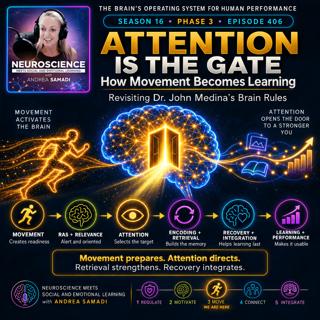
Attention Is the Gate—How Movement Becomes Lasting Learning with Dr. John Medina

Attention Is the Gate—How Movement Becomes Lasting Learning with Dr. John Medina

Episode 406 explains how movement prepares the brain but does not guarantee learning. It traces the full sequence—movement, RAS-driven readiness, salience and relevance, focused attention, encoding, r...

6 Sep 46min
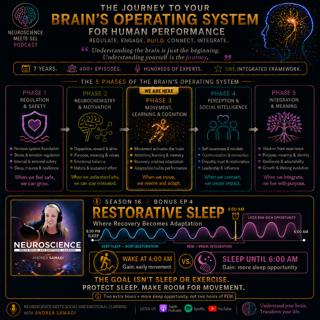
The 4:00 AM Tradeoff: Movement, REM and Recovery (Bonus Episode)

The 4:00 AM Tradeoff: Movement, REM and Recovery (Bonus Episode)

In this episode Andrea Samadi explores how movement and sleep work together in a "brain operating system" for human performance, focusing on restorative sleep (deep + REM), personal WHOOP data, and th...

30 Aug 29min
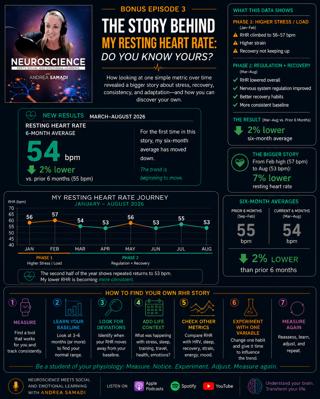
The Hidden Story Behind Your Resting Heart Rate: What Your RHR Can Reveal About Stress, Recovery & Adaptation

The Hidden Story Behind Your Resting Heart Rate: What Your RHR Can Reveal About Stress, Recovery & Adaptation

Andrea Samadi shares her personal resting heart rate data to show why measuring over time matters more than fixating on a single score. She explains how trends reveal stress, recovery, and adaptation,...

23 Aug 30min
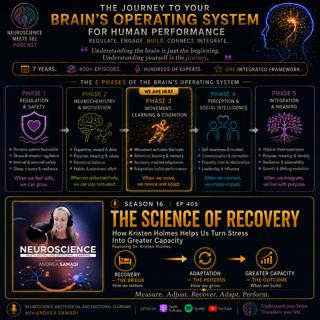
The Science of Recovery—How Dr. Kristen Holmes Helps Us Turn Stress Into Greater Capacity

The Science of Recovery—How Dr. Kristen Holmes Helps Us Turn Stress Into Greater Capacity

In this episode Andrea Samadi explores Phase 3 of the Brain's Operating System—movement, learning, and cognition—focusing on the recovery and adaptation side of the "movement loop." She revisits Dr. K...

16 Aug 45min
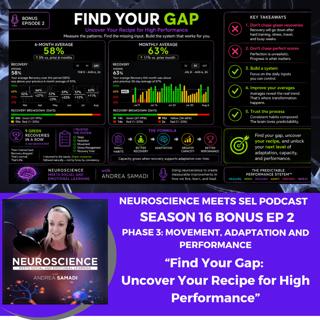
Find Your Gap: How Recovery Unlocks Predictable Performance (Bonus Episode)

Find Your Gap: How Recovery Unlocks Predictable Performance (Bonus Episode)

In this bonus episode Andrea Samadi introduces the Predictable Performance System, a practical roadmap from her Brain’s Operating System. She shows how measuring patterns—not chasing daily scores—plus...

9 Aug 30min
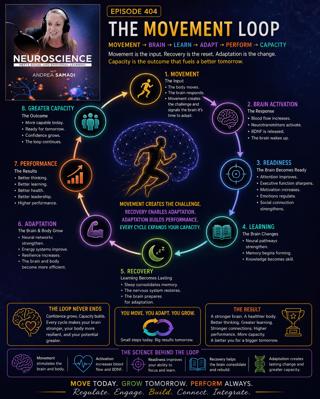
Dr. John Ratey and The Movement Loop: How Movement Becomes Human Performance

Dr. John Ratey and The Movement Loop: How Movement Becomes Human Performance

In this episode Andrea Samadi explores Phase Three of the Brain’s Operating System — how movement acts as the essential input that activates the brain, sharpens attention, boosts learning, and improve...

2 Aug 21min
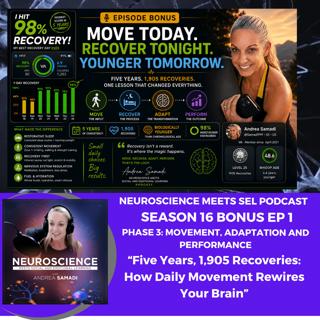
Five Years, 1,905 Recoveries: How Daily Movement Rewires Your Brain (Bonus Episode)

Five Years, 1,905 Recoveries: How Daily Movement Rewires Your Brain (Bonus Episode)

Andrea Samadi shares a five-year self-experiment using a WHOOP wearable to track sleep, recovery, movement, and biological age. She reveals how daily low-intensity movement and consistent recovery—not...

25 Jul 16min
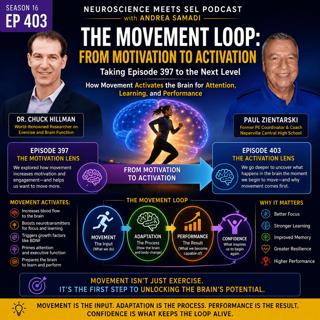
The Movement Loop: How Movement Activates the Brain for Learning, Adaptation & Performance

The Movement Loop: How Movement Activates the Brain for Learning, Adaptation & Performance

Welcome back to Season 16 of the Neuroscience Meets Social and Emotional Learning Podcast. I'm Andrea Samadi, and this is where we bridge neuroscience, social and emotional learning, and human perform...

19 Jul 34min

Populært innen Fakta

fastlegen
dine-penger-pengeradet
relasjonspodden-med-dora-thorhallsdottir-kjersti-idem
foreldreradet
rss-orjasater
treningspodden
rss-strid
jakt-og-fiskepodden
rss-kunsten-a-leve
hverdagspsyken
sinnsyn
mikkels-paskenotter
tomprat-med-gunnar-tjomlid
rss-var-forste-kaffe
gravid-uke-for-uke
branncast
babyverden
lederskap-nhhs-podkast-om-ledelse
fryktlos
level-up-med-anniken-binz