Director of Rutgers SEL and Character Development Lab, Maurice J. Elias on "Boosting Emotional Intelligence Through Sports, Academics and Character."

Director of Rutgers SEL and Character Development Lab, Maurice J. Elias on "Boosting Emotional Intelligence Through Sports, Academics and Character."

Welcome back to the Neuroscience Meets Social and Emotional Learning podcast, episode #75 with Maurice Elias, a Professor of Psychology at Rutgers University[i], Director of the Rutgers Social-Emotional Learning Lab[ii], Academic Director of The Collaborative Center for Community-Based Research and Service at Rutgers and he is one of the members of CASEL (Collaborative for Social and Emotional Learning) which our listeners will know as a trusted source for knowledge about high-quality, evidence-based social and emotional learning programs.[iii] Prof. Elias lectures nationally and internationally to educators and parents about students’ emotional intelligence, school success, and social-emotional and character development. Among Dr. Elias’ numerous books are ASCD’s Promoting Social and Emotional Learning: Guidelines for Educators, the Social Decision Making/Social Problem-Solving curricula for grades k-8, Emotionally Intelligent Parenting, and many others that I will reference in this interview.

Watch the interview on YouTube here.

Podcast Introduction and Backstory of Maurice Elias

My name is Andrea Samadi, I’m a former educator who created this podcast to bring the most current neuroscience research, matched with social and emotional skills, with interviews from experts who have risen to the top of their field with specific strategies or ideas that you can implement immediately, to take your results to the next level. My vision is to bring the experts to you, and help you to implement their proven strategies, whether you are a teacher working in the classroom or online, a student, or parent working in the corporate space, for immediate results.

When I was first introduced to Maurice Elias, it was from Corwin Press’s Marketing Department, who explained to me that his work fit directly into what we are doing with this podcast. When I looked at his website, and the Rutgers Social and Emotional Learning lab, it looked familiar—I know I have been on his page before, while researching leaders in this field, and within a minute of watching a YouTube video of his work from back in 2010[iv] that describes Emotion in Education, I wish I had been introduced to him 10 years ago.

Welcome Maurice, it’s wonderful to meet you.

Thank you so much for agreeing so quickly to share all the work you have been doing to transform education. After reading a couple of your books, I couldn’t stop thinking about what would have happened, if I had met you 10 years ago when I worked at Pearson Education...

At that time, I was working as a sales rep, selling programs and services to the school market and someone reminded me recently of how hard I tried to put social and emotional learning content into one of the products we were selling. For those who have been following this podcast, you will know that I have had this vision for teaching these skills in the classroom for the past 20 years, and finally decided to approach Pearson’s Product Development team with this vision and was told “let’s take it slow, and poll some educators, and see how they respond.” It just wasn’t the right time. If only I had met you back then, Maurice, I would have just played the video I saw of you in 2010 called Emotions in Education to help them catch the vision that you explained in be “the foundation of what learning is all about.”[v] I would have had the right person, with the right sense of the urgency for this vision but so glad to be meeting you now!

Q1: Maurice, as a Professor of Psychology at Rutgers University and the Director of the Social-Emotional and Character Development Lab that guides school-based efforts on SEL and character development, I wonder how and when your vision for SEL and Character began and what’s the vision that you hold now for your SECD lab[vi] and SEL in schools?

Q2: I’ve always thought that character was an integral component to SEL and I can see that you agree calling your lab social and emotional and character lab. Can you explain the idea that Character has two essential parts: moral character and performance character that you talk about in your book The Other Side of the Report Card[vii]?

Q3: I know that many educators want to improve their students’ social and emotional intelligence, but don’t know where to begin. In your book The Educators Guide to Emotional Intelligence and Academic Achievement[viii], you mention some first steps that educators should consider when implementing these ideas into the classroom (in person or virtual classroom)? I read your article about creating buy in for educators[ix], but what else should they consider? How can they best prepare for their vision of integrating these skills into the classroom?

Q4: What about parents who want to raise emotionally intelligent children, (which is all of us) and especially children who have the ability to think and make decisions. In your book, Emotionally Intelligent Parenting,[x] you take some of the principles from Daniel Goldman’s bestseller, Emotional Intelligence[xi] and explain how they can be applied to successful parenting. Can you explain a couple of these principles and why we its crucial to be teaching them at home to our children?

Q5: I loved the article you published for Parent Toolkit (I saw it on LinkedIn about how watching sports with your children can boost their SEL/Emotional Intelligence skills).[xii] I absolutely loved this idea, as I never thought about this connection but there was this one time, we were at a baseball game with my 2 girls, ages 10 and 8 and we watched Wilson Ramos[xiii] (Ra-Mos) meditate away from some other players who were warming up, before a game. We did talk about it, but I never thought about going deeper with this like you did with this article. (Talking about focus, the athlete’s preparation and practice, emotion regulation, goal setting, problem solving, planning, teamwork, building resiliency and overcoming obstacles). I know it’s going to be awhile since we are all watching a game like this live, but can you recap these ideas so we can think of creative ways to talk about discussing these skills so we can learn from these athletes?

Q6: It’s definitely been different times the past few months, but I know there is always a positive side to every challenging situation. What do you think are some challenges that educators/parents/families are going to face in the next year, and how can we think of these challenges as learning opportunities to build resilience?

Q7 Final thoughts. Is there anything that we’ve missed that you think is important?

Thank you so much Maurice, for your time today. I’ve thoroughly enjoyed learning more about the work you are doing at Rutgers’s Social and Emotional Learning Lab. My brother in law went to the New Brunswick Campus, and he’s now a Professor at SMU in Texas, and I’ve only heard great things about Rutgers over the years. For those who want to reach you directly, they can go to www.secdlab.org and contact you from there.

RESOURCES:

www.casel.org

www.character.org

Committee for Children https://www.cfchildren.org/

https://sel4us.org/

REFERENCES:

[i] https://psych.rutgers.edu/faculty-profiles-a-contacts/93-maurice-elias

[ii] https://www.secdlab.org/

[iii] https://casel.org/founders/

[iv] Emotion in Education YouTube with Maurice J Elias Published Aug. 4, 2010 https://www.youtube.com/watch?v=7K2uSg-_KlI

[v] Emotions in Education, Maurice J. Elias, YouTube Published August 4, 2010

[vi] Social and Emotional and Character Development Lab https://www.secdlab.org/

[vii] The Other Side of the Report Card by Maurice J. Elias, Joseph Ferrito, and Dominic Moceri. (2015) https://us.corwin.com/en-us/nam/the-other-side-of-the-report-card/book245000

[viii]The Educators Guide to Emotional Intelligence and Academic Achievement by Maurice J. Elias and Harriett Arnold (2006) https://us.corwin.com/en-us/nam/the-educators-guide-to-emotional-intelligence-and-academic-achievement/book226781

[ix] Creating Buy-in for SEL at Your School by Maurice J. Elias Published October 10, 2017 https://www.edutopia.org/article/creating-buy-sel-your-school

[x] Emotionally Intelligent Parenting: How to Raise a Self-Disciplined, Responsible, Socially Skilled Child by Maurice J. Elias, Steven Tobias and Brian S. Friedlander (May 18, 2011) https://www.amazon.com/Emotionally-Intelligent-Parenting-Self-Disciplined-Responsible-ebook/dp/B004G5ZY92

[xi] Emotional Intelligence: Why it Can Matter More than IQ by Daniel Goleman (2009) https://www.amazon.com/dp/B002ROKQNS/ref=dp-kindle-redirect?_encoding=UTF8&btkr=1

[xii] Watch Sports with Your Kid and Build Their SEL/Emotional Intelligence Skills by Maurice J. Elias (Nov. 2018) https://www.linkedin.com/pulse/watch-sports-your-kids-build-selemotional-skills-maurice-elias/

[xiii] Wilson Ramos https://www.mlb.com/player/wilson-ramos-467092

Denne episoden er hentet fra en åpen RSS-feed og er ikke publisert av Podme. Den kan derfor inneholde annonser.

Episoder(406)

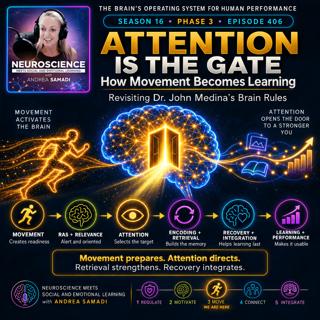
How Movement Builds the Brain, the Body & Human Performance (Phase 3 Introduction)

How Movement Builds the Brain, the Body & Human Performance (Phase 3 Introduction)

Season 16, Episode 402 explores the Brain's Operating System for Human Performance, focusing on Phase 3: movement, adaptation, and performance. Andrea Samadi explains how movement triggers neurochemic...

12 Jul 25min

Trust as the Foundation with Greg Hill: How Great Leaders Create the Conditions for Learning, Growth and Performance

Trust as the Foundation with Greg Hill: How Great Leaders Create the Conditions for Learning, Growth and Performance

In episode 401 Andrea Samadi welcomes Greg Hill to explore why trust is the essential foundation for learning, growth, and high performance. They discuss how trust creates psychological safety, encour...

27 Jun 37min

Episode 400: Sales Leadership Under Pressure with Majid Samadi: 7 Lessons Learned from 7 Years of Neuroscience

Episode 400: Sales Leadership Under Pressure with Majid Samadi: 7 Lessons Learned from 7 Years of Neuroscience

In this milestone episode (400), Andrea Samadi celebrates seven years of the Neuroscience Meets SEL Podcast with her husband Majid Samadi. They reflect on the journey of translating neuroscience into ...

20 Jun 47min

Phase 2 Review: The Motivation Loop: How to Keep Effort Worthwhile

Phase 2 Review: The Motivation Loop: How to Keep Effort Worthwhile

Episode 399 reviews Phase 2 of Season 15 and introduces the Motivation Loop — the sequence of meaning, belief, attention, action, reward, and recovery that drives sustained effort. The episode explain...

14 Jun 28min

Fun, Fear, Focus: Closing the Motivation Loop with Friederike Fabritius

Fun, Fear, Focus: Closing the Motivation Loop with Friederike Fabritius

Episode 398 revisits neuroscientist Friederike Fabritius (from November 2022) to explain how three ingredients — fun (dopamine), fear (productive challenge), and focus — create the neurochemical condi...

9 Jun 23min

Move to Learn: How Movement Activates the Brain and Fuels Motivation (with Dr. Chuck Hillman and Paul Zientarski)

Move to Learn: How Movement Activates the Brain and Fuels Motivation (with Dr. Chuck Hillman and Paul Zientarski)

Season 15, Episode 397 revisits research and real-world practice showing movement is more than fitness: it activates the brain, boosts attention, enhances learning, and sustains motivation. Dr. Chuck ...

31 Mai 35min

Dopamine, Motivation and Why the Brain Repeats Behavior with Dr. Anna Lembke

Dopamine, Motivation and Why the Brain Repeats Behavior with Dr. Anna Lembke

Host Andrea Samadi welcomes Dr. Anna Lembke to explain how pleasure and pain share the same neural circuitry and how dopamine governs motivation. The episode explores why overconsumption of easy rewar...

24 Mai 23min

Theory of Mind: The Missing Link Between Attention, Reward, and Motivation with John Medina

Theory of Mind: The Missing Link Between Attention, Reward, and Motivation with John Medina

Episode 395 explores how theory of mind — our ability to understand others' intentions — drives attention, emotional relevance, and reward, shaping motivation and behavior. Dr. John Medina explains wh...

17 Mai 37min

Populært innen Fakta

fastlegen
dine-penger-pengeradet
relasjonspodden-med-dora-thorhallsdottir-kjersti-idem
foreldreradet
rss-kunsten-a-leve
treningspodden
mikkels-paskenotter
sinnsyn
rss-strid-de-norske-borgerkrigene
tomprat-med-gunnar-tjomlid
gravid-uke-for-uke
jakt-og-fiskepodden
hverdagspsyken
rss-var-forste-kaffe
rss-sarbar-med-lotte-erik
fryktlos
rss-impressions-2
uroskolen
hagespiren-podcast
dopet