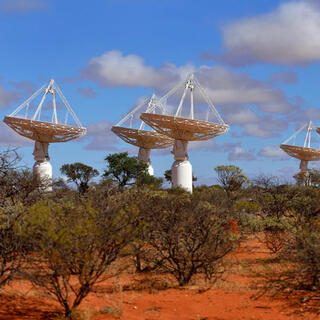
Cosmic Rays and the Hunt for Ultra-High-Energy Photons at the the Pierre Auger Observatory

Cosmic Rays and the Hunt for Ultra-High-Energy Photons at the the Pierre Auger Observatory

**Introduction**

* The podcast discusses the search for **diffuse photons** with energies above tens of PeV, using data from the **Pierre Auger Observatory**.

* These photons are produced by interactions between cosmic rays and interstellar matter or background radiation.

* The measurement of a diffuse photon flux can help us understand the distribution of cosmic rays in the Galaxy and probe models of super-heavy dark matter.


**The Pierre Auger Observatory**

* The observatory uses a surface detector (SD) and an underground muon detector (UMD).

* The SD array consists of **water-Cherenkov detectors (WCDs)**, and the UMD uses **buried scintillators**.

* The study focuses on data from a 2 km² area with 19 WCDs and 11 UMD stations.

* The combination of SD and UMD measurements allows for a more accurate analysis of air showers.


**The Search for Photons**

* Primary photons are difficult to distinguish from the background of charged cosmic rays.

* Photon-initiated air showers are mostly electromagnetic, while hadron-initiated showers have more muons.

* The analysis uses a **muon content estimator (Mb)** to discriminate between photon and hadron events.

* The study uses **15 months of data** collected during the construction of the array.

* A photon-equivalent energy scale is developed for comparing events initiated by different primary species.


**Results and Implications**

* No photon candidate events were identified in the data.

* Upper limits on the integral photon flux were set between 13.3 and 13.8 km−2 sr−1 yr−1 above tens of PeV.

* These limits are the only ones based on measurements from the **Southern Hemisphere** in this energy domain.

* The analysis extends the Pierre Auger Observatory photon search program to lower energies.

* The results provide constraints on models of super-heavy dark matter.

* Future data from the observatory is expected to improve the upper limit by a factor of ~20.


**Article Reference:**

* A. Abdul Halim et al., Search for a diffuse flux of photons with energies above tens of PeV at the Pierre Auger Observatory, 2024,


Acknowledements: Podcast prepared with Google/NotebookLM. Illustration credits: Pierre Auger Observatory

Denne episoden er hentet fra en åpen RSS-feed og er ikke publisert av Podme. Den kan derfor inneholde annonser.

Episoder(101)

Record-Breaker: Catching Gamma Rays from the Distant Quasar OP 313

Record-Breaker: Catching Gamma Rays from the Distant Quasar OP 313

In this episode, we dive into a groundbreaking astronomical discovery: the detection of very-high-energy (VHE) gamma rays from the quasar OP 313. Located at a redshift of $z = 0.997$, OP 313 has shatt...

1 Jun 20min

Ripples in Spacetime: Unpacking the GWTC-5.0 Catalog

Ripples in Spacetime: Unpacking the GWTC-5.0 Catalog

In this episode, we dive into the monumental release of the Gravitational-Wave Transient Catalog version 5.0 (GWTC-5.0) and the open data from the second part of the fourth observing run (O4b) by the ...

29 Mai 21min

SN 2017egm : Fermi-LAT's Breakthrough Gamma-Ray Detection

SN 2017egm : Fermi-LAT's Breakthrough Gamma-Ray Detection

In today’s episode, we dive into the mystery of superluminous supernovae (SLSNe)—rare, extreme astronomical events that shine 10 to 100 times brighter than standard core-collapse supernovae. For years...

22 Mai 23min

Supernovae on the RISE: Why Dead Stars Wake Up Decades Later

Supernovae on the RISE: Why Dead Stars Wake Up Decades Later

In this episode, we explore the fascinating phenomenon of core-collapse supernovae that refuse to fade away quietly. Years, or even decades, after their initial explosion, some of these stellar deaths...

20 Mai 17min

The SVOM Satellite: A New Era in Multi-Messenger Astronomy

The SVOM Satellite: A New Era in Multi-Messenger Astronomy

In this episode, we dive into the fascinating world of gamma-ray bursts (GRBs) and high-energy transients through the lens of the SVOM (Space-based Multi-band Variable Object Monitor) mission. Launche...

29 Apr 24min

Chasing the Flash: Hunting Neutron Star Mergers with CTAO

Chasing the Flash: Hunting Neutron Star Mergers with CTAO

In this episode, we dive into the thrilling world of multi-messenger astronomy! Ever since the historic detection of GW170817, scientists have known that binary neutron star (BNS) mergers can produce ...

14 Apr 19min

Tiling the Sky: A New Strategy for Finding Elusive GRBs

Tiling the Sky: A New Strategy for Finding Elusive GRBs

In this episode, we dive into the intense and fast-paced world of **Gamma-ray bursts (GRBs)—the most luminous and rapidly evolving transients in the Universe**. While space-based instruments like the ...

13 Apr 19min

Fast Radio Bursts & Magnetar X-Rays: A Peculiar Discovery

Fast Radio Bursts & Magnetar X-Rays: A Peculiar Discovery

In this episode, we dive into the deep cosmos to explore a recent astronomical breakthrough linking Fast Radio Bursts (FRBs)—enigmatic, millisecond-long cosmic transients—to extreme stellar objects kn...

7 Apr 22min

Populært innen Vitenskap

fastlegen
tingenes-tilstand
jss
rekommandert
liberal-halvtime
sinnsyn
forskningno
tomprat-med-gunnar-tjomlid
villmarksliv
rss-paradigmepodden
fjellsportpodden
kvinnehelsepodden
tidlose-historier
dekodet-2
rss-zahid-ali-hjelper-deg
rss-overskuddsliv
hva-er-greia-med
rss-rekommandert
rss-inn-til-kjernen-med-sunniva-rose
grunnstoffene