PeV Power from Stellar Explosions: The Role of Dense Environments

PeV Power from Stellar Explosions: The Role of Dense Environments

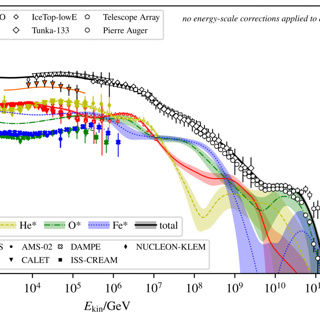
The research investigates how supernovae exploding into dense circumstellar environments, specifically those with dense shells of material, can potentially accelerate particles to energies of a few PeV, thus acting as "PeVatrons" and contributing to the "knee" feature in the cosmic ray spectrum.


Supernova remnants (SNRs) have long been considered prime candidates for the sources of Galactic Cosmic Rays (CRs) up to energies of a few PeV. However, despite decades of gamma-ray astronomy, there hasn't been clear observational proof that standard SNR models can accelerate particles beyond approximately 100 TeV. Young SNRs like Tycho and Casiopeia A, initially expected to be strong accelerators, show even lower cutoff energies.


The presented study explores a different scenario: supernovae that expand into **much denser circumstellar material**, including dense shells ejected by the progenitor star shortly before explosion. These dense shells are thought to be present around massive stars like Luminous Blue Variables (LBVs), which can undergo brief episodes of very high mass-loss rates (up to 1 M⊙/yr). Type IIn supernovae, associated with LBVs, make up about 5% of core-collapse supernovae.


The researchers used spherically symmetric 1D simulations with their time-dependent acceleration code called **RATPaC** (Radiation Acceleration Transport Parallel Code). This code simultaneously solves the transport equations for cosmic rays, magnetic turbulence, and the hydrodynamical flow of the thermal plasma in the test-particle limit. Unlike models that assume a steady state for magnetic turbulence, RATPaC accounts for the time needed for turbulence to build up, which often leads to lower maximum energies in standard scenarios.


**The key finding is that the interaction of the supernova shock front with these dense circumstellar shells can significantly boost the maximum energy** of the accelerated particles.


Specifically, the simulations show that:

* **Interactions with shells that occur earlier post-explosion lead to a greater increase in maximum energy (Emax)**.

* If the interaction happens within the first **5 months (approximately 140 days)** after the explosion, the **Emax can increase to more than 1 PeV**.

* For very early interactions, around **0.1 years**, Emax can even surpass **10 PeV**.


This significant energy boost is attributed to several mechanisms during and after the shock-shell interaction:

1. **Enhanced Particle Escape:** The shock slows down considerably during the interaction with the dense shell, which temporarily enhances the "precursor scale" (the region upstream where particles diffuse back towards the shock, given by D(E)/v_shock). This increased scale provides more time for turbulence to grow. Enhanced particle escape also occurs during the onset of the interaction, boosting the CR current.

2. **Reacceleration in a Pre-amplified Field:** After passing through the shell, the shock propagates into a medium where the magnetic field has been pre-amplified by escaping cosmic rays during the interaction phase. The shock accelerating into this region with an enhanced field boosts Emax.

3. **Interaction with Reflected Shocks:** The collision with the dense shell creates reflected shocks. These can catch up with and interact with the forward shock from behind, leading to sharp increases in the forward shock's velocity and slightly boosting Emax.


Acknowledements: Podcast prepared with Google/NotebookLM. Illustration credits: ESO/L. Calçada

Denne episoden er hentet fra en åpen RSS-feed og er ikke publisert av Podme. Den kan derfor inneholde annonser.

Episoder(101)

Record-Breaker: Catching Gamma Rays from the Distant Quasar OP 313

Record-Breaker: Catching Gamma Rays from the Distant Quasar OP 313

In this episode, we dive into a groundbreaking astronomical discovery: the detection of very-high-energy (VHE) gamma rays from the quasar OP 313. Located at a redshift of $z = 0.997$, OP 313 has shatt...

1 Jun 20min

Ripples in Spacetime: Unpacking the GWTC-5.0 Catalog

Ripples in Spacetime: Unpacking the GWTC-5.0 Catalog

In this episode, we dive into the monumental release of the Gravitational-Wave Transient Catalog version 5.0 (GWTC-5.0) and the open data from the second part of the fourth observing run (O4b) by the ...

29 Mai 21min

SN 2017egm : Fermi-LAT's Breakthrough Gamma-Ray Detection

SN 2017egm : Fermi-LAT's Breakthrough Gamma-Ray Detection

In today’s episode, we dive into the mystery of superluminous supernovae (SLSNe)—rare, extreme astronomical events that shine 10 to 100 times brighter than standard core-collapse supernovae. For years...

22 Mai 23min

Supernovae on the RISE: Why Dead Stars Wake Up Decades Later

Supernovae on the RISE: Why Dead Stars Wake Up Decades Later

In this episode, we explore the fascinating phenomenon of core-collapse supernovae that refuse to fade away quietly. Years, or even decades, after their initial explosion, some of these stellar deaths...

20 Mai 17min

The SVOM Satellite: A New Era in Multi-Messenger Astronomy

The SVOM Satellite: A New Era in Multi-Messenger Astronomy

In this episode, we dive into the fascinating world of gamma-ray bursts (GRBs) and high-energy transients through the lens of the SVOM (Space-based Multi-band Variable Object Monitor) mission. Launche...

29 Apr 24min

Chasing the Flash: Hunting Neutron Star Mergers with CTAO

Chasing the Flash: Hunting Neutron Star Mergers with CTAO

In this episode, we dive into the thrilling world of multi-messenger astronomy! Ever since the historic detection of GW170817, scientists have known that binary neutron star (BNS) mergers can produce ...

14 Apr 19min

Tiling the Sky: A New Strategy for Finding Elusive GRBs

Tiling the Sky: A New Strategy for Finding Elusive GRBs

In this episode, we dive into the intense and fast-paced world of **Gamma-ray bursts (GRBs)—the most luminous and rapidly evolving transients in the Universe**. While space-based instruments like the ...

13 Apr 19min

Fast Radio Bursts & Magnetar X-Rays: A Peculiar Discovery

Fast Radio Bursts & Magnetar X-Rays: A Peculiar Discovery

In this episode, we dive into the deep cosmos to explore a recent astronomical breakthrough linking Fast Radio Bursts (FRBs)—enigmatic, millisecond-long cosmic transients—to extreme stellar objects kn...

7 Apr 22min

Populært innen Vitenskap

fastlegen
tingenes-tilstand
jss
rekommandert
liberal-halvtime
sinnsyn
forskningno
tomprat-med-gunnar-tjomlid
villmarksliv
rss-paradigmepodden
fjellsportpodden
kvinnehelsepodden
tidlose-historier
dekodet-2
rss-zahid-ali-hjelper-deg
rss-overskuddsliv
hva-er-greia-med
rss-rekommandert
rss-inn-til-kjernen-med-sunniva-rose
grunnstoffene