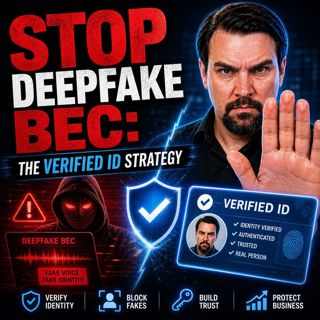

Stop Deepfake BEC: The Verified ID Strategy

Stop Deepfake BEC: The Verified ID Strategy

A wire request lands in your inbox. Everything looks right—the name, the tone, even a voice note that sounds exactly like your CEO. In the past, that was enough. Today, it’s a liability. This episode breaks down a hard truth: trust based on recognition is no longer safe. We’re no longer dealing with crude phishing attempts—we’re facing believable authority powered by AI. Traditional controls like SPF, DKIM, and DMARC still matter, but they only validate the path of a message, not the person behind it. And that gap is exactly where deepfake Business Email Compromise thrives. If your organization still trusts email signals to authorize high-risk actions, you’re already exposed.

THE EMAIL HEADER IS NO LONGER A TRUST SIGNAL

For years, we relied on familiar cues—display names, domains, writing styles—to make quick trust decisions. But AI has erased the old tells. Attackers can now generate flawless messages, mimic executive tone, and align perfectly with real business context. Emails don’t need to look suspicious anymore—they just need to feel familiar for a moment. And sometimes, they’re not even spoofed. They come from real accounts, through trusted SaaS platforms, passing every technical check. That’s the dangerous shift: your security stack sees a valid message, your team sees a believable request—but neither answers the only question that matters—should this action be allowed?

WHAT EMAIL SECURITY PROVES—AND WHAT IT NEVER COULD

Mail authentication validates infrastructure, not intent. SPF confirms sending servers, DKIM ensures message integrity, and DMARC aligns policies—but none of them verify human authority. A perfectly authenticated email can still carry a fraudulent request. That’s not a failure of the tools—it’s a misuse of them. We’ve been asking email security to solve a problem it was never designed to handle. And now, with deepfake voice, cloned writing styles, and AI-driven social engineering, the illusion of legitimacy is stronger than ever. Teams confuse polished communication with real authority—and that’s exactly where attacks succeed.

THE SHIFT: FROM TRUSTING MESSAGES TO VERIFYING ACTIONS

The old model let email carry trust into workflows. The new model demands proof before any action is taken. This is the essence of Zero Trust applied to business processes. Instead of asking “Did this come from a trusted source?”, we must ask, “Can this person prove they have the authority for this decision right now?” That shift moves security from the inbox to the moment of consequence—where money moves, access changes, and critical decisions happen.

ENTRA VERIFIED ID: CHANGING THE UNIT OF TRUST

This is where Microsoft Entra Verified ID transforms the model. Instead of relying on messages, organizations issue verifiable credentials—cryptographically signed proof of identity and authority. These credentials are held by users and presented when required. The system includes three roles: issuer, holder, and verifier. Trust is no longer assumed—it’s requested, presented, and validated. With decentralized identifiers (DIDs) and cryptographic verification, workflows can confirm not just who someone is, but what they are authorized to do. This is a fundamental shift—from identity as recognition to identity as proof.

FROM IDENTITY TO AUTHORITY: THE CRITICAL DESIGN CHANGE

Most organizations get this wrong by stopping at “verified employee.” But identity alone doesn’t stop fraud—authority does. A credential must reflect real business permissions: who can approve payments, who can change vendor data, who can reset executive access. These claims must be precise, enforceable, and tied directly to workflows. Narrow credentials are stronger, easier to govern, and faster to revoke. Because authority changes faster than identity—and stale authority is a hidden risk.

WHERE VERIFIED ID FITS IN A REAL BEC DEFENSE MODEL

Verified ID doesn’t replace your existing controls—it strengthens the point where they fail. Email filtering, MFA, and monitoring reduce noise, but they don’t stop high-quality attacks. Verified ID operates at the moment of decision. An email can trigger a workflow, but it cannot complete it without proof. No credential, no action. This moves trust out of human interpretation and into enforceable, cryptographic validation inside your business systems—finance apps, service desks, and approval workflows.

IMPLEMENTATION: START SMALL, PROVE CONTROL, SCALE FAST

You don’t need a massive transformation to begin. Start with one high-risk workflow—treasury approvals or executive account recovery. Map where trust is assumed and where actions are executed. Insert verification at the decision point. Measure impact: did it block risky actions, how did it affect speed, and where did users struggle? Expect friction, plan for exceptions, and keep fallback paths strict. Then scale by repeating the pattern—not by expanding scope blindly, but by reinforcing control where it matters most.

WHAT LEADERS NEED TO CHANGE NOW

Business Email Compromise is no longer just an email problem—it’s a business process failure. Leaders must ask: which decisions still rely on email trust? Who can actually prove their authority? Where can value move without verification? The answer to those questions defines your real risk posture. The new standard is simple and non-negotiable: no high-risk action without proof of authority.

CONCLUSION: REPLACE RECOGNITION WITH PROOF

Deepfake attacks succeed because we still trust what we recognize. But recognition can be faked. Authority cannot—if it’s verified properly. The trust model has already failed. The only question is how fast you replace it. If this episode changed how you think about security, follow Mirko Peters on LinkedIn and leave a review on Apple Podcasts. And tell us—what topic should we break down next?

Become a supporter of this podcast: https://www.spreaker.com/podcast/m365-fm-modern-work-security-and-productivity-with-microsoft-365--6704921/support.

Det här avsnittet är hämtat från ett öppet RSS-flöde och publiceras inte av Podme. Det kan innehålla reklam.

Avsnitt(867)

How Do You Successfully Deploy Microsoft 365 Copilot Across an Enterprise?

How Do You Successfully Deploy Microsoft 365 Copilot Across an Enterprise?

A successful Microsoft 365 Copilot deployment begins long before licenses are assigned. Organizations should first define measurable business outcomes, identify high-value use cases, and secure execut...

29 Juli 1h 32min

From Pilot to Production: Building Enterprise AI That Actually Delivers with Leon Gordon [MVP]

From Pilot to Production: Building Enterprise AI That Actually Delivers with Leon Gordon [MVP]

Leon Gordon explains why most enterprise AI initiatives never reach production and introduces the concept of the Pilot Tax—the hidden cost organizations pay when AI projects remain stuck in proof-of-c...

28 Juli 59min

Microsoft Purview is a Trap: The Hard Truth About Data Governance

Microsoft Purview is a Trap: The Hard Truth About Data Governance

Microsoft Purview is included with many Microsoft 365 subscriptions, making it incredibly easy to enable. That convenience is also its biggest danger. Because there is no procurement process or large ...

28 Juli 1h 1min

From Excel Expert to Microsoft MVP: Empowering Millions with Data, Dashboards & AI with Karen Abecia [Microsoft MVP]

From Excel Expert to Microsoft MVP: Empowering Millions with Data, Dashboards & AI with Karen Abecia [Microsoft MVP]

aren Abecia shares the remarkable journey that transformed a passion for Microsoft Excel into a global career as one of the world's best-known Excel educators. She explains how discovering creative sp...

27 Juli 59min

The Copilot Credit Trap- Why Your AI Economy is Already Broken

The Copilot Credit Trap- Why Your AI Economy is Already Broken

For decades, enterprise software followed a predictable financial model. Organizations purchased licenses, assigned them to users, and budgeted annual IT spending with confidence. AI changes that comp...

26 Juli 1h 12min
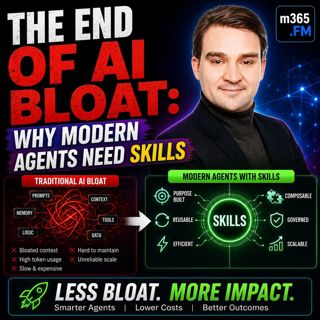
The End of AI Bloat: Why Modern Agents Need Skills

The End of AI Bloat: Why Modern Agents Need Skills

Many AI agents start out fast, responsive, and surprisingly intelligent. But after a few months of real-world use, something changes. Response times increase, costs rise, prompts become enormous, and ...

26 Juli 1h 13min

THE DEATH OF THE PROXY: Architecting Dataverse for the Agent Fabric

THE DEATH OF THE PROXY: Architecting Dataverse for the Agent Fabric

For years, Microsoft's recommended architecture for connecting AI assistants like Claude Desktop to Dataverse relied on a local STDIO proxy. It was simple, easy to install, and perfectly suited for in...

26 Juli 59min
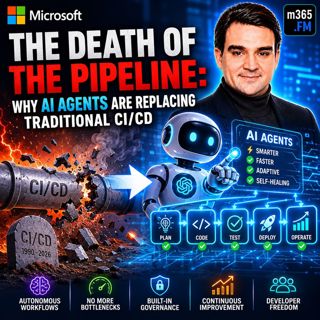
The Death of the Pipeline: Why AI Agents are Replacing Traditional

The Death of the Pipeline: Why AI Agents are Replacing Traditional

For more than two decades, CI/CD pipelines have been the backbone of modern software delivery. Developers commit code, automated builds run, tests execute, security scans complete, someone approves th...

25 Juli 1h 9min
Populärt inom Politik & nyheter

svenska-fall
p3-krim
aftonbladet-daily
aftonbladet-krim
flashback-forever
tv4-nyheterna-story
rss-sanning-konsekvens
rss-krimreportrarna
rss-krimstad
motiv
rss-frandfors-horna
de-fyras-gang
rss-vad-fan-hande
mannen-utan-spar
rss-flodet
politiken
rss-aftonbladet-krim
spar
krimmagasinet
olyckan-inifran