
The Quietest Edge

The Quietest Edge

The Quietest Edge: Why Your Fund’s Return Isn’t Your Return

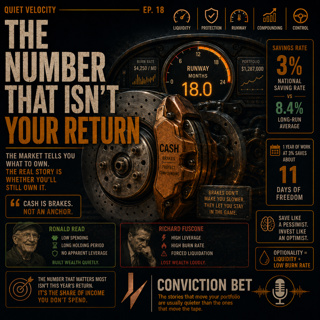
Picture two people buying the same fund and holding it through the same market. On paper, they own the same investment. In practice, they can walk away with completely different returns—because one stayed in the seat, while the other kept climbing off whenever the ride became uncomfortable.

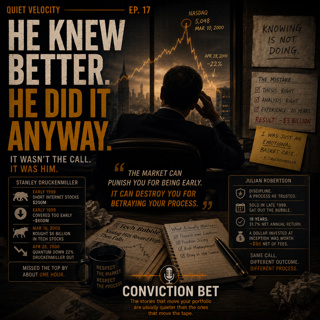
This week, chip stocks offered a live demonstration. After one of the year’s hottest trades suffered a violent selloff and partial rebound, investors were reminded how quickly recent performance can turn into a reason to buy at exactly the wrong moment.

But the clearest example is ARK Innovation. Over one five-year stretch, the fund compounded at roughly 41% a year. The average dollar invested in it earned about 10%. The fund’s track record was extraordinary. The experience of many of its owners was not.

In this episode, we will examine the gap between what an investment earns and what its investors actually capture—and then challenges the familiar claim that the entire gap is caused by panic, greed, and bad timing.

We get into:

— The difference between a fund’s published return and the return experienced by the dollars actually invested

— Morningstar’s “Mind the Gap” finding: funds returned 8.2% annually, while the average invested dollar earned 7.0%

— Why a recent academic critique argues that only a small part of that 1.2-point gap may represent genuinely poor timing

— Why chasing last year’s best fund so rarely works, and what S&P’s persistence data says about repeat winners

— How trading apps, rewards, alerts, and even meaningless points can encourage investors to act when waiting would serve them better

— The ARKK timeline: spectacular returns when little money was invested, followed by billions arriving near the top

— Why daily-reset leveraged ETFs can lose money even when the underlying index finishes where it started

— The difference between the investor-return gap and “Gamma”—the value created through better decisions about debt, taxes, accounts, diversification, risk, and withdrawals

— Why paying off 21% credit-card debt may be a better investment decision than finding the next great stock

— The most controllable edge in investing: designing a plan you can actually follow when the market gives you a reason not to

The conclusion is less dramatic than a stock tip, but more useful: the market is mostly outside your control. Costs, taxes, risk, account placement, diversification, and the decision not to trade on noise are not.

Read the written version and subscribe at quietvelocity1.substack.com.

New episodes of Conviction Bet wherever you listen—Apple, Spotify, YouTube, and Amazon. If the show is useful, a quick review helps new listeners find it.

Conviction Bet is for information and education only. It is not investment advice or a recommendation to buy or sell any security. Do your own research.

Det här avsnittet är hämtat från ett öppet RSS-flöde och publiceras inte av Podme. Det kan innehålla reklam.

Avsnitt(13)

Who Settles the Check: Who Really Pays for the AI Build-Out

Who Settles the Check: Who Really Pays for the AI Build-Out

Who Settles the Check: Who Really Pays for the AI Build-OutPicture the most expensive dinner ever ordered. The finest of everything, courses still arriving, nobody checking the price. The whole mood o...

19 Juni 27min

The Oracle, Decoded: How They Reverse-Engineered Warren Buffett

The Oracle, Decoded: How They Reverse-Engineered Warren Buffett

For fifty years, Warren Buffett's record looked like magic — a once-in-a-century gift you either have or you don't. Then three quantitative researchers took that genius apart, piece by piece, and foun...

10 Juni 26min

The Credit Card That Owns the Mint

The Credit Card That Owns the Mint

A US Treasury bond is the asset the whole financial system calls risk-free — the benchmark every other risk is measured against. This year, the most conservative institutions on earth started quietly ...

4 Juni 27min

Read the Label: What's Actually Inside the S&P 500

Read the Label: What's Actually Inside the S&P 500

Buying the S&P 500 feels like the most diversified decision in investing. It has quietly become one of the most concentrated.The index everyone owns hasn't changed — but the recipe underneath has. Sev...

1 Juni 23min

Dead Reckoning: What the 4% Rule Cannot See

Dead Reckoning: What the 4% Rule Cannot See

Most retirement planning math is correct. The problem is the question it's answering.The 4% rule was built for a 30-year retirement. An early retiree who leaves work at 35 and lives to 90 needs a port...

27 Maj 33min

The Ouroboros Quarter

The Ouroboros Quarter

In most earnings seasons, the profit reported is the profit earned. Q1 2026 was different. The most important number in Alphabet's results was not on the revenue line, not in the cloud segment, and no...

21 Maj 29min

Fluent in Money, Illiterate in Wealth

Fluent in Money, Illiterate in Wealth

In most languages, the word for wealth still carries traces of its origin — wellbeing, capability, the conditions of a good life. In English, that meaning was stripped out somewhere between the Champa...

14 Maj 31min

Populärt inom Business & ekonomi

badfluence
framgangspodden
varvet
rss-borsens-finest
svd-tech-brief
uppgang-och-fall
avanzapodden
rss-svart-marknad
rss-dagen-med-di
24fragor
lastbilspodden
fill-or-kill
bathina-en-podcast
rss-inga-dumma-fragor-om-pengar
borsmorgon
kapitalet-en-podd-om-ekonomi
rikatillsammans-om-privatekonomi-rikedom-i-livet
dynastin
tabberaset
rss-den-nya-ekonomin