The Cloud Promise Is Broken: Why Migrations Never End, Dashboards Don’t Change Anything & How To Fix Azure Responsibility Gaps

The Cloud Promise Is Broken: Why Migrations Never End, Dashboards Don’t Change Anything & How To Fix Azure Responsibility Gaps

You were promised speed, savings and security in one move to the cloud—and got half‑finished migrations, surprise bills and endless “stabilization” instead. In this episode, I explain why cloud migrations never really end, how the data you collect turns into busywork instead of decisions, and where responsibility for fixing things quietly evaporates between teams. You’ll get concrete targets you can set this quarter so Azure stops feeling like a moving target and starts behaving like a platform you can actually steer.

WHY CLOUD MIGRATIONS NEVER REALLY END

Most teams treat “we’re in Azure now” as a finish line, but the platform keeps changing under your feet. Services evolve, pricing shifts, security baselines update and suddenly yesterday’s “done” architecture looks outdated or too expensive. We walk through the pattern: migration projects celebrate landing workloads, then drift into constant reconfigurations, cost firefighting and compliance fixes because the cloud behaves like a living ecosystem—not a static destination. The key shift is moving from “Are we done?” to “How fast can we adjust?” and measuring resilience instead of pretending you’ll ever reach a final state.

THE DATA TRAP: DASHBOARDS WITHOUT DECISIONS

Collecting metrics is easy; acting on them is where most organizations fail. Dashboards show utilization, latency, cost and security alerts, but too often they’re produced, emailed and forgotten—creating the illusion of control without any actual changes in the environment. I break down why reports become background noise, how that lulls leadership into thinking risks are handled, and how to flip one metric this month into a real intervention (for example, shutting down underused VMs at night and tracking the savings). Monitoring only creates value when someone has both the mandate and the habit to turn numbers into adjustments.

THE RESPONSIBILITY MIRAGE

On paper, ownership looks clear: security owns security, finance owns cost, ops owns uptime. In reality, the teams who see the problems often don’t control the budgets, permissions or tools needed to fix them—so issues get logged, escalated and slowly forgotten. We explore this “responsibility mirage” with examples like security teams who can see missing encryption but can’t enable the feature, or FinOps teams who spot waste but can’t change application design. You’ll learn how to redraw the responsibility map so every key signal (cost, risk, performance) has a clearly named owner with authority to change configurations, not just write slide decks.

WHAT YOU’LL LEARN
  • Why the idea of a “finished” cloud migration creates false expectations and constant firefighting.
  • How to turn at least one existing Azure metric into a concrete, measurable change this quarter.
  • How the responsibility mirage blocks improvements when teams see risks but can’t act.
  • How to define targets and ownership so your cloud platform evolves on purpose instead of by accident.
THE CORE INSIGHT

The core insight of this episode is that the cloud promise isn’t wrong—you just don’t get cost, speed and security automatically by landing workloads. When you accept that Azure never stops moving, tie monitoring to real decisions and fix who actually owns which levers, the platform stops feeling like a broken promise and starts behaving like a controllable system you can improve month by month.

WHO THIS EPISODE IS FOR
  • Cloud architects and platform teams stuck in “migration done, chaos continues.”
  • FinOps, SecOps and CloudOps teams drowning in dashboards without clear authority to act.
  • IT and business leaders who signed off on cloud promises and now need evidence of real progress.
ABOUT THE AUTHOR / HOST

Mirko Peters is a Microsoft 365 and Azure governance consultant and host of the M365.FM podcast, helping organizations treat Azure, Microsoft 365 and their operating model as one integrated system instead of disconnected projects and reports. He works with teams running on Microsoft 365 and Azure to design ownership, metrics and improvement loops so cloud platforms deliver measurable gains in cost, risk and speed—instead of becoming permanent “stabilization” projects.

Become a supporter of this podcast: https://www.spreaker.com/podcast/m365-fm-modern-work-security-and-productivity-with-microsoft-365--6704921/support.

Tämä jakso on lisätty Podme-palveluun avoimen RSS-syötteen kautta eikä se ole Podmen omaa tuotantoa. Siksi jakso saattaa sisältää mainontaa.

Jaksot(780)

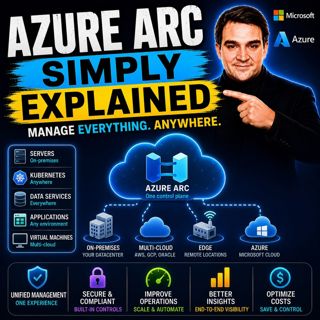
Azure Arc - Simply Explained

Azure Arc - Simply Explained

Modern IT environments rarely exist in a single cloud. Most organizations run Windows and Linux servers across on-premises data centers, Microsoft Azure, Amazon Web Services (AWS), Google Cloud Platfo...

17 Heinä 17min
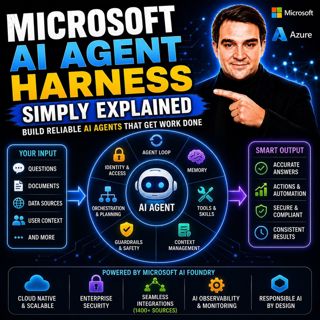
Microsoft AI Agent Harness - Simply Explained

Microsoft AI Agent Harness - Simply Explained

Writing the perfect AI prompt used to be the goal of every AI developer. But as businesses began asking AI to perform increasingly complex tasks—analyzing code, researching topics, coordinating workfl...

17 Heinä 16min
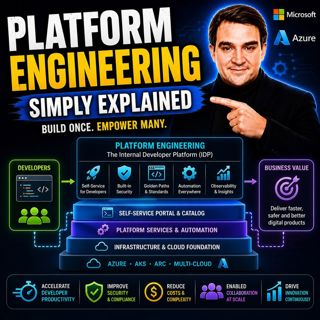
Platform Engineering - Simply Explained

Platform Engineering - Simply Explained

For years, DevOps promised to break down the barriers between development and operations by giving teams greater ownership over the software they build. While the idea was powerful, reality became far...

16 Heinä 16min
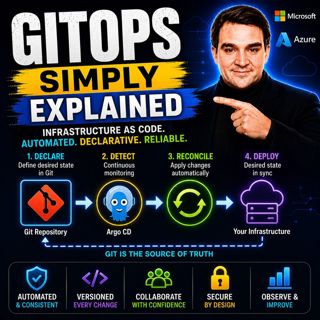
GitOps - Simply Explained

GitOps - Simply Explained

Managing Kubernetes manually quickly becomes a nightmare as environments grow. One engineer updates a deployment directly using kubectl, another changes a ConfigMap through the Azure portal, and sudde...

16 Heinä 16min
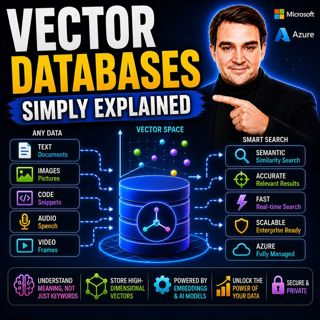
Vector Databases - Simply Explained

Vector Databases - Simply Explained

Large Language Models like GPT-4o, Microsoft Copilot, and ChatGPT are incredibly powerful, but they all depend on one critical technology that most people never hear about: vector databases. Tradition...

16 Heinä 14min
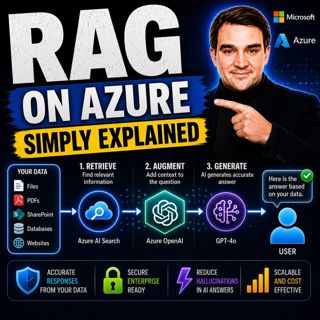
RAG on Azure — Simply Explained

RAG on Azure — Simply Explained

Large Language Models like GPT-4o are incredibly powerful, but they have two major limitations. First, their knowledge is frozen in time, meaning they don't automatically know about recent events, cha...

16 Heinä 13min
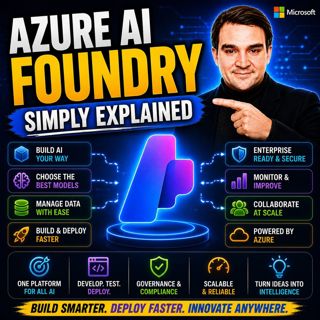
Azure AI Foundry - Simply Explained

Azure AI Foundry - Simply Explained

Artificial Intelligence is evolving faster than almost any other technology, and with new models, frameworks, and AI services appearing almost every month, it's becoming increasingly difficult to know...

16 Heinä 14min
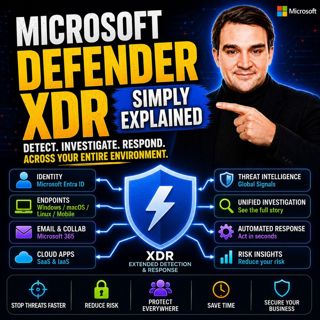
Microsoft Defender XDR - Simply Explained

Microsoft Defender XDR - Simply Explained

Modern cyberattacks rarely target a single system. An attack might begin with a phishing email, move to a compromised device, steal user credentials, access cloud applications, and finally exfiltrate ...

16 Heinä 14min

Suosittua kategoriassa Politiikka ja uutiset

aikalisa
uutiscast
ootsa-kuullut-tasta-2
rss-ootsa-kuullut-tasta
rss-vaalirankkurit-podcast
rss-podme-livebox
rss-seksicast
otetaan-yhdet
tervo-halme
politiikan-puskaradio
aihe
linda-maria
rss-raha-talous-ja-politiikka
viela-yksi-sivu
the-ulkopolitist
mtv-uutiset-polloraati
et-sa-noin-voi-sanoo-esittaa
rss-sveriges-radio-finska
rss-fingo-podcast
rss-girls-finish-f1rst