Fabric Domains, Workspaces & Capacities Explained: How To Avoid Sprawl, Broken Governance & Surprise Premium Bills

Fabric Domains, Workspaces & Capacities Explained: How To Avoid Sprawl, Broken Governance & Surprise Premium Bills

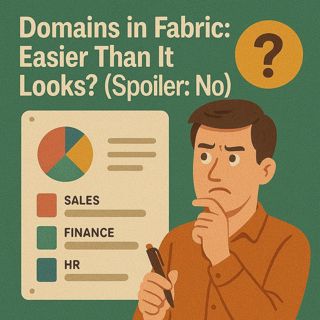
Admins, remember when Power BI Premium felt like your biggest headache? Overnight you became Fabric admins, staring at domains, workspaces, and capacities like an IKEA manual written in Klingon. In this episode, we unpack why Microsoft’s promise of “simpler organization” actually means more moving parts, and how you can still build something stable: clear domain taxonomy, purpose‑driven workspaces, and capacity rules that won’t blow your budget at quarter‑end. By the end, you’ll know what to lock down in the first 30, 60, and 90 days so Fabric doesn’t turn into a very expensive CSV swamp with Gold badges on top.

FABRIC DOMAINS: ORDER OR JUST FANCY NAME TAGS?

Domains look harmless—HR here, Finance there, Marketing somewhere else—but they change how data, people, and governance collide across your tenant. We break down why treating domains like renamed workspaces is a trap: each brings its own owners, policies, and permission logic that can quietly override workspace rules. You’ll hear how “Sales,” “Sales Reporting,” and “Sales 2025” domains show up when nobody defines a taxonomy, how domain sprawl accelerates faster than workspace sprawl, and how to stop it with three boring but essential moves: agree domain purpose (department vs function vs project), assign a single owner with escalation, and pilot policies in one domain before going tenant‑wide.

WORKSPACES: FROM LEGO BOX TO JENGA TOWER

Old Power BI workspaces were simple—few reports, one dataset. Fabric workspaces are everything: lakehouses, warehouses, notebooks, pipelines, and dashboards all crammed into the same container. We show how this overload turns simple “report spaces” into Jenga towers where raw ingests, staging, experiments, and production reporting all sit side‑by‑side, and why applying old Viewer/Member/Admin habits isn’t enough anymore. You’ll learn a practical pattern: separate staging, production, and experimentation into different workspaces; enforce naming and lifecycle rules so abandoned workspaces don’t eat capacity; and use templates so every new workspace starts with the right owners, tags, and purpose instead of becoming the next junk drawer.

CAPACITIES: WHEN PREMIUM STOPPED BEING JUST “MORE HORSEPOWER

Fabric capacities aren’t just Power BI Premium with a new coat of paint—they’re shared fuel tanks for everything: reports, warehouse queries, pipelines, notebooks, and more. We explain why old “Premium per workspace” mental models break down when multiple domains and workspaces hammer the same capacity, and how that shows up as throttling, random slowdowns, or surprise cost spikes. You’ll get a simple capacity playbook: map which workloads are allowed on which capacities, set guardrails for noisy engineering workloads vs business reporting, and monitor utilization so you can adjust assignments before the CFO’s bill shock email lands in your inbox.

WHAT YOU’LL LEARN
  • Why Fabric domains aren’t just labels—and how to prevent domain sprawl early.
  • How domain roles and policies can override workspace expectations if you don’t design them on purpose.
  • How to move from “one big workspace” chaos to function‑based staging/production/experiment workspaces.
  • Why Fabric capacities behave differently from classic Premium and how to keep workloads from fighting each other.
  • A 30/60/90‑day checklist to stabilize domains, workspaces, and capacities before usage explodes.
THE CORE INSIGHT

The core insight of this episode is that Fabric didn’t actually simplify your life—it just exposed the architecture you already needed but never had to design. Domains, workspaces, and capacities can give you real control, but only if you decide early what they mean, who owns them, and which workloads go where; otherwise, you get a neat‑looking UI wrapped around the same old chaos, now with a bigger compute bill.

WHO THIS EPISODE IS FOR
  • Fabric and Power BI admins suddenly responsible for domains, workspaces, and capacities.
  • Data and analytics architects designing tenant‑wide Fabric governance.
  • IT and platform owners worried about Fabric cost, performance, and sprawl.
  • Consultants helping customers move from Power BI Premium to Fabric without burning weekends.
ABOUT THE AUTHOR / HOST

Mirko Peters is a Microsoft 365 and data platform consultant and host of the M365.FM podcast, helping organizations treat Microsoft 365, Power BI, and Fabric as one integrated operating system instead of a pile of isolated tools and capacities. He works with teams running on Microsoft 365, Azure, and Fabric to design domain taxonomies, workspace architectures, and capacity strategies so analytics stays fast, governed, and affordable—even when usage takes off.

Become a supporter of this podcast: https://www.spreaker.com/podcast/m365-fm-modern-work-security-and-productivity-with-microsoft-365--6704921/support.

Tämä jakso on lisätty Podme-palveluun avoimen RSS-syötteen kautta eikä se ole Podmen omaa tuotantoa. Siksi jakso saattaa sisältää mainontaa.

Jaksot(780)

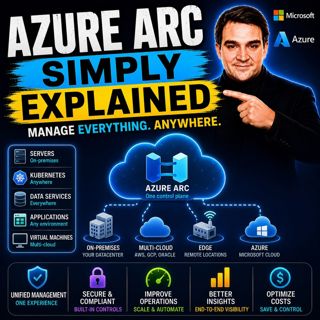
Azure Arc - Simply Explained

Azure Arc - Simply Explained

Modern IT environments rarely exist in a single cloud. Most organizations run Windows and Linux servers across on-premises data centers, Microsoft Azure, Amazon Web Services (AWS), Google Cloud Platfo...

17 Heinä 17min
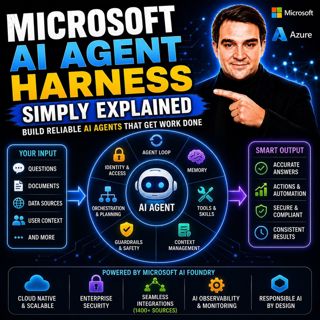
Microsoft AI Agent Harness - Simply Explained

Microsoft AI Agent Harness - Simply Explained

Writing the perfect AI prompt used to be the goal of every AI developer. But as businesses began asking AI to perform increasingly complex tasks—analyzing code, researching topics, coordinating workfl...

17 Heinä 16min
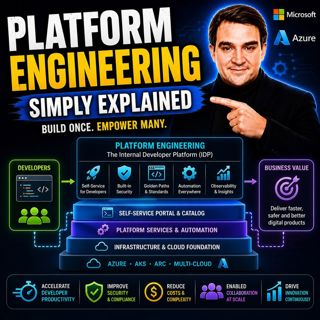
Platform Engineering - Simply Explained

Platform Engineering - Simply Explained

For years, DevOps promised to break down the barriers between development and operations by giving teams greater ownership over the software they build. While the idea was powerful, reality became far...

16 Heinä 16min

GitOps - Simply Explained

GitOps - Simply Explained

Managing Kubernetes manually quickly becomes a nightmare as environments grow. One engineer updates a deployment directly using kubectl, another changes a ConfigMap through the Azure portal, and sudde...

16 Heinä 16min
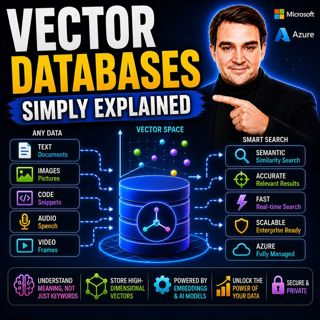
Vector Databases - Simply Explained

Vector Databases - Simply Explained

Large Language Models like GPT-4o, Microsoft Copilot, and ChatGPT are incredibly powerful, but they all depend on one critical technology that most people never hear about: vector databases. Tradition...

16 Heinä 14min

RAG on Azure — Simply Explained

RAG on Azure — Simply Explained

Large Language Models like GPT-4o are incredibly powerful, but they have two major limitations. First, their knowledge is frozen in time, meaning they don't automatically know about recent events, cha...

16 Heinä 13min

Azure AI Foundry - Simply Explained

Azure AI Foundry - Simply Explained

Artificial Intelligence is evolving faster than almost any other technology, and with new models, frameworks, and AI services appearing almost every month, it's becoming increasingly difficult to know...

16 Heinä 14min

Microsoft Defender XDR - Simply Explained

Microsoft Defender XDR - Simply Explained

Modern cyberattacks rarely target a single system. An attack might begin with a phishing email, move to a compromised device, steal user credentials, access cloud applications, and finally exfiltrate ...

16 Heinä 14min

Suosittua kategoriassa Politiikka ja uutiset

aikalisa
uutiscast
ootsa-kuullut-tasta-2
rss-ootsa-kuullut-tasta
rss-vaalirankkurit-podcast
rss-podme-livebox
rss-seksicast
otetaan-yhdet
tervo-halme
politiikan-puskaradio
aihe
linda-maria
rss-raha-talous-ja-politiikka
viela-yksi-sivu
the-ulkopolitist
mtv-uutiset-polloraati
et-sa-noin-voi-sanoo-esittaa
rss-sveriges-radio-finska
rss-fingo-podcast
rss-girls-finish-f1rst