
Enterprise AI Architecture: How to Build Verifiable Multi‑Agent Copilots with Azure OpenAI and Microsoft 365

Enterprise AI Architecture: How to Build Verifiable Multi‑Agent Copilots with Azure OpenAI and Microsoft 365

(00:00:00) The Hallucination Pattern
(00:00:27) The Trust Problem
(00:00:40) The Chain of Custody Breakdown
(00:03:15) The Single Agent Fallacy
(00:05:56) Security Leakage Through Prompts
(00:11:16) Drift and Context Decay
(00:16:35) Audit Failures and the Importance of Provenance
(00:21:35) The Multi-Agent Architecture
(00:26:55) Threat Model and Controls
(00:29:50) Implementation Steps

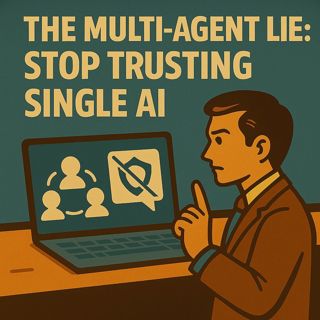
The promise was simple: one smart copilot that knows your enterprise. The reality is messier. Single “do‑everything” agents hallucinate under token pressure, ignore Microsoft 365 permissions, drift on stale indexes, and fall apart the moment an auditor asks, “Can you show me exactly how this decision was made?” In this episode of m365.fm, Mirko Peters opens a forensic case on today’s enterprise AI patterns and shows why the single‑agent story is a lie in complex Microsoft 365 and Azure environments — and what a verifiable, multi‑agent architecture actually looks like when you build it on Azure OpenAI, Microsoft Graph, and the Microsoft 365 security and compliance plane.

WHY SINGLE COPILOTS FAIL IN REAL ENTERPRISES

Most organizations start with a single copilot pattern: an SPFx web part, a Teams bot, or a line‑of‑business front end that sends a giant prompt to Azure OpenAI and hopes for magic. It works in demos, then collapses under production load. Mirko breaks down the failure modes: one agent asked to retrieve, rank, reason, cite, and decide; prompts that exceed safe context windows and compress evidence into fluent fiction; RAG systems that never reindex SharePoint and OneDrive content; and citations that point vaguely to entire documents instead of to specific paragraphs. You will hear why “it sounded right” is not good enough when the output touches money, people, or policy.

HOW HALLUCINATION, LEAKAGE, AND DRIFT REALLY HAPPEN

Hallucination is not random. It emerges from architecture choices. Mirko walks through concrete examples from Azure OpenAI + Microsoft 365 stacks: app‑only Graph permissions used to build indexes that ignore the end user’s identity; SharePoint pages and Confluence exports that inject hostile instructions into prompts; vector stores that go stale because no one wired content lifecycle into reindexing; and token‑heavy prompts that hide the fact retrieval was weak. He explains how latency from overloaded deployments or misconfigured networks shows up as “AI unreliability,” and why most organizations lack the logs to replay what actually happened when things go wrong.

THE MULTI‑AGENT REFERENCE ARCHITECTURE

Instead of one “smart” copilot, you get a cast of specialized agents, each with a narrow mission and clear contract:
  • Retrieval agents that use Graph, hybrid search, and vector stores with user‑scoped, Purview‑aware permissions.
  • Rerank agents that apply cross‑encoder models or semantic ranking to push the right passages to the top.
  • Generator agents that are explicitly forbidden from inventing facts not present in retrieved chunks.
  • Verification agents that cross‑check claims against evidence and reject or downgrade unproven statements.
  • Red‑team agents that sanitize prompts and content for injection and policy violations before generation.
  • Blue‑policy agents that enforce tool allow‑lists, data zones, tenant boundaries, and safety rules.
  • Maintenance and compliance agents that track index freshness, drift, latency, and produce replayable audit dossiers for each session.
Mirko shows how these agents coordinate through Azure API Management, queues, and well‑defined schemas, so every step in the chain is observable, testable, and replaceable.

CHAIN OF CUSTODY FOR AI ANSWERS

A decision is only trustworthy if you can show your work. This episode lays out how to design chain of custody for enterprise AI: capturing prompts, retrieved passages, model IDs, tool invocations, and outputs with correlation IDs; logging everything in a tamper‑evident store; and mapping citations back to file IDs, versions, and paragraph ranges in SharePoint or other systems of record. You will hear how to design replay modes that can re‑run a session with the same configuration when regulators, auditors, or internal review boards ask, “Why did the system answer this way on that day?”

WHERE AZURE OPENAI, GRAPH, AND COPILOT STUDIO FIT

The episode then puts tools in their proper place instead of treating them as magic: Azure OpenAI as the model engine, Graph as the permission‑aware lens into Microsoft 365, Copilot Studio as the orchestration and experience layer for business‑facing copilots, and SPFx / Teams as delivery surfaces. Mirko explains when to call Azure OpenAI directly, when to ground through Graph‑powered retrieval APIs, how to separate retrieval and generation identities, and how to wrap all tools behind APIM, Purview, DLP, and Conditional Access so AI cannot bypass governance even if a developer makes a mistake.

WHAT YOU WILL LEARN
  • Why single‑agent copilots fail under real enterprise conditions.
  • How hallucination, data leakage, and RAG drift actually happen with Azure OpenAI and Microsoft 365.
  • How to design a multi‑agent architecture with retrieval, rerank, generation, verification, red‑team, blue‑policy, and maintenance agents.
  • How to implement chain of custody and replayability for AI answers using Graph, APIM, and structured logging.
  • How Azure OpenAI, Microsoft Graph, Copilot Studio, SPFx, and Teams fit together in an enterprise‑safe AI stack.
WHO THIS EPISODE IS FOR
  • Microsoft 365 and Azure architects designing enterprise AI and copilot platforms.
  • Developers building SPFx, Teams, and Copilot Studio experiences on Azure OpenAI and Graph.
  • Security, compliance, and risk leaders who need AI systems that are explainable and auditable.
  • Data, platform, and MLOps teams running RAG, vector search, and hybrid search in production.
  • Anyone who wants copilots that can be trusted in front of regulators, finance, HR, or the board — not just in demos.
ABOUT THE HOST

Mirko Peters is a Microsoft 365 and Azure architect and the host of m365.fm. He works with organizations from small businesses to large enterprises on Microsoft 365 architecture, security, AI integration, governance design, and system architecture. His work focuses on designing context‑driven systems that reduce complexity, enable autonomous execution, and create scalable performance across modern enterprises.

Become a supporter of this podcast: https://www.spreaker.com/podcast/m365-fm-modern-work-security-and-productivity-with-microsoft-365--6704921/support.

Det här avsnittet är hämtat från ett öppet RSS-flöde och publiceras inte av Podme. Det kan innehålla reklam.

Avsnitt(863)

The Copilot Credit Trap- Why Your AI Economy is Already Broken

The Copilot Credit Trap- Why Your AI Economy is Already Broken

For decades, enterprise software followed a predictable financial model. Organizations purchased licenses, assigned them to users, and budgeted annual IT spending with confidence. AI changes that comp...

26 Juli 0s
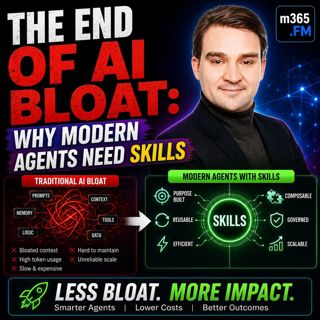
The End of AI Bloat: Why Modern Agents Need Skills

The End of AI Bloat: Why Modern Agents Need Skills

Many AI agents start out fast, responsive, and surprisingly intelligent. But after a few months of real-world use, something changes. Response times increase, costs rise, prompts become enormous, and ...

26 Juli 0s
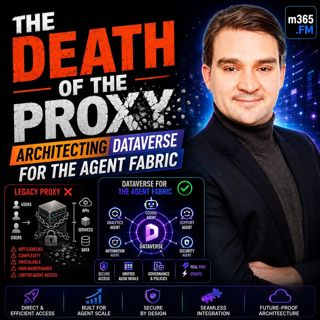
THE DEATH OF THE PROXY: Architecting Dataverse for the Agent Fabric

THE DEATH OF THE PROXY: Architecting Dataverse for the Agent Fabric

For years, Microsoft's recommended architecture for connecting AI assistants like Claude Desktop to Dataverse relied on a local STDIO proxy. It was simple, easy to install, and perfectly suited for in...

26 Juli 0s
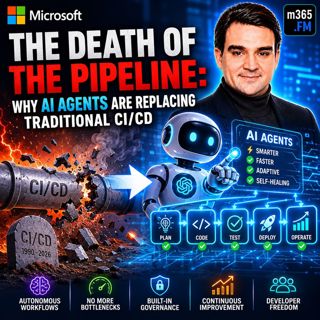
The Death of the Pipeline: Why AI Agents are Replacing Traditional

The Death of the Pipeline: Why AI Agents are Replacing Traditional

For more than two decades, CI/CD pipelines have been the backbone of modern software delivery. Developers commit code, automated builds run, tests execute, security scans complete, someone approves th...

25 Juli 0s
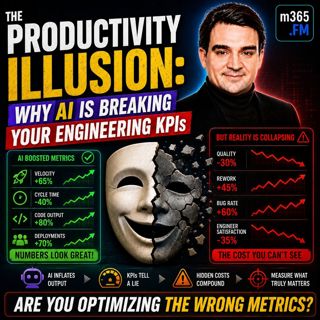
The Productivity Illusion: Why AI is Breaking Your Engineering KPIs

The Productivity Illusion: Why AI is Breaking Your Engineering KPIs

At first glance, the numbers look incredible. Deployment frequency is increasing, pull requests are being merged faster than ever, AI is generating more code, and engineering teams appear dramatically...

25 Juli 0s
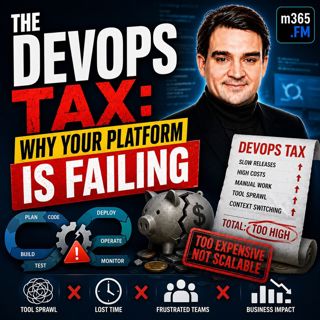
The DevOps Tax: Why Your Platform is Failing

The DevOps Tax: Why Your Platform is Failing

Welcome to another episode of Knowledge Nuggets with Mirko Peters. Today we're exploring The DevOps Tax—the hidden cost that silently reduces engineering productivity, increases cognitive overload, an...

25 Juli 0s
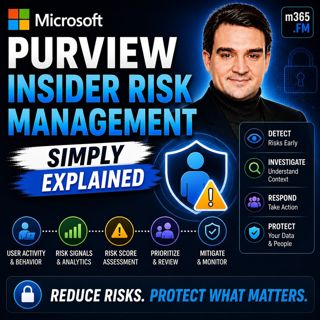
Microsoft Purview Insider Risk Management - Simply Explained

Microsoft Purview Insider Risk Management - Simply Explained

Welcome to another episode of Knowledge Nuggets with Mirko Peters. Today we're exploring Microsoft Purview Insider Risk Management, Microsoft's intelligent solution for identifying risky user behavior...

24 Juli 0s

Microsoft Purview Information Protection - Simply Explained

Microsoft Purview Information Protection - Simply Explained

Welcome to another episode of Knowledge Nuggets with Mirko Peters. Today we're exploring Microsoft Purview Information Protection, the foundation of Microsoft's data classification and protection stra...

24 Juli 0s
Populärt inom Politik & nyheter

svenska-fall
p3-krim
aftonbladet-daily
aftonbladet-krim
flashback-forever
rss-sanning-konsekvens
tv4-nyheterna-story
rss-krimstad
rss-krimreportrarna
motiv
de-fyras-gang
rss-frandfors-horna
rss-vad-fan-hande
mannen-utan-spar
politiken
rss-flodet
spar
rss-aftonbladet-krim
krimmagasinet
grans