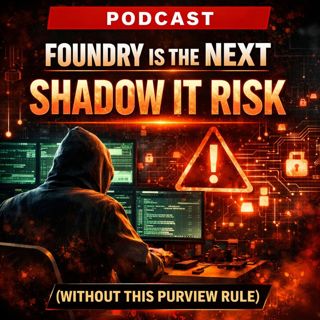
Microsoft Foundry & Shadow IT: Why One Missing Purview Rule Puts Your AI Governance at Risk

Microsoft Foundry & Shadow IT: Why One Missing Purview Rule Puts Your AI Governance at Risk

(00:00:00) Microsoft Foundry: A Platform for Autonomous Workloads
(00:00:29) Reframing Foundry as an Agent Factory
(00:01:13) The Four Components of Foundry
(00:01:37) Agents as Non-Human Identities
(00:02:23) The Governance Challenge of Foundry
(00:04:00) Learning from Microsoft's Past Mistakes
(00:06:56) The Autonomous Nature of Foundry Agents
(00:08:15) Failure Mode 1: Agent Identity Collapse
(00:12:49) The Danger of Permission Drift
(00:17:51) Failure Mode 2: Data Boundary Collapse

In this episode of m365.fm, Mirko Peters breaks down why Microsoft Foundry is quietly becoming the next major Shadow IT risk inside organizations — especially as teams rush to build AI apps, copilots, and agents faster than security and governance can keep up. Shadow IT did not disappear. It evolved. What used to be unsanctioned SaaS tools has now turned into unsanctioned AI workloads, and the implications are far more serious than anything organizations faced before. When Foundry environments are created without guardrails, security teams may not even know the apps exist — let alone the agents running inside them.

WHY FOUNDRY CHANGES THE SHADOW IT EQUATION ENTIRELY

Foundry makes it incredibly easy for developers, data teams, and business units to spin up powerful AI-driven applications and agents. That speed is exactly the problem. The barrier to creating risky AI workloads is now lower than ever. Sensitive data can be accessed or processed without oversight, agents can run autonomously with excessive permissions, and compliance boundaries can be bypassed completely — not through malicious intent, but through the absence of deliberate governance design. The old Shadow IT problem was about applications. The new Shadow IT problem is about autonomous AI systems that act on your data around the clock.

WHY ONE MISSING PURVIEW RULE CHANGES EVERYTHING

One of the most critical insights in this episode is how a single missing Microsoft Purview policy can eliminate visibility across an entire Foundry environment. Without the right Purview configuration, data classification may not apply to AI prompts or outputs, DLP controls may never trigger, and sensitive information can be exposed through agent workflows without any alert being raised. Organizations assume Purview just works for AI by default — it does not. This episode explains exactly where that assumption breaks down and what it costs when it does.

AI AGENTS ARE NOT JUST APPS — THEY ARE AUTONOMOUS ACTORS

One of the most important mindset shifts this episode addresses is how AI agents must be treated as first-class IT assets, not as lightweight applications. Agents do not just read data — they act on it. They chain tools together, make decisions, trigger downstream systems, and operate continuously without human review. When these agents are created in Foundry without identity controls, policy enforcement, and lifecycle governance, they effectively become autonomous shadow employees with access to your most sensitive data. That is not a theoretical risk. It is happening right now in organizations that moved fast without governance keeping pace.

WHAT YOU WILL LEARN
  • Why Shadow IT has evolved from unsanctioned SaaS tools into unsanctioned AI workloads and why the risk profile is fundamentally different.
  • How Foundry lowers the barrier to creating powerful AI applications faster than governance can follow.
  • Why one missing Microsoft Purview rule can eliminate data classification, DLP enforcement, and visibility across AI inputs and outputs entirely.
  • How AI agents must be governed with the same rigor as human users — or more.
  • Why assuming Purview works for AI by default is one of the most dangerous mistakes organizations are making right now.
  • How to inventory AI workloads, define ownership for Foundry environments, and bring security into the AI development lifecycle before incidents happen.
  • What practical steps security teams, architects, and compliance professionals should take immediately to close the most critical gaps.
WHERE ORGANIZATIONS ARE GETTING THIS WRONG

Most organizations are making the same set of mistakes right now: letting developers deploy Foundry solutions before governance is ready, assuming Purview covers AI workloads by default, treating AI experimentation as low-risk because it is still in early stages, ignoring agent identities and permission scopes, and failing to build any inventory of AI workloads running across their environment. The result is security teams left reacting after incidents instead of preventing them — exactly the pattern that defined the worst years of classic Shadow IT, now playing out at AI speed and scale.

KEY TAKEAWAYS
  • Shadow IT is no longer just about apps — it is about AI platforms, agents, and autonomous workloads.
  • Foundry dramatically lowers the barrier to creating high-risk AI environments without governance.
  • One missing Purview rule can eliminate data visibility and DLP enforcement entirely across AI workflows.
  • AI agents require the same governance as human users — and in many cases, significantly stronger controls.
  • Security and governance must evolve alongside AI adoption, not chase it after the fact.
  • Every Foundry environment and every agent needs a defined owner, a policy scope, and an explicit lifecycle.
WHO THIS EPISODE IS FOR
  • Security leaders and CISOs responsible for AI risk, data governance, and compliance in Microsoft environments.
  • IT teams managing rapid AI adoption across Microsoft 365, Azure, and Foundry.
  • Architects designing modern AI platforms who want to build governance in from the start.
  • Compliance and data protection professionals navigating AI-driven data usage and regulatory requirements.
  • Developers building in Foundry who want to understand the governance expectations they need to design for.
ABOUT THE HOST

Mirko Peters is a Microsoft 365 expert, architect, and host of m365.fm. He works with organizations from small businesses to large enterprises on Microsoft 365 architecture, security, AI integration, governance design, and system architecture. His work focuses on designing context-driven systems that reduce complexity, enable autonomous execution, and create scalable performance across modern enterprises.

Become a supporter of this podcast: https://www.spreaker.com/podcast/m365-fm-modern-work-security-and-productivity-with-microsoft-365--6704921/support.

Det här avsnittet är hämtat från ett öppet RSS-flöde och publiceras inte av Podme. Det kan innehålla reklam.

Avsnitt(864)

From Excel Expert to Microsoft MVP: Empowering Millions with Data, Dashboards & AI with Karen Abecia [Microsoft MVP]

From Excel Expert to Microsoft MVP: Empowering Millions with Data, Dashboards & AI with Karen Abecia [Microsoft MVP]

aren Abecia shares the remarkable journey that transformed a passion for Microsoft Excel into a global career as one of the world's best-known Excel educators. She explains how discovering creative sp...

27 Juli 0s

The Copilot Credit Trap- Why Your AI Economy is Already Broken

The Copilot Credit Trap- Why Your AI Economy is Already Broken

For decades, enterprise software followed a predictable financial model. Organizations purchased licenses, assigned them to users, and budgeted annual IT spending with confidence. AI changes that comp...

26 Juli 0s
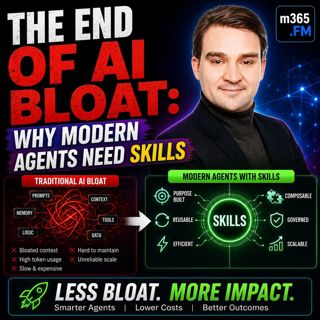
The End of AI Bloat: Why Modern Agents Need Skills

The End of AI Bloat: Why Modern Agents Need Skills

Many AI agents start out fast, responsive, and surprisingly intelligent. But after a few months of real-world use, something changes. Response times increase, costs rise, prompts become enormous, and ...

26 Juli 0s
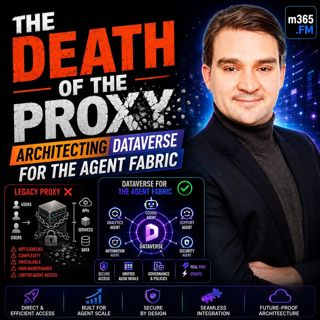
THE DEATH OF THE PROXY: Architecting Dataverse for the Agent Fabric

THE DEATH OF THE PROXY: Architecting Dataverse for the Agent Fabric

For years, Microsoft's recommended architecture for connecting AI assistants like Claude Desktop to Dataverse relied on a local STDIO proxy. It was simple, easy to install, and perfectly suited for in...

26 Juli 0s
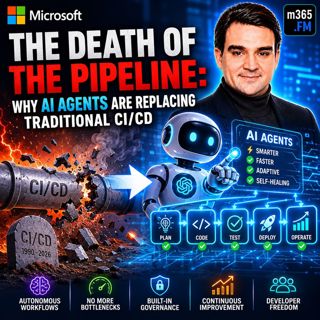
The Death of the Pipeline: Why AI Agents are Replacing Traditional

The Death of the Pipeline: Why AI Agents are Replacing Traditional

For more than two decades, CI/CD pipelines have been the backbone of modern software delivery. Developers commit code, automated builds run, tests execute, security scans complete, someone approves th...

25 Juli 0s
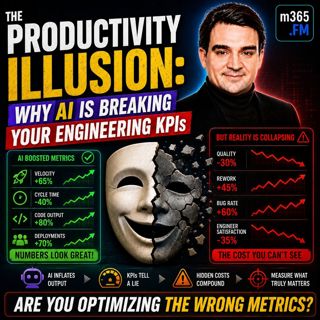
The Productivity Illusion: Why AI is Breaking Your Engineering KPIs

The Productivity Illusion: Why AI is Breaking Your Engineering KPIs

At first glance, the numbers look incredible. Deployment frequency is increasing, pull requests are being merged faster than ever, AI is generating more code, and engineering teams appear dramatically...

25 Juli 0s
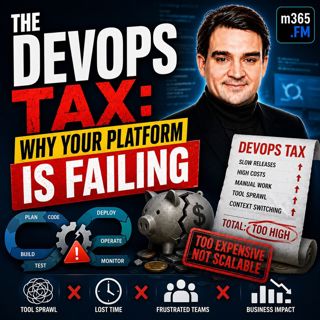
The DevOps Tax: Why Your Platform is Failing

The DevOps Tax: Why Your Platform is Failing

Welcome to another episode of Knowledge Nuggets with Mirko Peters. Today we're exploring The DevOps Tax—the hidden cost that silently reduces engineering productivity, increases cognitive overload, an...

25 Juli 0s
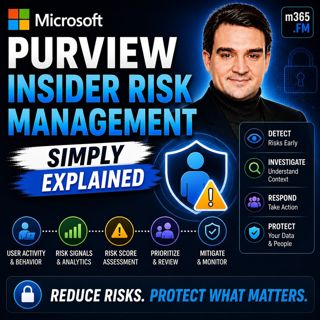
Microsoft Purview Insider Risk Management - Simply Explained

Microsoft Purview Insider Risk Management - Simply Explained

Welcome to another episode of Knowledge Nuggets with Mirko Peters. Today we're exploring Microsoft Purview Insider Risk Management, Microsoft's intelligent solution for identifying risky user behavior...

24 Juli 0s

Populärt inom Politik & nyheter

svenska-fall
p3-krim
aftonbladet-daily
aftonbladet-krim
flashback-forever
rss-sanning-konsekvens
tv4-nyheterna-story
rss-krimstad
rss-krimreportrarna
motiv
de-fyras-gang
rss-frandfors-horna
rss-vad-fan-hande
mannen-utan-spar
politiken
rss-flodet
spar
rss-aftonbladet-krim
krimmagasinet
grans