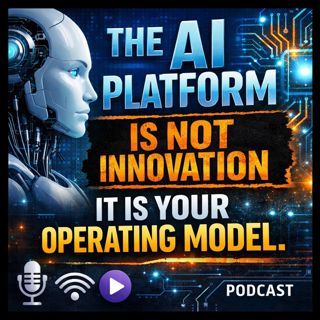

Microsoft 365 & AI Strategy: Why AI Is Not an Innovation Initiative — It Is Your New Operating Model

Microsoft 365 & AI Strategy: Why AI Is Not an Innovation Initiative — It Is Your New Operating Model

(00:00:00) The AI Adoption Dilemma
(00:00:12) The Pitfalls of AI Implementation
(00:00:30) AI as an Accelerator, Not a Transformer
(00:01:18) The Pilot Paradox
(00:02:30) The Operating System vs. Innovation Stack
(00:04:42) Decision Transformation: The True Target
(00:05:47) The Four Pillars of AI Decision-Making
(00:07:34) The Data Platform as a Product
(00:10:31) Organizational Challenges in Data Governance
(00:17:01) The Four Non-Negotiable Guardrails

Every enterprise AI initiative begins with the same promise: innovation. New capabilities, faster processes, smarter decisions, competitive advantage. And AI delivers on that promise — but only for the organizations that understand what they are actually building when they deploy Microsoft Copilot, Copilot Studio agents, or Fabric-powered AI pipelines across their operations. They are not building an innovation layer on top of their existing operating model. They are replacing the operating model itself. And that distinction changes everything about how AI must be governed, architected, integrated, and led.

In this episode of M365.FM, Mirko Peters examines why the organizations that treat AI as an innovation initiative consistently underperform those that treat it as an operating model transformation — and what that means for how Microsoft 365 leaders should be thinking about Copilot deployment, Copilot Studio architecture, Power Platform automation, and Microsoft Fabric analytics at enterprise scale. This is a conversation about the structural difference between piloting AI and operating AI, between demonstrating AI value and scaling AI governance, and between using Microsoft tools and redesigning the organizational systems that those tools must now power.

The organizations that will lead their industries over the next decade are not those with the most impressive AI demos. They are those that have built AI into the operating fabric of how decisions are made, how workflows execute, how data governs itself, and how people work. That is not an innovation project. It is an operating model — and it requires everything that operating models require: governance, accountability, measurement, ownership, and continuous improvement.

WHAT YOU WILL LEARN
  • Why treating AI as an innovation initiative rather than an operating model transformation produces consistent underperformance in Microsoft 365 environments
  • How the shift from AI pilot to AI operating model changes governance, architecture, and leadership accountability requirements
  • What an AI operating model actually looks like in a Microsoft 365 environment — from Copilot deployment to Fabric pipelines and Copilot Studio agents
  • Why most Microsoft Copilot deployments stall at the pilot stage and never reach operating-model scale
  • How to design Microsoft 365 architecture that embeds AI into operational workflows rather than positioning it as an optional productivity enhancement
  • What the governance, ownership, and measurement frameworks look like for organizations that have successfully made AI part of their operating model
  • How Microsoft Fabric, Power Platform, and Copilot Studio work together as the technical foundation of an AI-native operating model
THE CORE INSIGHT

The operating model is the architecture of how an organization actually works — not how it intends to work, not how its org chart says it works, but how decisions get made, how work gets done, how information flows, and how accountability is distributed. When AI becomes part of the operating model, it is not adding a new capability alongside existing ways of working. It is changing the underlying system of how the organization operates. Workflows that were human-driven become AI-augmented or AI-executed. Decisions that were made by individuals become informed or generated by AI models. Data that was passively stored becomes actively governed and continuously analyzed.

Mirko argues that this is precisely why innovation-framing for AI is so dangerous. Innovation projects are bounded — they have start dates, end dates, success criteria, and a defined scope. Operating model transformations are continuous — they require permanent governance structures, ongoing ownership, evolving measurement frameworks, and leadership accountability that does not expire when the pilot concludes. Organizations that frame Microsoft Copilot as an innovation initiative will manage it like one. They will celebrate early wins, tolerate governance gaps as temporary, and deprioritize infrastructure investment as the initiative matures. Organizations that frame it as an operating model transformation will do the opposite — and the results, compounded over three to five years, will be structurally different.

WHY AI STAYS AT PILOT STAGE IN MICROSOFT 365 ORGANIZATIONS
  • AI initiatives are governed as projects with fixed timelines rather than as operating capabilities with permanent ownership
  • Microsoft Copilot is deployed as a productivity add-on rather than integrated into the workflows where work actually happens
  • There is no measurement framework connecting AI usage to operational outcomes — adoption is tracked, impact is not
  • Governance structures for AI in Microsoft 365 are temporary — created for the pilot, not designed for ongoing operations
  • Leadership accountability for AI outcomes is diffuse — everyone is responsible, so no one is accountable
  • Copilot Studio agents and Power Automate workflows are built for demos rather than designed for operational reliability and governance
  • Microsoft Fabric analytics pipelines are created without the data ownership and lineage governance that operational systems require
KEY TAKEAWAYS
  • AI in Microsoft 365 is not an innovation layer — it is the new operating model, and must be governed accordingly
  • The transition from AI pilot to AI operating model requires permanent governance structures, defined ownership, and ongoing measurement
  • Microsoft Copilot delivers maximum value when it is embedded in operational workflows, not positioned as an optional enhancement
  • Copilot Studio, Power Automate, and Microsoft Fabric are the technical foundation of an AI-native operating model — they must be architected as such
  • Leadership accountability for AI outcomes must be permanent, not project-bound
  • The organizations that will lead their industries are those that have made AI part of how they operate — not part of how they innovate
WHO THIS EPISODE IS FOR
  • CIOs, CTOs, and digital transformation leaders building AI strategy in Microsoft 365 environments
  • Microsoft 365 architects designing Copilot, Fabric, and Power Platform operating model architecture
  • IT leaders responsible for scaling AI from pilot to enterprise-wide operational deployment
  • Change management and organizational design leaders supporting AI operating model transformation
  • Microsoft partners and consultants advising on AI strategy, governance, and operating model design
  • Business leaders evaluating the organizational impact of Microsoft Copilot and AI at scale
TOPICS COVERED
  • Microsoft 365 AI operating model architecture and strategy
  • Microsoft Copilot deployment at scale and operating model integration
  • Copilot Studio and Power Automate as operational AI infrastructure
  • Microsoft Fabric and AI-native analytics operating model design
  • AI governance frameworks for operating model transformation in Microsoft 365
  • Leadership accountability and ownership models for enterprise AI at scale
  • Measuring AI operating model performance in Microsoft 365 environments
  • Transitioning from AI pilot to AI operating model in the Microsoft ecosystem
ABOUT THE HOST

Mirko Peters is a Microsoft 365 architect, strategist, and the host of M365.FM — a podcast dedicated to modern work, security, and productivity in the Microsoft ecosystem. With experience spanning small businesses to large enterprises, Mirko focuses on Microsoft 365 architecture, AI integration, governance, security, and the design of scalable, context-driven systems. M365.FM is the go-to resource for IT leaders, architects, and decision-makers navigating the Microsoft platform at scale.

Become a supporter of this podcast: https://www.spreaker.com/podcast/m365-fm-modern-work-security-and-productivity-with-microsoft-365--6704921/support.

Det här avsnittet är hämtat från ett öppet RSS-flöde och publiceras inte av Podme. Det kan innehålla reklam.

Avsnitt(865)

Microsoft Purview is a Trap: The Hard Truth About Data Governance

Microsoft Purview is a Trap: The Hard Truth About Data Governance

Microsoft Purview is included with many Microsoft 365 subscriptions, making it incredibly easy to enable. That convenience is also its biggest danger. Because there is no procurement process or large ...

28 Juli 1h 1min

From Excel Expert to Microsoft MVP: Empowering Millions with Data, Dashboards & AI with Karen Abecia [Microsoft MVP]

From Excel Expert to Microsoft MVP: Empowering Millions with Data, Dashboards & AI with Karen Abecia [Microsoft MVP]

aren Abecia shares the remarkable journey that transformed a passion for Microsoft Excel into a global career as one of the world's best-known Excel educators. She explains how discovering creative sp...

27 Juli 59min

The Copilot Credit Trap- Why Your AI Economy is Already Broken

The Copilot Credit Trap- Why Your AI Economy is Already Broken

For decades, enterprise software followed a predictable financial model. Organizations purchased licenses, assigned them to users, and budgeted annual IT spending with confidence. AI changes that comp...

26 Juli 1h 12min
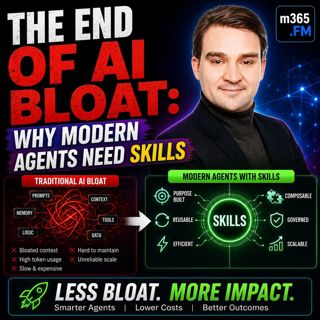
The End of AI Bloat: Why Modern Agents Need Skills

The End of AI Bloat: Why Modern Agents Need Skills

Many AI agents start out fast, responsive, and surprisingly intelligent. But after a few months of real-world use, something changes. Response times increase, costs rise, prompts become enormous, and ...

26 Juli 1h 13min

THE DEATH OF THE PROXY: Architecting Dataverse for the Agent Fabric

THE DEATH OF THE PROXY: Architecting Dataverse for the Agent Fabric

For years, Microsoft's recommended architecture for connecting AI assistants like Claude Desktop to Dataverse relied on a local STDIO proxy. It was simple, easy to install, and perfectly suited for in...

26 Juli 59min
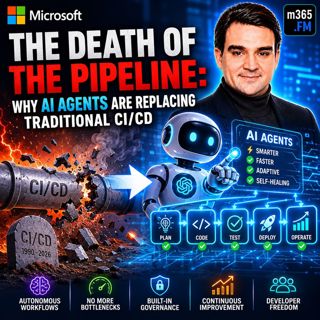
The Death of the Pipeline: Why AI Agents are Replacing Traditional

The Death of the Pipeline: Why AI Agents are Replacing Traditional

For more than two decades, CI/CD pipelines have been the backbone of modern software delivery. Developers commit code, automated builds run, tests execute, security scans complete, someone approves th...

25 Juli 1h 9min
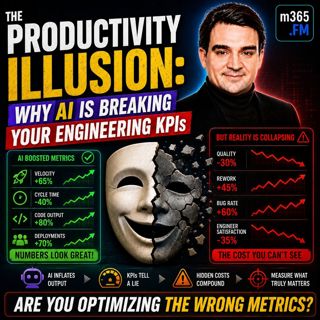
The Productivity Illusion: Why AI is Breaking Your Engineering KPIs

The Productivity Illusion: Why AI is Breaking Your Engineering KPIs

At first glance, the numbers look incredible. Deployment frequency is increasing, pull requests are being merged faster than ever, AI is generating more code, and engineering teams appear dramatically...

25 Juli 1h 15min
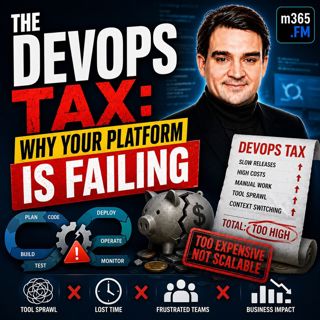
The DevOps Tax: Why Your Platform is Failing

The DevOps Tax: Why Your Platform is Failing

Welcome to another episode of Knowledge Nuggets with Mirko Peters. Today we're exploring The DevOps Tax—the hidden cost that silently reduces engineering productivity, increases cognitive overload, an...

25 Juli 1h 18min

Populärt inom Politik & nyheter

svenska-fall
p3-krim
aftonbladet-daily
aftonbladet-krim
rss-sanning-konsekvens
flashback-forever
tv4-nyheterna-story
rss-krimstad
rss-krimreportrarna
motiv
de-fyras-gang
rss-frandfors-horna
rss-vad-fan-hande
rss-flodet
politiken
mannen-utan-spar
rss-aftonbladet-krim
spar
krimmagasinet
grans