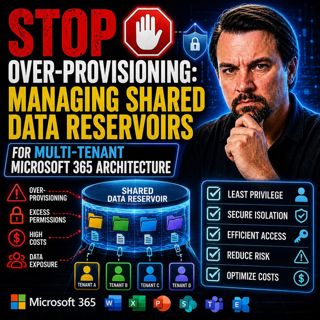

Stop Over-Provisioning: Managing Shared Data Reservoirs For Multi-Tenant Microsoft 365 Architecture

Stop Over-Provisioning: Managing Shared Data Reservoirs For Multi-Tenant Microsoft 365 Architecture

In this deep-dive episode of the m365.fm podcast, Mirko Peters breaks down one of the most expensive and misunderstood problems inside modern Microsoft 365 environments: over-provisioning caused by static quota architecture. Most organizations believe they are being safe by maintaining massive storage buffers, oversized environments, and rigid capacity allocations across Microsoft 365, SharePoint, OneDrive, Teams, Power Platform, and Azure infrastructure. But according to this episode, that “buffer mentality” is quietly creating a fiscal hemorrhage across enterprise environments. Organizations are paying for storage, performance, and licensing capacity that often sits unused while dark data silos continue growing in the background. This episode explores why traditional static quota models are failing modern cloud environments — and why the future of scalable Microsoft 365 architecture belongs to elastic shared data reservoirs powered by automation, orchestration, governance, and multi-tenant optimization strategies. If your Microsoft 365 environment is growing faster than your budget, this episode delivers a blueprint for building scalable, secure, and cost-efficient multi-tenant infrastructure before data growth overwhelms your operational model.

THE FISCAL HEMORRHAGE OF STATIC QUOTAS: WHY MOST M365 ENVIRONMENTS ARE BLEEDING MONEY

The episode opens by exposing the hidden cost problem behind most Microsoft 365 storage strategies. Traditional administration models rely heavily on static quotas and oversized safety margins designed to prevent emergency capacity failures. The fear is simple: Nobody wants the two AM support call where a tenant hits a storage limit and critical workloads stop functioning. To avoid that scenario, organizations massively over-provision capacity across:
  • SharePoint Online
  • OneDrive
  • Teams
  • Power Platform environments
  • Azure storage pools
  • Multi-tenant workloads
  • AI indexing infrastructure
But this creates an enormous amount of idle capacity that organizations continue paying for month after month. The discussion explains how most enterprises still treat storage like a rigid filing cabinet rather than a fluid cloud resource. This creates:
  • Dark data silos
  • Idle performance capacity
  • Wasted licensing spend
  • Fragmented storage pools
  • Performance bottlenecks
  • Artificial scaling limitations
  • Long-term operational inefficiency
The episode argues that the future belongs to organizations capable of managing storage as a dynamic elastic reservoir instead of isolated quota silos.

THE MYTH OF THE BUFFER MENTALITY: WHY STATIC SAFETY MARGINS FAIL AT SCALE

A major section of the episode focuses on what Mirko calls the “Buffer Mentality.” This is the outdated operational philosophy where administrators add massive extra capacity “just in case” future growth occurs. The logic sounds reasonable. But at enterprise scale, these static safety margins become extremely expensive. The episode explains how organizations routinely add thirty percent or more excess storage and compute capacity across environments simply to avoid potential outages. The result is infrastructure that remains partially empty most of the year while operational costs continue climbing. Topics explored include:
  • Capacity fragmentation
  • Idle storage allocation
  • Resource silos
  • Multi-tenant inefficiency
  • Static performance purchasing
  • Unused quota overhead
  • Long-term cost drift
The conversation argues that traditional quota architecture fundamentally breaks the economics of cloud computing because organizations continue paying for “what-if” scenarios rather than actual usage. Instead of scaling dynamically with demand, enterprises become trapped inside rigid resource structures that slow growth while increasing operational spend.

ARCHITECTING THE ELASTIC RESERVOIR: THE FUTURE OF MULTI-TENANT MICROSOFT 365 STORAGE

One of the largest and most technical parts of the episode focuses on building the Elastic Reservoir architecture model. Rather than isolating storage and compute resources into fragmented silos, the reservoir model pools capacity into centralized high-density shared infrastructure capable of scaling dynamically based on demand. The discussion explains how this changes the economics of Microsoft 365 operations entirely. Instead of buying performance and storage independently for every workload, organizations create shared elastic pools that distribute resources intelligently across tenants and workloads. Technologies and architectural concepts explored include:
  • Azure Elastic SAN
  • Azure SQL Hyperscale
  • Elastic storage pools
  • Shared performance layers
  • Power Platform Request Pools
  • Tenant-wide scaling models
  • Dynamic performance allocation
  • Resource pooling strategies
  • Multi-tenant optimization
The episode explains how Azure Elastic SAN allows organizations to decouple performance from raw storage volume. This becomes critical in large enterprise environments where some workloads require high IOPS while others simply require inexpensive capacity. Rather than over-paying for performance everywhere, organizations can centralize high-performance infrastructure while scaling bulk storage elastically as needed. The discussion also explores how this architecture dramatically improves readiness for Microsoft Copilot and AI indexing workloads. AI indexing creates unpredictable spikes in demand that traditional static quota systems struggle to handle efficiently. Elastic reservoirs absorb those spikes dynamically without requiring permanent over-provisioning.

DYNAMIC ORCHESTRATION & TOKEN BUCKET SCALING: AUTOMATING THE FLOW OF THE RESERVOIR

Architecture alone is not enough. The episode explains that automation becomes the heartbeat of the entire elastic model. One of the most fascinating sections dives into the orchestration mechanics behind large-scale Microsoft 365 scaling operations.

Topics include:
  • Azure Resource Manager token buckets
  • ARM throttling behavior
  • API consumption strategies
  • Dynamic scaling orchestration
  • Predictive bursting
  • Utilization threshold automation
  • Graph API optimization
  • Delta queries
  • Scaling event management
  • Multi-tenant orchestration


Become a supporter of this podcast: https://www.spreaker.com/podcast/m365-fm-modern-work-security-and-productivity-with-microsoft-365--6704921/support.

Det här avsnittet är hämtat från ett öppet RSS-flöde och publiceras inte av Podme. Det kan innehålla reklam.

Avsnitt(865)

Microsoft Purview is a Trap: The Hard Truth About Data Governance

Microsoft Purview is a Trap: The Hard Truth About Data Governance

Microsoft Purview is included with many Microsoft 365 subscriptions, making it incredibly easy to enable. That convenience is also its biggest danger. Because there is no procurement process or large ...

28 Juli 1h 1min

From Excel Expert to Microsoft MVP: Empowering Millions with Data, Dashboards & AI with Karen Abecia [Microsoft MVP]

From Excel Expert to Microsoft MVP: Empowering Millions with Data, Dashboards & AI with Karen Abecia [Microsoft MVP]

aren Abecia shares the remarkable journey that transformed a passion for Microsoft Excel into a global career as one of the world's best-known Excel educators. She explains how discovering creative sp...

27 Juli 59min

The Copilot Credit Trap- Why Your AI Economy is Already Broken

The Copilot Credit Trap- Why Your AI Economy is Already Broken

For decades, enterprise software followed a predictable financial model. Organizations purchased licenses, assigned them to users, and budgeted annual IT spending with confidence. AI changes that comp...

26 Juli 1h 12min

The End of AI Bloat: Why Modern Agents Need Skills

The End of AI Bloat: Why Modern Agents Need Skills

Many AI agents start out fast, responsive, and surprisingly intelligent. But after a few months of real-world use, something changes. Response times increase, costs rise, prompts become enormous, and ...

26 Juli 1h 13min

THE DEATH OF THE PROXY: Architecting Dataverse for the Agent Fabric

THE DEATH OF THE PROXY: Architecting Dataverse for the Agent Fabric

For years, Microsoft's recommended architecture for connecting AI assistants like Claude Desktop to Dataverse relied on a local STDIO proxy. It was simple, easy to install, and perfectly suited for in...

26 Juli 59min
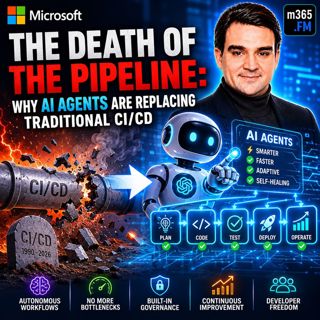
The Death of the Pipeline: Why AI Agents are Replacing Traditional

The Death of the Pipeline: Why AI Agents are Replacing Traditional

For more than two decades, CI/CD pipelines have been the backbone of modern software delivery. Developers commit code, automated builds run, tests execute, security scans complete, someone approves th...

25 Juli 1h 9min
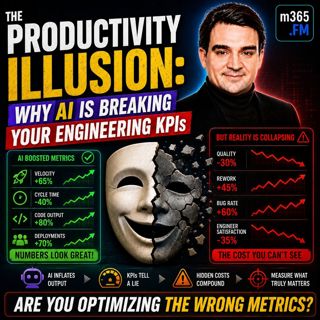
The Productivity Illusion: Why AI is Breaking Your Engineering KPIs

The Productivity Illusion: Why AI is Breaking Your Engineering KPIs

At first glance, the numbers look incredible. Deployment frequency is increasing, pull requests are being merged faster than ever, AI is generating more code, and engineering teams appear dramatically...

25 Juli 1h 15min
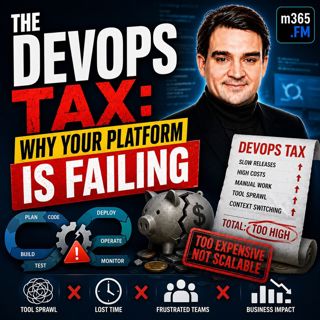
The DevOps Tax: Why Your Platform is Failing

The DevOps Tax: Why Your Platform is Failing

Welcome to another episode of Knowledge Nuggets with Mirko Peters. Today we're exploring The DevOps Tax—the hidden cost that silently reduces engineering productivity, increases cognitive overload, an...

25 Juli 1h 18min

Populärt inom Politik & nyheter

svenska-fall
p3-krim
aftonbladet-daily
aftonbladet-krim
rss-sanning-konsekvens
flashback-forever
tv4-nyheterna-story
rss-krimstad
rss-krimreportrarna
motiv
de-fyras-gang
rss-frandfors-horna
rss-vad-fan-hande
rss-flodet
politiken
mannen-utan-spar
rss-aftonbladet-krim
spar
krimmagasinet
grans