

Connectors are Breaking Your Enterprise: The Protocol-Level Shift

Connectors are Breaking Your Enterprise: The Protocol-Level Shift

Your enterprise automation strategy may be built on the wrong foundation. In this episode of the M365FM Podcast, we expose the hidden architectural failure behind modern enterprise integration: the managed connector. For years, organizations have embraced low-code connectors as the “easy button” for automation, believing these pre-built wrappers accelerate digital transformation and reduce complexity. But underneath the convenience lies a fragile transport model filled with hidden latency, throttling limits, middleware bottlenecks, retry storms, and black-box infrastructure you do not control. The connector model was optimized for rapid deployment—not resilient scale. And now, under the pressure of AI workloads, real-time orchestration, and machine-to-machine traffic, the cracks are becoming impossible to ignore. This episode breaks down why traditional REST-based connector architectures are failing modern enterprise demands and why the future belongs to protocol-level engineering built on gRPC, Protobuf, persistent streams, WebTransport, asynchronous resilience, and direct transport-layer control. If your workflows collapse during traffic spikes, if your integrations suffer unpredictable latency, or if your automation pipelines become unstable under concurrency, the issue is not your logic. The issue is the transport itself.

THE CONNECTOR ILLUSION

Managed connectors promise simplicity. Drag-and-drop automation. Rapid deployment. Fast integrations without deep engineering expertise. But simplicity comes with a hidden cost. Every managed connector introduces middleware friction between your services. Your data is intercepted, serialized, routed through shared infrastructure, throttled, retried, and transformed before it ever reaches its destination. This episode explains why:
  • Connectors create hidden architectural dependencies
  • Middleware layers introduce unpredictable latency
  • Shared infrastructure creates throttling bottlenecks
  • Retry storms amplify system failures
  • Convenience-driven design sacrifices structural resilience
We explore how most enterprise outages blamed on “application instability” are actually transport-layer failures hidden inside managed integration platforms.

THE LATENCY TAX OF MODERN CONNECTORS

Most architects think of connectors as transparent pipes. They are not. Every connector acts as a middleman sitting between your services, introducing serialization overhead, network hops, polling cycles, and CPU-intensive parsing operations. The result is a hidden performance tax that compounds dramatically under scale. We break down:
  • Why REST polling creates constant infrastructure waste
  • The cost of repetitive JSON serialization
  • How latency compounds across distributed workflows
  • Why 429 throttling errors destroy system stability
  • How retry storms can effectively DDoS your own environment
This episode explains why workflows that appear stable in development environments collapse under real-world enterprise concurrency.

THE BINARY REVOLUTION: WHY gRPC IS REPLACING REST

The next generation of enterprise architecture is moving away from verbose text-based communication and toward machine-optimized binary transport. This is where gRPC changes everything. Instead of relying on oversized JSON payloads and repetitive REST requests, gRPC uses Protocol Buffers (Protobuf) to transmit compact binary messages optimized for high-performance machine communication. We explore:
  • Why gRPC outperforms REST dramatically
  • How binary serialization reduces payload size
  • Why Protobuf reduces CPU overhead significantly
  • The performance gains of schema-first communication
  • How strongly typed contracts eliminate interface drift
You’ll learn why enterprise architects in finance, AI, and large-scale distributed systems are abandoning traditional connector models in favor of protocol-native communication stacks built for throughput, efficiency, and resilience.

THE END OF POLLING: PERSISTENT STREAMS AND REAL-TIME TRANSPORT

Modern connectors still operate on an outdated assumption: that work begins with a request. But in a real-time enterprise, waiting for systems to poll for updates creates unnecessary load, wasted bandwidth, and delayed context propagation. This episode explores the architectural shift away from polling and toward persistent streaming protocols using WebSockets, HTTP/3, QUIC, and WebTransport. We explain:
  • Why polling creates massive amounts of empty traffic
  • The scalability limits of repetitive request-response models
  • How persistent streams reduce overhead dramatically
  • The benefits of bidirectional communication
  • Why QUIC solves Head-of-Line blocking problems
We also examine how persistent streaming enables sub-100 millisecond event delivery at global scale while supporting modern mobile-first workforces through seamless connection migration.

ASYNCHRONOUS RESILIENCE AND QUEUE-FRONTED ARCHITECTURE

High-speed systems without resilience become high-speed failure engines. One of the biggest flaws in connector-based integration is the assumption that every backend service will always remain available. In reality, distributed systems constantly experience partial failures, slowdowns, maintenance events, and congestion. This episode explains why synchronous connector chains become dangerously fragile under load and how asynchronous resilience patterns solve the problem. We cover:
  • Why direct service coupling creates cascading failures
  • The mechanics of retry storms
  • How queue-fronted architecture stabilizes burst traffic
  • The role of Azure Service Bus, RabbitMQ, and SQS
  • Why durable buffering changes enterprise reliability
Instead of forcing services to process traffic immediately, asynchronous patterns decouple ingestion speed from processing speed, creating stable and fault-tolerant systems capable of surviving real-world volatility.

THE RUNTIME PIVOT: BUILT-IN VS MANAGED CONNECTORS

One of the most misunderstood aspects of enterprise automation is where managed connectors actually run. Most organizations assume that because their Logic Apps live in Azure, their data remains inside their trusted network boundary. But many managed connectors operate as external SaaS services running on shared infrastructure outside your VNet. This creates serious architectural and zero-trust concerns. We explore:
  • Why managed connectors violate zero-trust assumptions
  • The hidden networking path of SaaS-based connectors
  • Why On-Premises Data Gateways become bottlenecks
  • The advantages of Logic Apps Standard
  • How built-in connectors restore architectural sovereignty
This shift from managed middleware to in-process runtime execution dramatically improves latency, security posture, observability, and private network integrity.

Become a supporter of this podcast: https://www.spreaker.com/podcast/m365-fm-modern-work-security-and-productivity-with-microsoft-365--6704921/support.

Det här avsnittet är hämtat från ett öppet RSS-flöde och publiceras inte av Podme. Det kan innehålla reklam.

Avsnitt(865)

Microsoft Purview is a Trap: The Hard Truth About Data Governance

Microsoft Purview is a Trap: The Hard Truth About Data Governance

Microsoft Purview is included with many Microsoft 365 subscriptions, making it incredibly easy to enable. That convenience is also its biggest danger. Because there is no procurement process or large ...

28 Juli 1h 1min

From Excel Expert to Microsoft MVP: Empowering Millions with Data, Dashboards & AI with Karen Abecia [Microsoft MVP]

From Excel Expert to Microsoft MVP: Empowering Millions with Data, Dashboards & AI with Karen Abecia [Microsoft MVP]

aren Abecia shares the remarkable journey that transformed a passion for Microsoft Excel into a global career as one of the world's best-known Excel educators. She explains how discovering creative sp...

27 Juli 59min

The Copilot Credit Trap- Why Your AI Economy is Already Broken

The Copilot Credit Trap- Why Your AI Economy is Already Broken

For decades, enterprise software followed a predictable financial model. Organizations purchased licenses, assigned them to users, and budgeted annual IT spending with confidence. AI changes that comp...

26 Juli 1h 12min

The End of AI Bloat: Why Modern Agents Need Skills

The End of AI Bloat: Why Modern Agents Need Skills

Many AI agents start out fast, responsive, and surprisingly intelligent. But after a few months of real-world use, something changes. Response times increase, costs rise, prompts become enormous, and ...

26 Juli 1h 13min

THE DEATH OF THE PROXY: Architecting Dataverse for the Agent Fabric

THE DEATH OF THE PROXY: Architecting Dataverse for the Agent Fabric

For years, Microsoft's recommended architecture for connecting AI assistants like Claude Desktop to Dataverse relied on a local STDIO proxy. It was simple, easy to install, and perfectly suited for in...

26 Juli 59min

The Death of the Pipeline: Why AI Agents are Replacing Traditional

The Death of the Pipeline: Why AI Agents are Replacing Traditional

For more than two decades, CI/CD pipelines have been the backbone of modern software delivery. Developers commit code, automated builds run, tests execute, security scans complete, someone approves th...

25 Juli 1h 9min
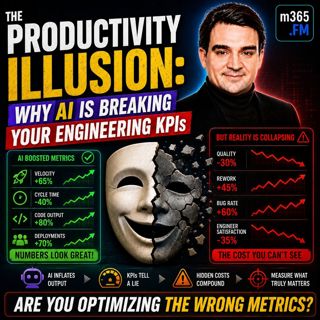
The Productivity Illusion: Why AI is Breaking Your Engineering KPIs

The Productivity Illusion: Why AI is Breaking Your Engineering KPIs

At first glance, the numbers look incredible. Deployment frequency is increasing, pull requests are being merged faster than ever, AI is generating more code, and engineering teams appear dramatically...

25 Juli 1h 15min
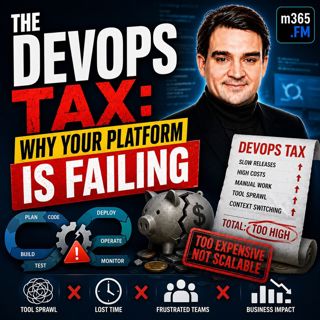
The DevOps Tax: Why Your Platform is Failing

The DevOps Tax: Why Your Platform is Failing

Welcome to another episode of Knowledge Nuggets with Mirko Peters. Today we're exploring The DevOps Tax—the hidden cost that silently reduces engineering productivity, increases cognitive overload, an...

25 Juli 1h 18min

Populärt inom Politik & nyheter

svenska-fall
p3-krim
aftonbladet-daily
aftonbladet-krim
rss-sanning-konsekvens
flashback-forever
tv4-nyheterna-story
rss-krimstad
rss-krimreportrarna
motiv
de-fyras-gang
rss-frandfors-horna
rss-vad-fan-hande
rss-flodet
politiken
mannen-utan-spar
rss-aftonbladet-krim
spar
krimmagasinet
grans