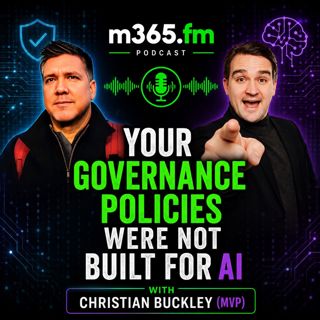
Your Governance Policies Were Not Built for AI with Christian Buckley [MVP]

Your Governance Policies Were Not Built for AI with Christian Buckley [MVP]

Artificial Intelligence is rapidly transforming the Microsoft 365 ecosystem. Organizations everywhere are deploying Microsoft Copilot, experimenting with AI agents, automating workflows, and integrating intelligent systems into their daily operations. But while companies are rushing toward AI adoption, most are overlooking one critical reality: their governance policies were never designed for AI. In this episode of the m365.fm podcast, Mirko Peters sits down with Microsoft Regional Director, MVP, collaboration strategist, and governance expert Christian Buckley to explore why traditional Microsoft 365 governance approaches are no longer enough in an AI-driven world. This conversation goes far beyond generic AI discussions and dives deep into the operational challenges organizations now face around permissions, compliance, information architecture, metadata, lifecycle management, Copilot readiness, and responsible AI adoption.

WHY AI CHANGES GOVERNANCE COMPLETELY

For years, governance inside Microsoft 365 focused primarily on collaboration management, SharePoint permissions, Teams provisioning, compliance controls, and external sharing. But AI changes the entire equation. Christian explains how tools like Microsoft Copilot can now surface information across multiple systems instantly, making old governance gaps far more visible than ever before. Content that technically existed inside Microsoft 365 for years — but remained difficult to discover — can suddenly become accessible through AI-powered discovery experiences. That creates major risks for organizations with:
  • Poor permissions management
  • Overshared Teams environments
  • Broken SharePoint inheritance
  • Unmanaged OneDrive content
  • Inconsistent metadata structures
According to Christian, AI does not create governance problems. It exposes the governance problems organizations already had.

THE HIDDEN DANGER OF PERMISSIONS SPRAWL

One of the biggest topics throughout the episode is permissions sprawl inside Microsoft 365 environments. Over the years, many organizations accumulated forgotten sharing links, legacy SharePoint permissions, unused Teams workspaces, stale guest accounts, and poorly managed collaboration sites. Before AI, much of this remained hidden because users rarely searched deeply enough to accidentally discover sensitive information. But AI changes discoverability completely. Christian compares this shift to the original impact of Microsoft Delve, where users suddenly realized how much information they already had access to without understanding it beforehand. With Copilot and AI-powered search experiences, this effect becomes dramatically larger because intelligent systems can aggregate information, summarize documents, identify relationships, and surface hidden content instantly. This makes governance maturity one of the most important foundations for successful AI adoption.

AI READINESS IS NOT ABOUT BUYING COPILOT LICENSES

One of the strongest points Christian makes during the episode is that AI readiness is not a licensing project. Organizations often believe they become “AI-ready” the moment they purchase Copilot licenses or deploy AI tooling. But true AI readiness requires clean permissions, structured content, metadata strategies, ownership models, governance automation, classification policies, compliance enforcement, and lifecycle management. Without these foundations, AI systems can become unreliable, risky, and difficult to control. Christian explains that many organizations are now being forced to solve governance problems they ignored for years because AI finally made those weaknesses impossible to hide.

WHY INFORMATION ARCHITECTURE MATTERS MORE THAN EVER

Another major theme throughout the discussion is information architecture. Many organizations underestimate how important structured information becomes once AI enters the environment. AI systems rely heavily on metadata, taxonomy, naming conventions, content organization, classification systems, and relationship mapping. Without structure:
  • AI responses become inconsistent
  • Search quality suffers
  • Recommendations weaken
  • Compliance risks increase
  • Sensitive content becomes harder to govern
Christian explains that governance and information architecture are no longer optional operational tasks. They are foundational requirements for effective enterprise AI.

THE RISE OF SHADOW

AI One of the most fascinating parts of the episode focuses on shadow AI. Employees today are already using ChatGPT, Claude, Gemini, Copilot Studio, custom AI agents, and third-party automation platforms — often completely outside official governance frameworks. Christian warns that organizations cannot simply ban AI usage and expect innovation to stop. Instead, companies need responsible AI policies, governance guardrails, approved AI environments, user education, and secure experimentation spaces. The organizations that succeed will be the ones that balance innovation with governance rather than treating them as opposing forces.

GOVERNANCE SHOULD NOT SLOW USERS DOWN

A key insight from the conversation is that good governance should become nearly invisible. Overly restrictive governance models often fail because users eventually work around them through shadow IT, personal cloud storage, external tools, or unmanaged AI workflows. Christian explains that modern governance should enable productivity rather than block it. Automated site provisioning, sensitivity labels, lifecycle automation, controlled sharing policies, and built-in compliance controls allow organizations to create intelligent guardrails without slowing down collaboration. The goal is to support users while still protecting enterprise data.

WHY AI GOVERNANCE IS NOT JUST AN IT PROBLEM

Another important discussion throughout the episode is how governance responsibilities are shifting beyond IT departments. AI governance now impacts:
  • Compliance teams
  • Business leadership
  • HR departments
  • Legal teams
  • Security professionals
  • End users
Christian strongly believes governance must become a shared organizational responsibility. Different business units often have completely different risk profiles, compliance requirements, and collaboration models. That means organizations need governance strategies flexible enough to adapt across departments instead of relying on rigid one-size-fits-all approaches.

THE FUTURE OF AI GOVERNANCE

Looking ahead, Christian believes governance will increasingly become automated, intelligent, and context-aware. Future AI governance models may include AI-assisted compliance monitoring, automated risk detection, intelligent data classification, context-aware permissions, and AI-driven lifecycle automation. But despite all the technology advancements, one principle remains constant: organizations still need strong governance foundations before AI can operate safely at scale.

KEY TOPICS COVERED IN THIS EPISODE
  • Microsoft 365 governance strategy
  • Copilot readiness
  • AI governance frameworks
  • SharePoint governance
  • Teams governance
  • Permissions sprawl
  • Information architecture
  • Metadata and taxonomy
  • Shadow AI risks
  • Governance automation
  • Compliance and security
  • AI readiness maturity
ABOUT CHRISTIAN BUCKLEY Christian Buckley is a Microsoft Regional Director, Microsoft MVP, collaboration strategist, governance expert, speaker, author, podcaster, and technology evangelist with more than thirty years of experience in enterprise collaboration and productivity platforms. He is widely recognized in the Microsoft ecosystem for his expertise around SharePoint, Microsoft 365 governance, information architecture, collaboration strategy, and digital workplace transformation.

Become a supporter of this podcast: https://www.spreaker.com/podcast/m365-fm-modern-work-security-and-productivity-with-microsoft-365--6704921/support.

Det här avsnittet är hämtat från ett öppet RSS-flöde och publiceras inte av Podme. Det kan innehålla reklam.

Avsnitt(864)

From Excel Expert to Microsoft MVP: Empowering Millions with Data, Dashboards & AI with Karen Abecia [Microsoft MVP]

From Excel Expert to Microsoft MVP: Empowering Millions with Data, Dashboards & AI with Karen Abecia [Microsoft MVP]

aren Abecia shares the remarkable journey that transformed a passion for Microsoft Excel into a global career as one of the world's best-known Excel educators. She explains how discovering creative sp...

27 Juli 0s

The Copilot Credit Trap- Why Your AI Economy is Already Broken

The Copilot Credit Trap- Why Your AI Economy is Already Broken

For decades, enterprise software followed a predictable financial model. Organizations purchased licenses, assigned them to users, and budgeted annual IT spending with confidence. AI changes that comp...

26 Juli 0s
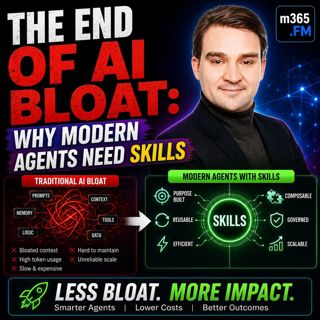
The End of AI Bloat: Why Modern Agents Need Skills

The End of AI Bloat: Why Modern Agents Need Skills

Many AI agents start out fast, responsive, and surprisingly intelligent. But after a few months of real-world use, something changes. Response times increase, costs rise, prompts become enormous, and ...

26 Juli 0s
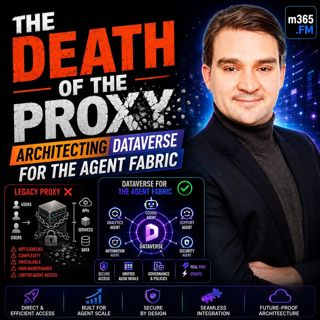
THE DEATH OF THE PROXY: Architecting Dataverse for the Agent Fabric

THE DEATH OF THE PROXY: Architecting Dataverse for the Agent Fabric

For years, Microsoft's recommended architecture for connecting AI assistants like Claude Desktop to Dataverse relied on a local STDIO proxy. It was simple, easy to install, and perfectly suited for in...

26 Juli 0s
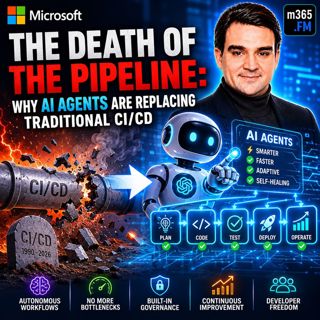
The Death of the Pipeline: Why AI Agents are Replacing Traditional

The Death of the Pipeline: Why AI Agents are Replacing Traditional

For more than two decades, CI/CD pipelines have been the backbone of modern software delivery. Developers commit code, automated builds run, tests execute, security scans complete, someone approves th...

25 Juli 0s
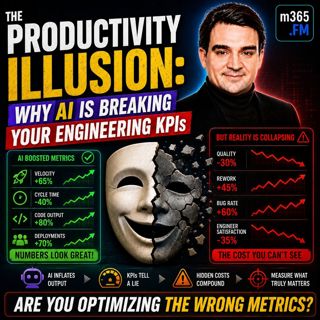
The Productivity Illusion: Why AI is Breaking Your Engineering KPIs

The Productivity Illusion: Why AI is Breaking Your Engineering KPIs

At first glance, the numbers look incredible. Deployment frequency is increasing, pull requests are being merged faster than ever, AI is generating more code, and engineering teams appear dramatically...

25 Juli 0s
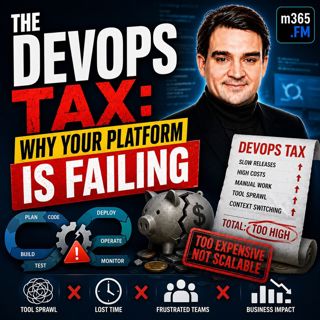
The DevOps Tax: Why Your Platform is Failing

The DevOps Tax: Why Your Platform is Failing

Welcome to another episode of Knowledge Nuggets with Mirko Peters. Today we're exploring The DevOps Tax—the hidden cost that silently reduces engineering productivity, increases cognitive overload, an...

25 Juli 0s
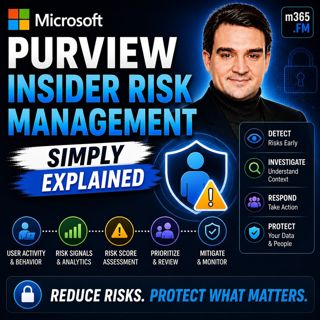
Microsoft Purview Insider Risk Management - Simply Explained

Microsoft Purview Insider Risk Management - Simply Explained

Welcome to another episode of Knowledge Nuggets with Mirko Peters. Today we're exploring Microsoft Purview Insider Risk Management, Microsoft's intelligent solution for identifying risky user behavior...

24 Juli 0s
Populärt inom Politik & nyheter

svenska-fall
p3-krim
aftonbladet-daily
aftonbladet-krim
flashback-forever
rss-sanning-konsekvens
tv4-nyheterna-story
rss-krimstad
rss-krimreportrarna
motiv
de-fyras-gang
rss-frandfors-horna
rss-vad-fan-hande
mannen-utan-spar
politiken
rss-flodet
spar
rss-aftonbladet-krim
krimmagasinet
grans